By Kenneth Oerke
They took hire and sailed into Germany through the Weser River on a Dutch ship loaded by timber merchants. The Viking clan went ashore and then stayed in Germany on a farm. (In Norway Oerke is also spelled: Yrke, Orke, the O has a / line through it, pronounced ER, Other spellings are: Oucke, Oreke, Yrecke)."
Let me explain about the different spellings of Oerke before I have you all confused. Yrkje is a new spelling for Oerke introduced by Denmark when they ruled Norway. Orke with a / through the O is the old spelling. As our alphabet does not have this letter the closest that they can come to it to give the correct pronunciation is to use "Oe" instead.
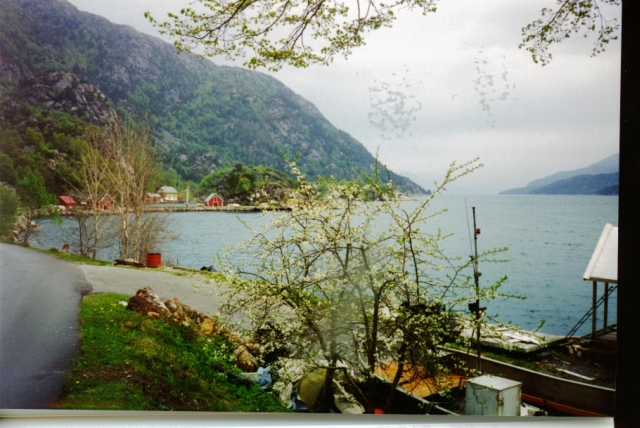
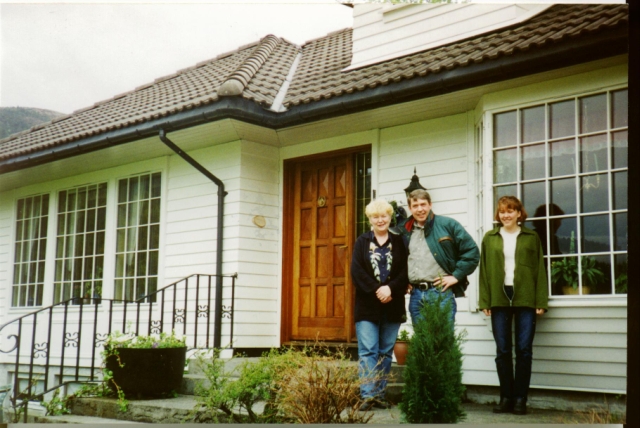
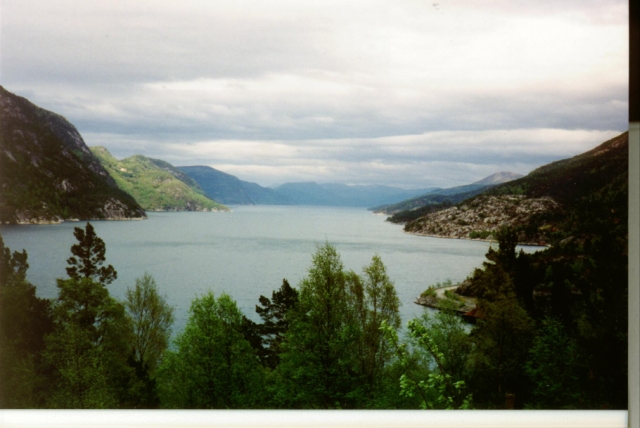
We went on to the Oerke (yrkje) fjord and a small village called Yrkje. We saw mailboxes with both names Orke and Yrkje. We then traveled up from the village to the end of the fjord and found the Orke farm. They were expecting us because Rowena had written and they had a little American flag at the entrance of their driveway. We felt welcomed!
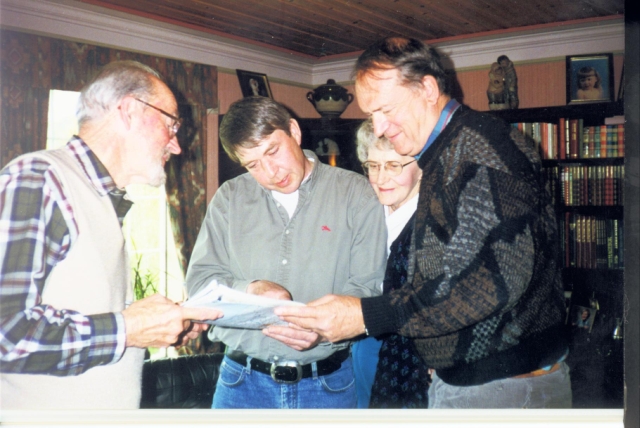
Randi and Axel Orke came out to greet us as we drove up. Randi had an traditional Norwegian lunch for us, consisting many types of small sandwiches. Axel listened to our findings of the origin of the Oerke family, and then had several points to make.
First was about the origin of the family name. He told us that the Vikings had no last name, so when the government wanted to take a census everyone had to take on a last name so individuals could be identified. Many took on the name of their profession (i.e. Smith), just added son to their father’s name (i.e. Johnson, the son of John) or as in our case where they came from. The fjord was always called Orke, so several that lived there took on that as a last name even though they were not from the same family. He said that some of his neighbors also are Orke or Yrkje but are not related to him.
Second, Axel showed us the farm records going back to the 15th century. The records show that around 1600, all the trees were cut and loaded onto ships in the fjord, the lumber was sold to England, Scotland, Holland, and Germany. It is very likely that some Orke family took passage with one of these ships and emigrated to Germany, but he has no record of this.
Next, the given names of his family from this period of early 1600´s are in many cases the same as were used by our early ancestors in Germany in the late 1600´s. (Harbort, Johann, & Jobst). In those days given names were repeated in the same family, so he thought it was likely that we could have been from his family. But because the records are missing from Germany of the early 1600´s (caused by the destruction during the thirty year's war), we could never know.
Axel also took us out to drive around his farm on the fjord. His main products are still lumber and also sheep. He showed us the construction site where the largest offshore oil-drilling platform in the world was built. They used the Yrkje fjord because it is very deep yet very well protected. He also showed us a fresh water lake on his farm where he has built summer cabins to be rented. They were very well built of wood and looked beautiful among the trees beside the lake.
We reluctantly said goodbye to our gracious host as we had a ferry to make that took us to Denmark where we had breakfast with a family that Rowena had stayed with on one of her world trips.
Hans Oerke, our cousin in Germany, has another tradition handed down by his family.
"Oerke means actually "work" but more in the sense of Power or Energy.
And that is what I have heard about all our ancestors: energetic, hard
workers, brave and respected by others. Many married into nobility, like
I did and my children.