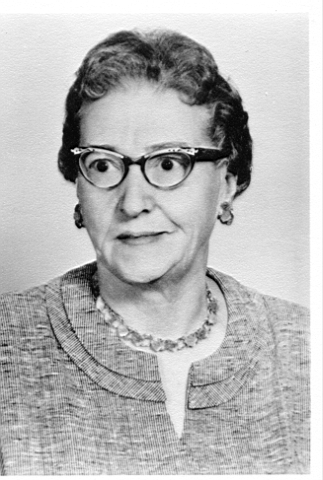
A personal account of my relationship with God, family and friends
Written by: Nanetah J. Oerke
Edited by: Barbara A. Oerke
Introduction *
In Appreciation *
1959 - A Widow's Adjustment
*
1960 - My Pink Ford (or, The Road and Me) *
1961 - Mostly about Lake Hattie
*
1962 - Houses and More Houses
*
1963 - California, Here I Come!
*
1964 - Family Activities *
1965 - Sunshine and Shadows
*
1966 - To Dream the Impossible Dream *
1967 - Where's Brazil? *
1968 - Work and Fun in Brazil
*
1969 - Who Needs a Broken Leg?
*
1970 - Calling Dr. Kaufman *
1971 - Travel and Other Family Fun *
1972 - Deacon Oerke and a Visitor from Brazil *
1973 - Some More Sunshine and Shadows *
1974 - Imagine, The Canaries!
*
1975 - Another Operation? *
1976 - Another Broken Leg? *
1977 - Closing Thoughts *
Page
Credits: "The Impossible Dream," by Mitch Leigh and Joe Darion; Hope
for the Flowers, by Trina Paulus, Paulist Press, New York, 1972.
'It's a big, wide, wonderful world.' Looking back over the many varied experiences of nearly 80 years of living, I ought to know I don't mean to say the years have all been good. An artist uses all colors and shades in his painting, and so it seems to be in life. A person hasn't really lived until he has had some of the sunshine and the shadows that blend intricately to make a beautiful sunset of life.
A basic fact of life we must accept is that everyone has a different personality. I remember when I was told as a child that even each snowflake has a different shape. Impossible! It's not so hard to believe, though, when you study nature. Try to find two of anything just alike! Take leaves or flowers or animals or people. It is a marvel how the same features can be different on each person. And then, the different nationalities, each with its own peculiar characteristics; you can tell whether the person is Mexican, Italian, Chinese or Eskimo by his general looks. How can this be possible? But it is, as we all know.
After my husband's death I wrote a book about his
life and personality, and I titled it, There Can Be Only One. He
was such a nonconformist, doing things his way without apology or explanation.
He valued the opinion of others, listened, thought the matter over and
did what he thought was best. After his death I had to make decisions alone.
I couldn't consult all the children for I would never get anything done.
I have spread my wings, and I, too, have learned to do things my way.
(GO TOP)
I want to express my appreciation to the many people who have contributed their thoughts and time to make this book and birthday celebration possible.
George and Barb
The book probably would not have been completed if Barb and George had not consented to help write my life history from the point Lloyd's book ends It has been a tremendous job, but has been done cheerfully and well.
Wilford and Rowena
These two have labored with me looking up letters, facts and information for the book, as well as making suggestions and giving advice when needed.
Gregory and Joanne
The music in my birthday program is their big contribution. It adds so much to the festivities. I just had to have my namesake in the program, and how convenient she is a musician.
Steven Lloyd Jones
You recognize the name--Lloyd. Steve's grandfather and I were at the hospital the day he was born. Steve's job today is to strike the gong to represent the months.
Joe and Sara
It gives me great pleasure to have them among our family group today. I appreciate the many helpful suggestions they made in planning this party, and for contributing the cake. I also needed them to hold my hand during the final stages!
Bud and Ann
I appreciate their offering their lovely home for my guests to refresh themselves. Where could we have found a more beautiful and restful spot? Many thanks also for obtaining a room at the Crestview Country Club for our party.
Ken and Elisa
There is no doubt these two have traveled the farthest to be here today. I thank them and the children for making the long trip. It wouldn't have been the same without them.
My husband's death was the result of a construction accident and his final illness was short. I was very quickly thrust into decision-making. As with all widows, I was faced with the very difficult problem of having to do everything alone. By alone, I mean there was no one to take charge except myself. Family and friends were important, but they were like supporting beams to a roof. My children were all married with family responsibilities of their own. As my story progresses you will see they have done more than their share.
I found there were many things which had to be taken care of immediately, such as a house under construction in Wyoming, legal matters, bills to be paid, our home in Cedarvale, the house trailer, etc., etc. They say work is a blessing in difficult times, and I believe it is so. It was late August and the winter would not be far off. Edward and his wife, Vina, said they would be glad to go to Laramie to work until the weather was too cold, so shortly after the funeral we drove to Wyoming.
A neighbor offered to use his bulldozer to finish the digging Lloyd had started and to make a driveway up to the top of the slope about thirty feet higher. We ordered cement blocks to put up the wall, set up a bank account, and I introduced Ed and Vina to the folks in Laramie.
I tried to stop shipment on the aluminum we had purchased in Florida, but upon learning it had already been shipped, made arrangements to have it stored. Then I left for Spears Hospital in Denver, the place we called our second home. I had things under control for the present, and with rest and therapy at Spears, I caught my breath again.
I soon returned to Cedarvale. Gladys had decided
to finish her college studies at Stillwater, and she and the children were
able to visit me often. I decided I could not keep the red station wagon
that Lloyd had bought in Dallas as it was too big for me to handle easily,
and it evoked too many memories of Lloyd. Gladys and the children drove
with me to Joplin where I found a car I liked. The price was right and
the color was cheerful--a deep pink. This car was to be my home away from
home for months to come. Gladys took the station wagon to Stillwater, and
I drove my new car home to Cedarvale.
1960 - My Pink Ford (or, The Road and Me)
For the next four years this car was my pride and joy. It was easy to handle and gave me little trouble. Whenever the children thought about me they knew I was probably on the road.
Where did I go? Good question! I made many trips to Sedan while closing Lloyd's estate and visited Gladys often. I didn't stay long for her time was very full, but I always felt welcome. When I drove up the children would run out of their apartment with open arms, smiles and hugs.
My mother was in the Methodist Home for the Aged in Topeka, and I felt I had neglected her too much. It seemed I never had the time or energy to visit her when I lived on the ranch and I felt guilty. I took her to Cedarvale once and several times stayed overnight in motels, but she became restless and nervous. She seemed most comfortable and content at the Home, so I settled into a habit of visiting her there, often taking her out for a ride and a meal. She got a thrill going out with me.
Once I drove all the way form Laramie to topeka to be with her on her birthday. It was a very hard and expensive trip, but I thought worthwhile. She loved for me to go with her to the dining room to meet her friends. The Home baked a cake for her birthday. They took her to a birthday party for a group of senior citizens where she won the prize for the oldest one there and got a corsage. In telling about it later she said the judges were surprised when she came down the aisle so spryly. She didn't feel old and was insulted when anyone referred to her as an "old lady."
Mother passed away in 1961 at age 88 and was buried in Wichita beside Grandfather Massey. The services were in the College Hill Methodist Church. Her grandson, the Rev. George Oerke, presented the funeral sermon The large casket wreath was pink and orchid colored roses. Sara Welch, her only other child, took care of the family dinner; nearly all the family were there. I was glad I had been able to do all I could for Mother while she was living.
Another trip I often made was to the ranch to see the two families who lived there, Marvin's and Edward's. On one of my visits I told them of a project which I thought would interest them. I had in mind the interests of both families and wanted to give them time to think over my plan. I suggested that Marvin and Ken trade their farm near Cedarvale to Edward for his part of the ranch. Ed and Vina could have a place of their own which would give Ed more freedom for work that he was able to do. The ranch was just too much for Ed, and Ed's problems were too much for those at the ranch. They accepted my suggestion, and Ed soon moved to the farm near Grenola.
Ed and Vina remodeled the house and seemed happy living by themselves. Mother Hughes, Vina's mother, lived with them which I thought was a good idea because sometimes Vina needed help with Ed. Both Vina and her mother enjoyed gardening and canning. Ed was clumsy with gardening, and perhaps their first real trouble started with that work. I made many trips to their place, and they visited me often at Cedarvale, too. Ed took up drawing at that time and was very good at it.
In May Joanne was born, and I spent some time before and after with Shirley and Marvin. I know that we will never forget those days. The baby took longer to arrive than we had planned, and to fill the time, Shirley and I worked jigsaw puzzles. We did so many that Shirley was plagued with dreams of the pieces flying around. We took rides all over the countryside around Butler and talked about names for the baby. I don't know if they had a boy's name in mind, but they wanted to name a girl after me. I objected because my name was difficult to remember and hard to pronounce and spell. My mother and father never called me Nanetah, but Netah. We thought of Nan, but it might be changed to Nanny and cause some teasing--a name is so important to a child. Finally it was decided to name her Nanetah Joanne Oerke and call her Joanne. My middle name is Josephine, so her initials would be the same, N.J.O.
On my way back to Cedarvale I stopped at Fort Scott and ordered a piano for the family. At that time I had no idea how much they all would use it. Not only did Joanne learn to play the piano as well as her mother, but she learned to play a number of other instruments and sing, also.
Another trip my pink car and I made again and again was to Norman. The first time I visited Rowena and Wilford they lived in the house on Rosemont Street. I arrived with all the problems I was having with business. I had to decide whether to finish building the Wyoming house or dispose of the start we had made on it. The lot really could not be sold without a house, and I had to have a house to get the deed on the property, so I decided to finish it.
Wilford was also working on house plans and showed me the ones he had drawn. They were marvelous. He and Rowena were going to build soon, so we had something in common. I needed help and I got it. Business and legal work have continued over these many years, and Rowena and Wilford have always been willing to help. It surely has taken a load off my mind.
I also used my little pink car to look for a job. Yes, I wanted something to do that was constructive and interesting. I hoped it might involve driving the car as I enjoyed it so much.
I had always felt rewarded by working for the Lord, so I interviewed several pastors whom I knew. I offered to give my land on the Caney River for a church camp thinking I could help operate the camp. It was a beautiful spot, and I was sure there could be a permanent job in the set-up for me. I could continue living at my home in Cedarvale as Lloyd had planned. A house with no steps, smooth floors, a good view, garage for the house trailer, ceramic shop in the garage--everything I would need Well, ministers looked into the venture, and the answer was "no."
In August when Gladys and the children were out of school and Ken could be free from ranch work, I decided to take them all with me to Laramie. We arrived at the trailer, bought groceries and got things set up before going out to Lake Hattie. The carpenters had been given their instructions about the beginning construction. Gladys was going to do the cooking and housework. Bob and Sylvia explored the lake when there was nothing for them to do around the house. We were there on July 4th, and Bob surely enjoyed the freedom of shooting firecrackers. One Sunday we went over the mountains to a wonderful restaurant. Gladys and I really enjoyed this treat.
We worked hard that summer. The floor went down, the sides went up and the roof went on. I kept busy instructing the carpenters, cleaning up after them to make room for the next day's work, and deciding just where to put each window and door and how big to make each room. Ken put up the aluminum, a job that consisted of putting in steel screws by the thousands, which he did like a professional. When the wind was blowing he got to rest. This house has stood the high winds of many years, and as far as I know, no other work of importance has been done on it since.
When the last screw was in place we moved the bed and some other items out of the trailer and into the house. Ken moved the cement into the basement and made things ready to leave. He was going to work in the space program in California and could use the trailer out there. We let him go ahead to test how the trailer would pull behind his car. When he felt sure all was o.k. he left for the ranch, and Gladys, the children and I headed south to Cedarvale.
We arrived on such a hot day we tried to find a swimming pool somewhere in the Cedarvale area, and when we couldn't locate one, we went back and all swam in the Caney River. Rowena and her children were there, too. We ate watermelon and enjoyed a wonderful day together.
My story wouldn't be complete if I didn't tell you about my dog, Chief. He was born in front of the fireplace at Cedarvale and was a big part of Lloyd's and my life. We took him every place we went and showered him with affection. He helped us adjust to our first disappearing family of children.
Chief was a collie and looked much like the TV dog, Lassie. He was more than a pet, almost a member of the family, and after Lloyd's death he became my faithful companion. He sat beside me in the front seat as I drove, and to people we met on the road he looked as big as I did. They laughed and waved as we went by.
In Wyoming he was protection for me as he barked at anyone approaching. I had to watch closely as he sometimes snapped if someone was too forward. This was good because there were a lot strangers around, but I didn't want him to bite anyone.
Chief was a bother at restaurants because he sat right outside the door and sniffed at everyone who went in. I tried to leave him in the car or tie him up, but neither worked very well. After several years of traveling with him I left him at Marvin's ranch. It was hard to part with an old friend, but I visited there often and he always knew me.
Harold Shaner and his family visited quite often during the years I lived at Lake Hattie. One summer they helped put up some fancy aluminum covers to protect the porch screens during the winter. It was hard work that was wasted because the wind blew them off the next year.
Christmas has always been a happy time for the Oerke family. It seems most of our reunions, until recent years, have been during holiday vacations. I guess it has been a convenient time for most everyone to get together. Christmas 1960 at Cedarvale was no exception.
One thing that added to the festivities was a family wedding. Ira and Gladys were remarried at the church with George performing the ceremony and Marvin singing the solo. Everyone was there except Ken who was in California.
For Christmas gifts I told everyone to choose a favorite
item from my ceramic shop. It was great fun.
(GO TOP)
1961 - Mostly about Lake Hattie
After the holiday I made the trip back to Ohio with George and his family. We used my car, and I really enjoyed having a driver. While in Orwell I was asked to give a course on the Ecumenical Movement. It was new then, and everyone had a hard time saying the name. I had given a study course in Cedarvale and was really excited about the Movement. I asked George if he thought it was possible for me to go to the international meeting at Delhi, India. Bless his heart, he tried to find out, and of course it was impossible for me to go, but it goes to show how my mind runs.
George and I had many talks about life and death, tears and laughter, pain and fun. We all planned for their Holy Land tour the following year. How excited they were.
Before the house in Wyoming was completely finished I wanted to interest a church in using it as a group project. I had written to a pastor who said his church might be interested. They were having a board meeting the first of February, and he wanted me to present the project. So in the ice and snow I drove to Laramie from Ohio. I took it easy and stayed overnight twice on the way, but I was on the road a long time and didn't realize my family would worry about me. When I got to my motel there was a phone call waiting for me. It was George calling to find out how I made the trip. You see, I had become so independent I never thought of reporting to others. It was on this long drive I got the idea of writing about my adventures.
It turned out the church did not accept my offer of the house as the water situation was bad and there was no phone service. I continued with my plans for completing the house, and by spring the contractors were busy again.
Edwin Graham did a lot of work for me and was a favorite of mine. He put in all the pine paneling one winter with only a make-shift heater. He is now manager of the Deal Lumber Company in Laramie.
In May Gladys realized her hope of graduating from college, a great effort on her part as she had been away from school for a long time. The family gathered in Stillwater for the big affair and enjoyed a celebration dinner afterward. Gladys and Ira then moved to Oklahoma City.
The Jones family came to Laramie in June to install the electric heating system in the house. Fireplaces are nice, but coming in as irregularly as I did, I wanted instant heat. When they arrived the partitions were barely in and not yet covered. Cooking was difficult; comforts were few. They had to crawl under the house to lay the electric lines, and as the lines went everywhere, it was hard work.
Wilford and I had drawn the plans back in Norman so we knew what had to be done. Not only Wilford worked hard, but the boys crawled back and forth under the house until they were exhausted. Rowena cooked meals on a make-shift stove, and Pat washed dishes. The whole affair was like camping out. Their work was a great help, and they were happy thinking of all they had accomplished.
Before they left I wanted to show them some of the beauties and unusual things about Wyoming so we made a few short trips to rest from the work. We saw timberland and sheep country, rivers and hills, snow on top of Snowy Range--a bit of everything.
The following poem describes the drawing enchantment of Wyoming
Have you ever seen the sunrise on the high and rolling plain?
Have you ever felt the smart and sting of gravel in your face?
Then you've never known the glamour of that God-forsaken place,
WYOMING!
Have you ever seen the skyline when the evening shadows fall?
Find the mountains look like cardboard, and you hear the Coyotes call?
Have you seen the Painted Bad-lands in their yellow, red and blue?
Then you'll never know how lonesome life can be until you do,
IN WYOMING!
Have you seen the sand and sagebrush, while down the hills,
Along the draws, the cooling shadows lay?
It's lonesome and it's desolate; it's off the beaten track;
But once you've caught the lure of it, you're homesick 'till you're back,
IN WYOMING!
(Author Unknown)
I have always loved the mountains. They seem so everlasting and permanent in contrast to the restless ocean. I loved looking at them, repeating the Scriptures I had learned to love about the permanence of the love of God, as substantial and dependable as the mountains are. Now with the Snowy Range just a few miles from my home, I spent lovely hours looking at it. How different this was from the rest of the hurry-scurry world with its tensions and problems.
Although it was closer to go up the east side of the Snowy Range from my place, when company came we went a few miles south and from there up to Fox Park, the lumber camp and mill, then along the Platt River to Saratoga, a mineral bath resort which was quite well developed, then turned east up the Snowy Range. There was always snow there winter or summer, but during the winter the road was closed. My company always wanted to stop to make snowballs. From one tourist lookout we could see Lake Hattie, but we couldn't spot my cabin. There were several fishing lakes along the way, but I didn't have a permit to fish. It was fun to watch others catch them.
There were two choices of eating places. One was in the mountains, rather rustic, where good food was served along with mountain atmosphere. The other restaurant, the Diamond Horseshoe, was just north of Laramie. There one could dine with beautiful lighting, carpets and style. I even enjoyed going to this place alone.
In the country we saw huge cattle ranches, so isolated they had to lay in supplies for almost all winter. Our children wondered how the children who lived there could occupy their time with no stores or theaters, nothing but cows, grass and horses. The rancher's children loved it. They had their horses to ride, rodeos to work for and wouldn't want to live in a city at all. It goes to show you, life is just what you make it.
On the east side of Wyoming we saw old forts filled with relics of past days and Cheyenne with the famous "Daddy-of-them-all Rodeo." Across the middle of the state were sheep ranches with the typical sheepherder's wagon and dogs, oil fields and mining fields, prairies without a house for miles, trails where the early settlers managed to push through--all in all a very wonderful and exciting land.
The weather is one aspect of Wyoming that caused me a lot of trouble. Summer is so short I had to wait until almost May to go out, and then sometimes it was still cold and snowy. The natives didn't plant seeds in their gardens but set out already growing plants. It is necessary to do a lot of watering. I tried planting flowers in front of my house to make it seem more home-like. The first year they did very well, and the second year wasn't bad, but it took a lot of water which had to be carried up from the lake. Do you know how heavy a pail of water is? Well, it's twice as heavy carrying it uphill!
Autumn comes early with snow often falling in September. One year the Harold Shaner family left Denver, where it was hot, wearing light clothes. While they were in Laramie a cold spell almost froze them to death! One boy was determined to go in the lake, but he stayed only a few minutes and then sat shivering in front of the furnace. One year I stayed past September, but was forced to drive to a motel through blowing snow and let my neighbor close up my place after I left by train for Kansas.
That summer the carpenters put up the insulation, sheet-rock and plywood sub-flooring. I bought a good refrigerator. The windows went in, and electricity was connected. One day near the end of the summer a man came to inspect the house for final papers. He looked it all over, I signed his report and THE HOUSE WAS MINE!
I was tired so headed again for Spears. By Christmas time I felt much better and left for Norman where the family was gathering. I left Denver with the streets filled with snow, my friends waving from the window. It took me several days for the trip as I stopped often to rest and buy Christmas presents. I had made little red flannel boots I planned to give as gifts with money in each.
The Jones family was surprised to see me in Norman
as I hadn't told them I was coming. I was very independent in those days
for I didn't want to make a schedule and not be able to keep it. It was
fun to be free and not responsible to anyone, but I hope the children have
forgiven me for worrying them.
(GO TOP)
At this time my mind was busy trying to decide what to do about my living situation. With a home in Cedarvale and another in Wyoming, I could see the distance between them becoming too great for me. I needed a place to go in case of sickness, and wanted to be where I could get taxi service. Mother's house was available in Wichita, and I knew the town well. It seemed the ideal solution, so I made plans to fix up the basement as an apartment and move the best part of my furniture there and the rest to Wyoming. I had just redecorated the Cedarvale house so I didn't expect any trouble renting it. I really didn't like having three houses just for me, but I was trying to plan for the future.
After convincing my children of the wisdom of this plan, I bought Sara's half of the house in Wichita. Louise Stabler, who had worked for Welch Cleaners for years (and did until 1976), lived in the upstairs with her mother and sister.
The basement of the Wichita house was entered from the outside through cellar-like doors. I replaced the paperboard walls with pine paneling and replaced the roof, also. I looked around town to see how people were painting houses and decided it would be best to stay with a light color. I didn't like the corner posts, which were breaking down anyway, so I used white metal ones. The lacy looking wrought iron seemed to go well with the wicker furniture Mother had on the front porch. Sara had given it to her and it was quite pretty. Someone else apparently thought so too for one night it disappeared.
While the remodeling was in progress I took a train to Orwell, Ohio, to stay with the children while George and Dorothy went to the Holy Land and England. I stayed until the Kintners, Dorothy's parents, took over after school was out.
This year involved a lot of things to do with houses and property. My first sale was to the Prestigs, relatives of the Joneses, who were interested in lots on the Lake of the Ozarks. I owned several lots which I had never really liked. Although they had a good location on the lake, it was difficult for me to walk on the uneven ground.
I found a good renter for the Cedarvale house, a lady I knew who worked in the post office there. However, her circumstances changed as mine had, and she didn't stay long.
In April I hired a moving company and directed the loading of furniture, ceramics and building material to be taken either to Wichita or to Laramie. It was too cold to head for Wyoming so I had a little time to get things settled in Wichita.
In May I sold my western Kansas land and felt like a millionaire! A real estate company made a good offer, and as I was tired of the bother and expense of the land, I was glad to be rid of it. The business world was getting too complicated for me.
Upon arriving in Laramie, I found my things had arrived all right, but were not placed where I wanted them. I wanted the large dining room table by the front windows to work on ceramics. The davenport was in that room, and I wanted it in the middle room. That davenport was made when furniture was heavy and strong. With just my own strength and awkwardness, by pulling and grunting inch by inch, I finally got it where I wanted it and placed the table where the davenport had been. The main obstacle was the little door. I eventually wanted the table moved back where it was at first, but not before I had done a lot of ceramics on it.
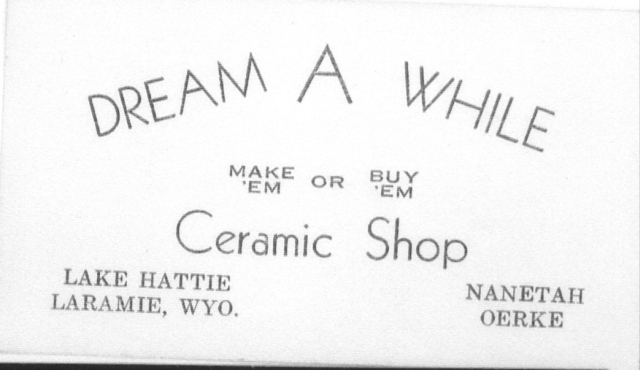
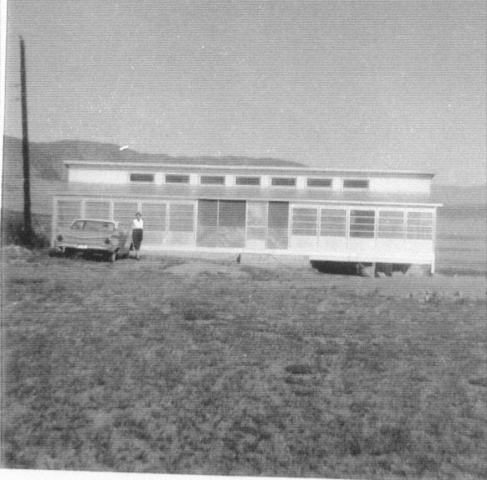
The name I chose for my Wyoming home was Dream-A-While. It was located on beautiful Lake Hattie, 25 miles from Laramie. I could look at the lake or at the mountains which were snowcapped most of the time. I could even see the mountains of Colorado. I ate and slept and worked whenever I was in the mood. I did go into town about every week for groceries, laundry and perhaps a meal. Although water was close by, I had to haul drinking water in the back of the car in buckets or cans. A neighbor had a well with an underground spring, but one day the gate was padlocked, so that ended my best source of cold, fresh drinking water.
A rancher and his wife, the Elwood Hansens, lived about a mile away on my road to town. They were good friends, helping me when Lloyd had his accident. They didn't usually like the lake residents, but thought I was a little different.
I began to feel at home, even joined the boat club to be one of the group. My next door neighbor, Mr. and Mrs. Orville Nottage, were also wonderful to me. I often went to their home for advice, help or companionship.
In June Alice Jean Oerke was born. Shirley's mother had an operation which apparently had gone well, but went home and died shortly thereafter.
In June, also, I sold the farm on the Caney River to the Rev. Houchin, pastor of the Methodist Church when I lived in Cedarvale.
George and Dottie came to Lake Hattie that summer and brought along their pictures from their trip. They described each so fully I almost felt like I had been there. When they had asked what they could bring me, I had said a Cashmere sweater, and jokingly asked for a cane. They brought both, and also jewelry from Jerusalem and Bethany. The cane was a real English walking cane with a silver top, and extra long because of my height It was difficult for them to carry back from London, but it was soon to be a great help to me. Before they left Wyoming I was having a terrible time with arthritis in my knees. I used the cane quite a bit while they were still there, and also many years later when I broke my leg.
While there, George cleaned out the basement junk and helped fill in for the porches on the front and back of the house. That was a lot of work to do. I felt I was completing what Lloyd had started and that he would be pleased. These finished porches topped off the looks of the house, turning it from just a cabin into a home.
This had been a busy year, and I was very tired. I closed the house and started back to Kansas, thinking I would never get there. I took some chiropractic treatments and went to a medical doctor for a general check-up. He said my problem was a greatly enlarged heart and high blood pressure, and I would never be able to be very active again!! Such news!
I took the medicine he gave me, but still didn't feel good. When Christmas time came, I drove to Missouri to be with the family. I had ordered a lot of toys and games for the grandchildren. I don't think the doctor wanted me to go, but he probably thought it would do me more harm to miss it. I drove slowly, having to stop several times to rest.
When I reached the ranch I was very tired; my hands, feet and chin were numb, and I was shaking all over. Marvin took me to the hospital in Butler where the doctor gave me a shot and told me to go to bed.
Marvin and shirley had a big Christmas tree upstairs
and the children were so excited. The weather was very bad, freezing rain
over snow. The Joneses almost turned back to Norman, but finally got to
the ranch. Ed and Vina were the only ones who couldn't make it, and I cried
over that. Ed always enjoyed our family get-togethers so much. It turned
out to be a good Christmas in spite of all the problems. .
(GO TOP)
1963 - California, Here I Come!
The new year didn't start out so well. My health was getting worse, and the doctor didn't think he could do much for me. Early one morning I got dizzy and fell, losing consciousness. Louise Stabler called Sara who wrote the following letter to the family:
With regret I must tell you that Netah had a heart
attack early this morning. I would have written sooner, but deemed it unwise
as everything was being done, and while it was a heart attack, it was not
too severe. She must have fallen backwards from the bump on her head. How
long she remained there we do not know, but when she regained consciousness,
she pounded on the wall and Louise heard her upstairs and called me. It
was obvious she could not be moved without risk, so I called an ambulance
and took her to St. Francis Hospital. They gave her oxygen through the
day and night and then x-rayed for head injury, an electrocardiogram, and
digitalis. She responded beautifully and is taking no oxygen now, is eating
well and not suffering. The doctor says it will be a long bedrest, but
we do not know how long. I can take care of her gowns and needs.
After a lengthy hospital stay, I went home with Rowena to Norman where she cared for me. Gradually my strength came back, and as spring approached, I wanted to go to Wyoming. As I would not be able to stay alone out there, we found Herman and Ila Voelschows, who agreed to drive out with me and stay as companions. Their home was in Texas, but they wanted to visit a friend in Iowa and had never seen Wyoming. He was a slow driver, but very good. She was an excellent companion and cook.
The construction men were still around and doing a good job. The Voelschows found lots of things to do to keep busy. We took many drives over Wyoming, and all along the road north to the Snake River which runs into Yellowstone Park. We drove through Mormon country, and into Utah and Idaho, just to say we had been there.
The whole look of the country was prosperous with planted fields and lots of cattle and neat looking houses. We stopped at a cheese factory and had cheese and sandwiches. We drove to the Grand Tetons and lunched at Jackson Hole. We went clear to the entrance to Yellowstone Park, but didn't have time or energy to go in, so we headed south and stayed overnight at Lander where the Indians were having a dance and celebration.
The scenery along the Wind River Range of the Continental Divide, the land of the Shoshone Indians, is colorful and unusual. Nobody had to point out Split Rock to us. Someone was always saying, "Look at that! Wish I had a picture of that!" But no Kodak could do justice to the scenery. A person who doesn't travel just doesn't know what is "out there." It is different form seeing it on a screen; you become part of the landscape.
On September 5 the Voelschows started for home. After they left I also packed and closed the house. I drove to Laramie, thinking all the way I didn't want to go back to Kansas so early. By the time I reached town I had made up my mind. I withdrew my money from the bank in Travelers Checks, had the car checked and started north. I just hadn't done all the traveling I wanted to do.
I wasn't very far from Laramie when I began feeling sick. I guess it was from the nervous strain of closing up the house and my decision to head into the unknown. After spending the night at a little town called Lusk I felt better and continued. I had told Rowena I would write her often so they would know my whereabouts in case of emergency. I didn't feel quite so alone that way either.
I started up the road leading to the Black Hills, but it looked so rough and winding I was afraid it was too much for me. I wasn't sure how adventurous I wanted to be. I looked over the maps and decided to go on to Sheridan, a town my dear friends, the Roy Coonfields, had talked about so much. Sheridan looked like a nice town, as did Livingston where I finally decided to spend the night. I got my hair fixed, had the car checked again and went to church on Sunday.
By this time I had been gone five days, taking things slow and easy. I did enjoy being alone and doing just what I pleased, being able to say, "So what!" if I decided to change my plans. Even the weather stayed nice for me. Perhaps if I had been aware of the long trip ahead, I would have gotten cold feet.
At some point I called Ken at Barstow, California, to let him know that my destination was to visit him, though I couldn't tell him what day.
I went through the Lewis and Clark territory and read the roadside sign explaining the history that was made where the rivers meet. I crossed the Continental Divide and didn't have much trouble going down, but I wouldn't want to climb back up.
In Butte, Montana, I found a place to stay for two days. There was a cafe on the corner and cabins in a circle around it. It had a AAA sign, but really didn't look too fine. Butte is a mining town with streets running everywhere. For directions they say, "Go three stop lights one way, turn right, five stop lights another," etc.
Copper is mined there, along with some other metals. One morning I went to an open pit. It was quite a sight. A friendly little boy told me about the pit and the work there, which he knew because his father worked there. He gave me some of the prettiest stones, and I gave him a tip for his consideration.
There are no paper dollars in Butte. They call them "tourist money," and don't even have a place in the cash register for them. And, oh, those silver dollars are heavy and awkward to carry!
I drove on to Kalispell where I planned to visit my mother's cousin, Nina Foot. I had not told Nina when I would arrive, so I took a motel for the night and phoned her the next morning. Nina's husband had been a judge for many years, and they both were active in the community. She made dolls which she had shown many places and had won prizes. She gave me one to bring home. I kept it a long time and when I left Laramie I gave it to the daughter of my favorite carpenter.
Kalispell is a lovely, friendly country town, not too big nor too small. There is a huge lake just south of town where people have lakeside homes. A picture of my mother and her brother was taken on the bank of this lake.
Nina and I talked a lot about the Hopper family. Her father and my mother were the brother and sister in that picture. She brought me up to date on the latest years of the family. The wife of my mother's brother was living in Eugene, Oregon, and I planned to visit her. It was such a pleasure talking with Nina after many years of corresponding.
My journey was ahead, though, so they advised me to be on my way before roads became impassable. They helped me plan my route which was helpful getting around so many lakes, mountains and woods. Forest fires are frequent in that part of the country; in fact, I went through a very small one and would not like to experience a large one. The smoke settles in the trees and it is difficult to breathe or see.
The mountains of Montana really are beautiful, but Idaho is extremely rough. My opinion of Idaho was not very good. As I looked below me I could see a big highway being constructed over a river miles below, so I had to take bypaths and board crossings that were scary.
I went to the Grand Coolee Dam. What a huge project! And the location! I drove miles over rough dirt roads and didn't see the dam until I was on the brink of it. I drove down and around winding roads to the dam and then down to the lower level. The main waterfall must be equal to a forty-story building. There were roads at various levels and many power plants and buildings.
After I was on the level again I drove to Waterville and had another surprise. The drop into the Columbia River is five miles long with speed limits form 20 to 40. I took the 20, of course. There were shelf roads dropping so rapidly I stopped at every turnoff to catch my breath. I could see several shelf roads above and below me. I always thought I would rather go down than up, but I'm not so sure now.
Wenatchee, Washington, is the apple capital of the world. I drove through miles and miles of orchards with the trees so heavy with ripe fruit the limbs had to be supported. And they tasted so delicious, too. I don't know if it was the apples or being so tired that made me stay three days. I had the car looked over, got myself a treatment and a hair set and a good chicken dinner at the Pancake House nearby. I had some knitting with me, so I ate apples and knitted until I felt ready to move on.
I decided not to go through Seattle as I thought the traffic could be difficult, so I went a little out of my way south following the river, and stayed all night at a little town named Hood River. I had been in six states during the last few weeks (counting a visit to Denver a short time before) and expected to be in another six before getting back to Wichita.
I found a good motel in Portland and, as my knees were bothering me, decided to rest a few days and see what might come up. I considered taking a train back to Seattle, or going for a boat ride, but something even better happened.
I bought a round-trip ticket to Vancouver and made a reservation for a night at the hotel. I took only my purse so I didn't have to bother with customs. It was dark as the crowded train sped along so I didn't get to see much scenery. After leaving the train I took a taxi to my hotel which was right in the heart of Vancouver, and thirteen floors high, not counting an elaborate tower five stories above that. My room was on the sixth floor, a very large room with elegant furniture and an English maid. She told me a lot about the big conventions the hotel handled and the silver that disappeared. From what she said people became very unruly and sometimes the police had to be called.
On the lower floor were shops of all kinds with fine jewelry, dishes, silver, china and gifts. I couldn't have gone through customs if I bought much, and not knowing the true value helped keep me from buying.
I had breakfast in a large fancy room and then walked a couple blocks to see a parade of Canadian soldiers in their uniforms. Then back to the hotel for the taxi and return trip. Words cannot describe the scenery I viewed on that trip.
My health problems were always with me, but I made it. My morale was good; I sometimes wished for company, but probably could not have kept up with anyone else. I think I was very lucky to have the experiences I had.
In Eugene, Oregon, I contacted my aunt, Mrs. Alfred Hopper, who invited me to her apartment. We had a good visit with much reminiscing about the past.
I phoned Ken, catching him just as he was going out the door. What luck! He had an extra day's leave and said he could fly to meet me and drive me back to Barstow.
To go anyplace with Ken is exciting. How we whizzed down the California coast, talking all the time. We stopped in San Francisco where he found rooms close to Fisherman's Wharf, and after changing clothes we enjoyed a fish dinner there. We hurriedly took in Chinatown, the parks and the cable cars and arrived in Barstow just in time for him to go to work.
At first I stayed in a motel as Ken thought the trailer might not be comfortable for me, but by the time he got home each evening, changed clothes and took me to a restaurant, he had to hurry all the time. So I moved into the trailer with him. It worked out better for me, too. I read lots of his books, went shopping and cooked some of the meals.
Once we went to the Mohave Desert taking along extra water, food and blankets as it is a treacherous place to explore, and one should always go prepared.
We went to Las Vegas, which was quite an experience, too. We had rooms at the Stardust, one of the biggest hotels. After dressing for dinner, we went to the Sahara Hotel where Victor Borge was starring. It was all so glamorous and different. The town has such a holiday atmosphere, everyone trying hard to let go and have fun. The lights are on all night, and the outside doors never close. There are a lot of little marriage chapels where a couple can get the whole works--gown, flowers, ring, wedding service and what-have-you--in about ten minutes.
The meals are fairly inexpensive as the money is made on gambling. There are all kinds of games going on for rich and poor alike--the rich to make more money and have fun, the poor perhaps break even or lose what they have.
Ken and I looked for a health resort for me to go to. One that Wilford's mother had heard about proved to be very poorly managed and a very rundown, depressing place. The doctor at Barstow had given me a check-up, and while the report was good, I still had little pep and endurance. No one seemed able to help that condition.
Ken heard of a health spa in Mexico that he thought I might like, so on his next long leave we headed south. On the way we stopped in Los Angeles to take a tour of movie stars' homes. The homes were very nice, but the yards were outstanding. We didn't see anyone outside, though. Do you suppose Ken would have talked with them? Yes, I think he would.
We stopped at Capistrano Mission to see a fountain with a lot of white doves flying around. I held out my hand, and one lit on it and another on my shoulder. The ponds and gardens were beautiful with arched walkways and bell towers.
We stayed overnight at the luxurious San Clemente Inn. That was before it became so famous. Ken got me a room with a porch on the ocean side. We had dinner in the main dining room--lots of style, for sure. Ken taught me to love lobster tails and abalone steaks and things like that. He really spoiled me, and I enjoyed every minute of it.
We continued along the coast, seeing many big ships near San Diego. We got a permit to enter Mexico, drove through Tijuana streets crowded with bullfight traffic, and finally reached Rancho La Puerta, near Tecate. We could see the border a few miles away, but the place was thoroughly Mexican.
My stay at Rancho La Puerta was restful, interesting and entertaining. There was something going on every hour of the day. We were weighed each morning, and the food was measured out to each person's particular needs. There was a special table for those on strict diets. The meals were good but didn't include meat. They also offered scientific skin care and facials, and I took some deep massages, which felt very good.
For recreation we had the latest movies, horseback riding, Spanish lessons and a library--no reason at all to be bored. I won three prizes playing bingo. I met two other women I enjoyed. One was a regular cut-up, and her friend wasn't far behind. We three played Crazy Eight and laughed so much the whole room turned to look at us.
One night I became quite ill, and they thought it was my heart. They took me in a station wagon over the border to a hospital in National City, Texas, and notified Ken. As usual, they found nothing seriously wrong with me.
In December I decided to go to Spears. Ken and I departed from Apple Valley Airport for my first airplane ride, which I enjoyed very much thanks to Ken's careful instructions before leaving.
I spent Christmas at Spears that year, most of the time in a wheelchair feeling very weak. Ken drove my car to Denver so it would be available when I was ready to leave
This year seems significant as I began and ended
it with trouble with my heart. I hoped that wouldn't happen again. .
(GO TOP)
1964 - Family Activities
I was still at Spears when Harold Shaner brought me the news of Dell Long's death. Dell had a very special place in my heart as she and her husband, George, had made our visits in Kingfisher very pleasant. After George's death Dell had continued to hover over the whole family, and when Lloyd died, she was the first person I called. She telephone other relatives in Kingfisher and made what arrangements she could for the funeral. When I arrived by train with the body of my husband, she had everyone gathered at her house. She waited on me and the family then, and in later years whenever I visited Kingfisher.
Harold Shaner was on his way to Dell's funeral and asked me to accompany him As I was nearly ready to leave Spears anyway, I decided to go with him We drove all that night, nibbling on sandwiches his wife had sent with him, stopping only for breakfast. The funeral was that day, but I was so exhausted from the trip I had to go to bed.
Later, on my way to the dinner, I went to a real estate office to ask about the value of my Kingfisher land. The price was much higher than I expected, and the demand for it good.
Rowena and I went together to dinner at Dell's. There were so many people there I hadn't seen for some time. In the course of conversation Mr. Harrison, a former neighbor, mentioned the farmland. He said he wanted to buy it, but I told him I would have to give Marvin Shaner a chance first. We had always felt close to Marvin and wanted him to have it as he was farming it at the time.
Later that winter, Wilford accompanied me to Kingfisher to finish the sale of the land to Marvin Shaner.
I spent Easter in Oklahoma City with Gladys and Ira. One morning they surprised me with the suggestion that they would like to move to Wichita if they could help me by being there. I agreed it seemed a very good idea. Bob had graduated from high school that year, and Sylvia had no objections, so they made plans for the move.
Not long after this time I drove to Laramie to supervise decorating the inside of the house. The painters were amazed at the size of the house, for with the sloping ceiling it took a lot of paint. I bought some nice electric fixtures, varnished the entire paneling and put up curtains. For the first time the house really looked lived in.
The Voelschows were with me again that summer in Wyoming. I spent a good amount of time hunting for money, even borrowing on my life insurance. It takes a lot of money to build a house. How about two and upkeep on a third?
October found me back in Wichita, busy with decorating plans for the apartment. My, how the house was transformed! New carpet, paint, etc. had made a big difference. Sylvia helped me choose lamps, curtains, flowers, etc. Of course, Gladys was the guiding hand behind all this.
I went to a new doctor who helped me temporarily with medicine and shots, but he never could tell me just what my trouble was. He said my ambition was more than I could live up to!
I guess this was true of some others in the family because in the last part of the year Bess Oerke, LaVeta Oerke (Leo Oerke's wife), and Margarie Shaner (Harold's wife) all passed away. I've often heard of things happening in threes.
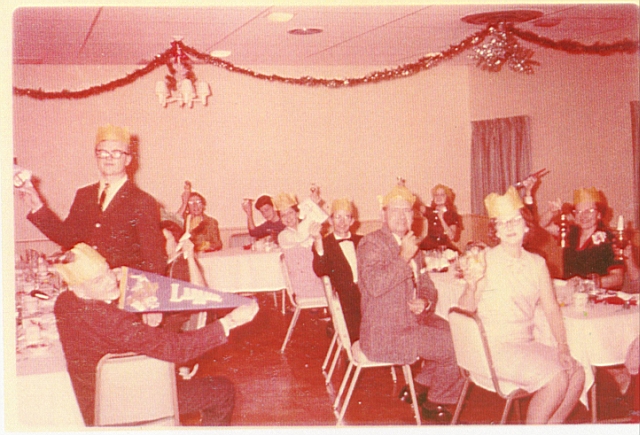
My plan for Christmas that year was to have a really fun get-together for the whole family. Gladys and I decided the Ramada Inn on East Kellogg was large enough to hold all of us. We reserved a room, chose the food to be served and planned Christmas decorations. We wrote little poems, one for each person. We bought paper hats and planned games and stunts for all to do.
It was so much fun with everyone getting into the spirit of the occasion. Joe and Sara added their own bit of sparkle, and Ann and her children were there, too. Ken was the only one of the children who couldn't be there, so we recorded a tape and took pictures to send him.
I think all of us remember
the beautiful spirit of family unity and the warm feelings we shared
that day. .
(GO TOP)
This was one of those years that brought both happiness and sadness. The sadness came first.
Ed and Vina had moved to Winfield from the farm in hopes that Ed would be happier if he could be with more people and perhaps find a job of some kind. But it seemed that any contact he made was terrible. For instance, he and Vina went to church and during class discussion; he talked at great length of his private life with Vina and embarrassed her very much. This sort of thing happened at every social event they attended, but Ed never thought he had done anything wrong. Finally, all he would do was watch TV and eat.
In May we took him to Prairie View Hospital in Newton for therapy and evaluation. I stayed with Vina, spending many long hours discussing every angle of the situation. We visited Ed often and could take him out in the car. Once he grabbed the keys and hit me, but Vina knew how to quiet him.
I discussed the possibility of a divorce with Vina. It was such a painful time for her, and she cried and cried when she decided a divorce was necessary. Poor girl! She loved him, but he never returned her affection, although for years after he begged her to work out some way they could be together again.
The doctors at the hospital said he had brain damage and probably would spend the rest of his life in and out of hospitals. We decided he should go to Osawatomie, but he became so violent on the way Vina had to turn back for her own safety.
I decided to take Ed with me to Wyoming as I thought the change might do him good. He wanted to go somewhere he hadn't been before to see new sights. I knew I had a big job ahead of me, but thought I could handle it even though Vina thought I couldn't.
Before the trip I purchased a new car, a copper colored 1964 Ford Galaxy. I hadn't planned to change cars, but mine needed a lot of work, so I followed an impulse to satisfy my own needs after devoting so much of myself to others.
When we got to Laramie we worked puzzles, went shopping and went for rides. Ed worked on lining a closet for me, which kept him busy although his work wasn't very good. One day he was putting up a window in the basement but was restless, so I told him he could look around. I guess he went to every neighbor's house to talk scaring some when he went in without knocking.
I received a letter from Vina with news of the divorce proceedings. I was afraid to show it to him by myself, so I told him I needed to go to the doctor and asked him to come along. I told the doctor privately what was in store for Ed, and he tried to help us. But Ed went berserk, tried to knock me down, got the car keys and headed for the car. The doctor had asked a policeman to stand outside the door, and he took him to the hospital where they had to lock him up.
Marvin and Ken came to Laramie to take Ed back to Wichita where he lived in a rooming house for awhile. He visited every minister he could find, tried to get a job and went to YMCA activities until they asked him not to come back. We finally had to face the inevitable and have him committed to Larned.
Ed got along well there and was so well behaved he was allowed visiting rights. He took the bus to Norman one time and to Wichita another time for family dinners.
The happy event for this year was Ken and Elisa's wedding, which took place October 1 in Madrid, Spain. Ken had tried for so long to find just the right girl. He always told me he would like to marry someone from a foreign country, as they seemed to be more devoted and faithful to the marriage vows. I knew what kind of girl he wanted, one that was beautiful, but one you could talk to like you talk to a man. That is, she would not say one thing and think another, but be straightforward about matters. I wondered if he would ever find such a girl, and now he was certain he had.
At first I hesitated about going, but the more I thought and talked about it with others, the more excited I became. As there were other Americans there, the language problem could be dealt with, but to be able to cope with everything ahead of me, I knew I would be using all my reserve strength.
Before leaving I shopped for the proper shoes and dress for the wedding, and finally found a light blue frilly skirt and a fitted blouse with sequins of light pink and white. The back seemed too low, but I planned to wear a shawl over it. One of the traditions in Spain is the groom's mother is maid of honor, and the bride's father is best man. I wanted to look very appropriate for this occasion.
The morning I was supposed to leave the ground was covered with snow. The weather was so bad the planes were not landing in Laramie. I couldn't wait another day, so I took the train to Denver where Harold Shaner met me and took me to the airport. We had to wait to take off until the crew cleared the ice off the wings. Finally we were airborne--but what a rough ride! We could hardly hold our coffee cups level, but we arrived in New York safely.
In New York I had a long walk through the airport and a long wait for the bus to the Spanish Air Terminal. I was so tired I hit my ankle getting on the bus, and although it hurt terribly, it seemed the least of my troubles.
Another long walk to the plane and I sank exhausted into my seat. How fortunate I was to be seated next to a couple whom made this flight often and did so much to make me comfortable. They got me a pillow and a drink and helped me with my dinner. We saw the most beautiful sunrise in the middle of the night over the ocean.
Before we knew it we were in Madrid! Someone took my picture as I got off the plane, and of course I bought it. What a relief to see Elisa's smiling face greeting me!
Ken met us for breakfast, and then we went to their lovely house with patio roses everywhere. The world seemed to be moving much too fast for me mentally as well as physically. They noticed my injured ankle, which I had completely forgotten. Of all things the bride didn't need was a crippled mother-in-law to worry about.
What a mad rush to be ready for the wedding. Ken had ordered a special suit with a dark cutaway coat with tiny stripes, and it didn't arrive until the day before the wedding. A friend of Elisa's made over my dress. Elisa shopped for gloves and a purse for me and had a hairdresser come to the house to fix my hair on the day of the wedding.
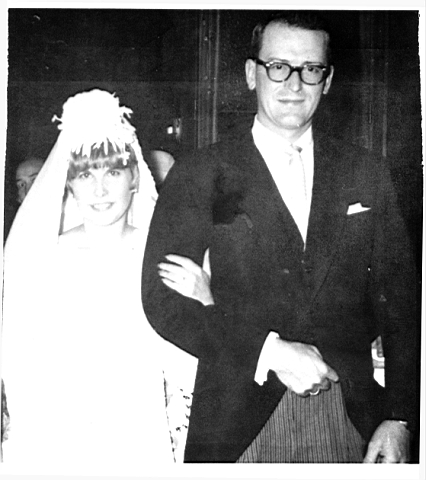
Elisa's dress was handmade, and I wish I could describe it! It would take a thousand words to do what a glance at the picture could do! A long trailing embroidered veil, a large fluffy mum at the head and down a little over her eyes, long sleeves of the same lace as the fitted dress. She carried a bouquet of white glads. Elisa looked so relaxed and happy--such a lovely bride.
Elisa's father wore a formal cutaway coat and striped pants. He is a very short man and I am very tall, so we had fun about that. He said he thought of bringing a stool when he talked to me!
A little boy and girl, relatives of Elisa, carried a box containing coins, another Spanish wedding tradition. When the bride and groom walked down the aisle everyone crowded around them to extend best wishes. A Catholic priest performed the service. Ken tried to memorize his part, as he didn't speak Spanish. Neither he nor I knew what the priest said.
After the ceremony they signed two books, one for the Spanish records and another for the American. We then went to a large building in the park for a celebration. There were people and waiters everywhere. The band started to play when Ken and Elisa arrived. There was the most elaborate food and lots of it. The cake was six layers high--I had never seen such a cake. Ken and Elisa danced so gracefully when the band played the wedding waltz. When they got to their car, someone had written "Just Married" on it with lipstick.
While they were gone on their honeymoon, I stayed in their house. I had a maid who didn't understand English, and I didn't understand Spanish, so we had lots of fun trying to talk to each other.
The people of Spain believe in enjoying oneself to the fullest and many people entertained me. Some of Ken's American friends took me to a Chinese dinner, an opera and Flamenco dances. Elisa's parents were wonderful, taking care of my every need. After the young couple returned, they entertained friends often, too.
Ken took us to Segovia where Elisa's father was from, and we went to a very famous restaurant where matadors, past and present, have dined. The walls were full of historic mementos. We were given little crockery mugs inscribed; "This was stolen from the Cafe de Segovia."
In Segovia we saw the old Roman viaduct, high above the street, which is in excellent condition after thousands of years. We also visited a very large and magnificent cathedral, which was built solely by manual labor. I marvel how this could be possible. A lot of slave labor must have been used. The vaults of monarchs were buried under the marble floor. All over Spain we saw this sort of elaborate work.
Once we took a trip up the mountains into the snow and skiing area. People drive small cars in Spain, and these were bumper to bumper for miles on a Sunday or holiday. On this trip I learned something of Elisa's feeling for Ken. A car behind us got in a hurry, and in trying to pass us, hit us quite hard. Elisa jumped out of the car, mad as a hornet, and blamed them for it all. When they tried to direct some of the blame toward Ken, she really let them have it. She didn't say a crossword to Ken. I'm not sure what she said as it was in Spanish, but I thought it was so nice the way she defended Ken.
The force of the collision threw me forward and I had a bad bump on my head. Some cold compresses, an aspirin and a good night's sleep took care of me pretty well.
While in Spain I celebrated another birthday. Elisa invited her parents and close friends and relatives to a party. All the Americans who worked at the Base with Ken came with their wives. There was a beautiful cake, and someone handed me a big bouquet of flowers. They sang Happy Birthday, and I thanked them all.
Then I repeated a little poem my sister Sara said when she was just a little girl. I had lain awake the night before remembering the words and making up the last verses. It goes like this:
When I'm in my ones, I can frolic all day,
I can laugh and run and fly around and play.
When I'm in my tens, I must get up with the lark,
And sew and read and practice from early morn till
dark.
When I'm in my twenties, I'll wear my hair up high,
And have the prettiest dresses, and maybe have a
beau,
When I'm in my thirties, I'll be just like my ma,
I'll order things and go to teas and grow a little
fat.
But Mother is so sweet and nice, I'll not object
to that.
When I'm in my forties, mercy my, I don't think
the world will
Last until I see that day, it's so very, very far
away.
Instead of ending, life is just beginning at forty,
we are told.
Beginning to be hectic, and can make you young or
old.
Young folks, college, weddings, success or bust;
If one doesn't get you, then one of the others must.
Then the years go swiftly by, the gray hair starts
to sprout,
You pull them, dye them and try to rub those telltale
wrinkles out.
Some folks you may fool--but shucks, why bother
a lot,
Just join the grandmother's club and show those
pictures about.
At sixty, I'm inclined to say life gets sweeter
with every passing day.
Rheumatism may get you; ulcers give you pain, doctors’
call and want to remain,
But kick up your heels and go to Spain, buy those
things you have longed to get.
If people wonder if you're sane, just smile and
say, "I'm not dead yet."
Oh, what comes after sixty, oh Lord, mercy my.
When I get to be a hundred I think I'll have to
die.
But, lack enough, the world won't last till I see
that day,
It's so very, very far away.
There were about fifty guests, and they gathered around while I cut the cake. Flowers, candles burning, happy talk--it was the loveliest party I ever had.
Ken and Elisa gave me a book of Don Quixote. We had no premonition of what importance that story was going to have in my life. The book became a stage play with the theme song, "To Dream the Impossible Dream." This song would mean a great deal to me in the future.
I shopped in Madrid for some things to take back to the U.S., and found a lovely oil painting of the street and steps close to a cafe where we had eaten. It was a famous place that had been written up in National Geographic. I had a red suede suit made to order. This was rather shocking in Spain because older women, especially widows, wore only long black dresses and black stockings. I ended up with so much more that when I went over Elisa loaned me a little trunk to carry all my extra things home.
As the time neared for me to return to the U.S., I decided to try another new experience--taking a boat home. I was to leave from Barcelona so Ken and Elisa took this opportunity to show me their home on the Mediterranean Sea, at Benidorm. Their apartment was so attractive with the beach right outside the door. I could see why they liked it so much.
We had a typical Spanish dinner at Valencia, the home of the famed saffron-tinted paella with its variety of shellfish. We also had a candied orange, which was different and very good. The center of the street was filled with booths selling every kind of flower. A horse-drawn carriage was giving rides to tourists.
Ken and Elisa left me in Barcelona, as he had to get back to work. After spending a night in a hotel I arrived at the ship and was greeted with, "So, you are Nanetah Oerke. We have been waiting for you. Your berth is ready. Some people must think a lot of you." In my cabin was a vase of beautiful roses and a special delivery letter. There was a card form Elisa saying, "These roses are a symbol of our love and gratitude. Hope they make your boat trip more enjoyable. We're proud of you, Mom." Ken's card read, "It was wonderful having you. Have a good trip home. We love you. Ken." The letter was from George telling me he would meet me in New York. What sweet greetings from all of them!
In the dining room I was assigned a booth with a couple who made the trip often. He was a professor in an American college who visited his parents in Hungary. Our meals were excellent. At one of our stops three New York office girls got on and shared my room with me. They were pleasant enough, but young and lively, and I would have enjoyed more having someone nearer my own age. I had plenty to do; however: movies, church services, a library, life-saving drills and canasta games with three other ladies.
George and Dorothy met me in New York and took me to lunch at the United Nations. That was a thrill. Our drive to Leipsic, Ohio went quickly as we had so much to talk about. It was good to be back, although the Spain experience was so very exciting.
Is it worth it to raise a family? You can count on it. Never a dull moment. Lots of activity, some heart aches, a lot of work, but it wouldn't be much of a life without them.
My stay at Leipsic was very pleasant. They had fixed a room for me downstairs so I could rest whenever I needed to. Dorothy fixed such good meals and served them so graciously. David was good at games, and we played a lot of them. Of course, he usually won. I love games, too, so we got along fine.
I was introduced to nearly everyone at church as I stood beside George at the door after the service. Many invitations came for meals. In return, Dorothy entertained several ladies for dinner. I showed the things I brought home and told them about my trip to Spain.
At Christmas the house was beautifully decorated. It was a big occasion, with a school play for the children and many friends stopping in to visit or play games.
Dorothy's parents lived a short distance from Leipsic. Her mother and I had been close friends when she was deaconess at St. Paul's Methodist Church in Wichita. She worked with the young people and missionary groups, was wise beyond her age, but so jolly and talkative. It was she to whom I had gone as a girl needing spiritual help. I feel I owe what I am today to her leading. When she prayed or spoke you were aware of the depth of her faith. I prize a picture of her, her husband and myself taken on the doorstep of their home in Ohio.
George made my stay so pleasant, even having a story
about my trip to Spain in the Leipsic newspaper. He worked very hard and
was the wheel horse back of the construction of a new educational building
at the church. It was completed after he left, but he was asked to return
for the dedication. I know it was a big thrill to see his project completed.
.
(GO TOP)
1966 - To Dream the Impossible Dream
Another year of exciting activities! On January 14th I returned to Oklahoma. It was so good to see all the Joneses again, and I relived my trip to Spain in telling them all about it. I have so many wonderful pictures of the wedding and Madrid. I would like to put them in this book, but life goes on and so did my activities.
Rowena entertained me by taking me to see Annie Get Your Gun at the University and inviting her bridge groups to the house. I never learned to play bridge well enough to join them, but I enjoyed seeing all her friends.
I returned to Wichita to see Gladys and Ira and spend a short time in my apartment. The real highlight of that time was the party for the Young People of St. Paul's Church. When I was in high school, and during the years after, a fine group of young people were very, very close friends. Mr. Roscoe Moore had sponsored this group and provided activities and guidance. We were very active in all parts of the church, and although our families were strangers for the most part, we held together through the years and occasionally had a big get-together.
I wanted to share my exciting trip with them so I planned a dinner. I invited them to a Spanish Cruise, the pier being my house, on March 18 at 6:30. Each family brought a covered dish, and the place cards on the tables read "Passenger" and each name. As I remember, there were about 45 there.
When the meal was over I spread my souvenirs on the mantle and made a report to them. I put all I had in this report to make it entertaining and had the group laughing. Being with this bunch made me feel young again, and made an evening that has lasted in my memory.
I made a brief visit to Marvin's family, but it was spring and I was eager to get to Wyoming. I took the bus out, found the house in good shape and really enjoyed the relaxation. It felt like Home, Sweet, Home, and I decided to stay awhile.
To become a resident of Wyoming I needed to get a driver's license. The test was very difficult for me. I studied the instruction book. Boy, how I studied! I had never taken an exam before because I had gotten my first license way back when Model-T Fords were made and had always kept it up.
One fine morning I felt very relaxed and went to take the test. I passed the eye test, the oral test and the written test with flying colors. I did so well I wasn't required to take the road test, which made me nervous just to think about.
Now that my house was completed and decorated I began searching for activities to occupy my time. Making ceramics had lost some of its excitement (I had filled all the shelves I had!), but I thought of setting up a studio. A woman with a shop in Laramie helped with advertising. She put signs along the road and in front of the house, but we had no results. She finally agreed to take my two kilns and 50 molds, and I was out of the ceramics business.
I tried to learn bridge, which was fun for a short time, did a lot of cross-stitch and knitted myself a very pretty suit. I enjoyed all these things but didn't want to do them over and over again. I studied Spanish, thinking I might go back to Spain, read library books about Laramie till my eyes hurt and tuned into the radio and TV occasionally.
I spent a lot of time on my lovely deck porch watching the boats and people, the mountains and clouds. So relaxing and peaceful, but there is a limit to that. It was also quite lonely! I needed someone to talk to. I didn't want to bother strangers; not even family and friends would really understand, but God would. I began making notes about my thoughts, and as time went by, began to understand myself a little better.
A new song became popular from the play Man of La Mancha, taken from the Spanish tales of Don Quixote, the book Ken and Elisa had given me. "To Dream the Impossible Dream" really got to me. I played it over and over; becoming convinced what I really needed was a challenge.
I had been attending the Presbyterian Church in Laramie. How that changed my life! I liked everything about the church, especially the minister, Dr. Glassman, and his sermons. When I left the church after Sunday worship to drive the 25 miles home, I was so up in the air I forgot to do errands I planned to do.
One Sunday I signed a card asking for a home visit. It seemed ages until he arrived at my door, although actually he had responded very quickly considering the distance he had to come. We sat on the porch overlooking the lake which he said reminded him of Lake Galilee. I told him I hoped he would have a job for me, perhaps something in the Sunday School Department. He remarked it was seldom anyone asked for a job, but there was an opening in the Junior Department.
I explained my desire to work in the missionary field, but with my age and health doubted if anything was available. He said he was the head of the Fifty Million-Dollar Fund, which was used to improve church facilities around the world, and I might find something through this. I said I would be able to help financially, too. He promised to look into the possibilities. I was so excited that anyone would listen to me and make an effort to help. "In quietness and confidence shall be your Strength." How very true I have found this.
The following Sunday I was introduced to the Junior Department. I was so excited I was afraid I would embarrass others and strain my energies, too. They asked me to take charge of opening exercises before the classes separated into their own age groups. Being someone new, I held the attention of the whole group, and I was on my way!
Dr. Glassman gave me some literature about a new seminary in Brazil that needed help. It seemed exactly the kind of situation where I could find a place for myself. I decided to make a sizable pledge for the seminary. Although the Fund looked for larger pledges, I felt $5,000 was all I could manage.
I still felt uncertain about my abilities in the Sunday School. I didn't want to mention my age or health as I might be put on the "Handle with care" shelf. One particular Sunday I felt nervous and tired when I went to the worship service and found the sermon that morning was from the life of Samuel and his answer to God's call, "Lord, send me!" That had been the main cry of my life, and every time I thought how little I had done, it made me blue. I was sure the sermon would touch me too deeply, and I was already fighting back tears, so I got up and left.
My prayer the next few days was, "God, as you have been with me in the past, give me health, faith and courage. Grant me my goal if possible. If not, give me what I need to serve you best. Quiet my nerves. Give me the feel of your presence.
Another Sunday arrived--a perfect morning. My lesson went well in Sunday School, I felt well and people told me how nice I looked. I felt such confidence I told Dr. Glassman I wanted to go to Brazil to see the seminary for myself. My birthday was the next week so I invited the pastor and his wife to have dinner with me at the Diamond Horseshoe. They listened very carefully to what I had to say and said they had never had anything like this happen before in their ministry. I had written a letter to the head of the Brazil Mission, and I wanted Dr. Glassman's permission to send it. He said he would think it over.
At this time I wrote in my notebook, "I am so happy; my life is so full and rich. Thank you, God. Now help me to keep well."
The days went by with no word from Brazil. My letter had been sent several weeks before with Dr. Glassman's blessing. Christmas was fast approaching, so I headed for Marvin's ranch for a holiday celebration with the family.
I always tried to think up something a little different for our Oerke get-togethers. This year my idea began with a bunch of aprons I had picked up at a sale somewhere. I always thought the cleanup after a holiday dinner was an awful lot of work, and it usually fell to the women who had already worked so hard getting the meal on the table. The others just sat around, and it wasn't fair.
I wrote numbers on slips of paper, two for each number. I cut each slip in half and put one-half into a pocket of each apron. The other half I put on a plate. I wrapped the aprons and gave them to the young people and a few of the women. They opened the packages and found the numbers.
Then I passed the plate to the men for each to draw a number and match it with the other part. This made several partners to work in the kitchen by turns, 20 minutes each. As their time was up the pair with the next number took their place. It didn't take long to get all the after dinner work done, and they had fun doing it.
I had filled the seat by the dining room windows with cookies, candy, nuts and fruit so everyone could nibble as they wished. For the little children I hid gifts all over the house, but in plain sight.
I had brought along a jigsaw puzzle that was a little different because it didn't have a border. It was a picture of a wicker basket containing balls of yarn in red, blue, green and yellow. In the basket there were three kittens playing with the yarn. The heads and ears of the kittens and the handles and sides of the basket made a border of sorts. This puzzle kept us busy for a long time.
Later in the day I arranged for the four young people
to go see Gone With the Wind. This was the first time Tom Traylor
came with Pat to an Oerke get-together. He remarked that I surely did run
the family! Is that good or bad? I wondered, but he soon was to find out
that my personal interests took a lot of my attention also. .
(GO TOP)
Upon returning to Laramie after the holidays I found the long awaited letter from Brazil. Al Sunderwirth, an American missionary form Wyoming and Director of Centennial Seminary, told me a little about himself and his past experiences, and responded to my desire to find something in the missionary field to absorb my interest.
"Maybe your dream is about to come true," Al wrote. He said he had informed the faculty of my approaching visit, and they were delighted. All were Brazilians except two and understood English when spoken slowly. He told me about the political situation there and sent a picture of his own family. He said they had good doctors and could see to my every need. He suggested the best time to come was the last of February or middle of March.
Plans began to move ahead very quickly. I had to get my passport updated, get the proper shots and gather things together for travel. The snow began to fall, so I left my house in care of the Nottages and took a room in a hotel in Laramie. Dr. Glassman asked me to speak to the congregation about my decision to go to Brazil. The text of my speech follows:
But the world, according to history, has been through many crises, and I believe we as Christians know more about what God is like, and how He would like for us to help him, than ever before. Some feel for them it's politics, some education, some science, etc., but I believe the church molds people to bring out their best and is the most important influence, no matter in what field they choose to serve.
I have always felt the importance of the gospel of Christ presented through the church. When I was a high school girl I dedicated my life for full time service. I looked around me, and it seemed we had all the "goodies" and the freedoms, but we were so complacent and unappreciative. I wanted service in a worldwide mission. Patterns of life change suddenly when we are young people. I met a nice-looking, lovable young man and we married. For many years I was busy with my home, but I never forgot my commitment.
In September I asked Dr. Glassman if there was any place in this whole wide world where I could still serve. I wanted something special, something personal, something challenging. Under the 50 Million Fund we found a little seminary in Brazil. I say little because it is really an infant. It came into existence in 1959, has graduated only three classes and has nothing but dreams, plans and courage. The men who graduated have received high praise for their ministry, and they are a blessing to the church. But there are no buildings, no administration building or classrooms, no dormitories or chapel. They have rented vacant places here and there and got along the best they could. The 50 Million Fund along with the Presbyterian Church of Brazil and the Board of World Missions are providing this infant seminary with housing and it will grow and grow and grow. This struck me as being exciting, to get in on the ground floor and watch the change and development as I had watched my children grow. But to make it personal, I wanted to get the feel of the country, to know the professors and students who are there now.
This I am going to have the privilege of doing and so my lifetime hope and dream is coming true. I'll fly from New York to Rio de Janeiro where Rev. Alfred Sunderwirth, the missionary from Wyoming and once a pastor at Casper, will meet me. We will fly by a small plane to Victoria where the seminary is located. In his most gracious letter that I received a few days ago, he invited me to stay in his home. The professors, she said, were most happy, and I am looking forward to a wonderful time. Not everyone finds his pot of gold at the foot of the rainbow, but I feel I have found mine. To this project I can give my love, my gifts, my watchful interest, as long as it is possible. What a lovely way, I think, to pass the time when that rocking chair catches up with me. I am very grateful to all who have made this climactic thing possible.
But, you may be thinking, what if the seminary doesn't make it? It might not survive all the hardships of growing up. I admit that is a possibility with the turmoil of the world and the differences even in the church itself.
If after my visit to Brazil I feel the same as I do now, all I can say is--I just have to try to help all I can and leave the rest to God. Christ told his disciples, "What is that to thee? Follow thou Me" (John 21:22). I have had this poem for many years in my Bible:
And burdensome seem Thy demands,
Lord, show me Thy nail-pierced hands.
If ever my footsteps should falter
And I be prepared for retreat,
Lord, show me Thy blood-stained feet.
Lord, Dare I Show Thee My Hands and My feet.
The time to include my children in my plans had come. I wrote a letter to Rowena, part of which follows:
I am going to New York and then flying down to Rio in Brazil to inspect a small seminary in Victoria that the Presbyterian Church started in 1959. Everything is cleared with the church and the seminary I will be met in Rio, taken by a smaller plane to Victoria, and stay in the missionary's home. He is a native of Wyoming. I'll get to meet all the professors and the students and sit in on the mid-semester activities.
I gave a five-minute talk at church this morning and will be scheduled for talks all over Wyoming. It is a small enough project where my gifts will count. It will be a pleasure to watch it grow and change, as I have watched you children. It will be my dream come true if I feel the same way after I return. Maybe it can't survive the world conflicts, but that is the chance we have to take in any new venture. I will stay about two weeks, or maybe a month.
I have my passport from last year and had to make use of it. Ha, Ha! Really, I don't suppose I would have thought of this if I hadn't made the trip to Spain. But how much richer and more meaningful it will be for me to do this traveling.
Once we left U.S. soil I had an uncomfortable feeling that I was helpless. At this point there is nothing one can do but continue. I relaxed and prayed: "Oh, Lord, I am going to Brazil to do Your work. Grant me a safe journey, but no matter how the trip goes, safe or not, I will be with You or in Brazil, and either will be all right."
When we landed at Rio the captain called out the name of the city, but it didn't sound like Rio to me. In the Portuguese language R's sound like H's and J's sound like D's, so I had to ask a fellow passenger where we were. I got off the plane, walking toward the terminal praying again: "Lord, grant that we may find each other. I can't speak Portuguese even to get food or information. I have no Brazilian money. This is like walking on the edge of a cliff!"
As I approached the building a man waved at me and called out a greeting, "Hello, Nan!" I threw my arms around him and we were strangers no longer. He was Dr. Alfred Sunderwirth, the Presbyterian missionary from Wyoming.
We toured Rio in a taxi. Such wild, rude drivers! We saw the huge statue of Christ on top of a hill, a landmark in Rio. Our driver drove down the hill so fast we were thrown from side to side.
We had lunch on the seventh floor of a round building. From the window we could see across the city and countryside for miles and miles. There were huge ships in the harbor. I let Al do the ordering, and we had a wonderful lunch, but we were much more interested in talking to each other, asking and answering our many questions and learning to know one another.
We took a small plane to Victoria, and upon reaching Al's home, I found a comfortable rocker and promptly fell asleep. When I awoke I ate a dish of soup and excused myself to go to bed, as I was too exhausted to talk.
The next day Al's wife, Mary Lou, came to meet me. She was a person of unlimited vitality and chatter. The family was on vacation at this time, staying at their beach house, so we drove there in a Volkswagon. The roads were rough and Mary Lou drove fast--bouncy, rough and fast. She did everything that way, very fast and efficiently. She was a lovely hostess and it was only a matter of days until I felt like one of the family.
The beach house was really something. The windows had no screens, and the flies swarmed in when food was cooking. Someone had to stand by to shoo them away. Mosquitos also were very plentiful at night, so we kept a protective fire going. They said I was a good guest because I could get along without conveniences such as running water and was able to "rough it." I had plenty of practice in Laramie!
Each house on the beach had a pool to catch rainwater. One day a horse accidentally got into the back yard and fell into the pool. What a time they had getting him out, and he looked like he wouldn't live. The fence or a rope thrown across some posts served as a clothesline. Very poor people lived nearby and came begging, always so grateful for every little handout.
Another American family lived in the neighborhood and one day invited us for a wonderful meal of freshly caught lobsters. We had a lovely time of relaxation after the meal. The men told stories of their boyhood and made jokes. Everything was laughter and fun. When the moon came up over the water it lighted the landscape in a most beautiful way. All we could see was beauty--palm trees, light and shadows. It was one of those memorable occasions one dreams about.
While we were at the beach all the professors were invited out to meet me. There was one couple who had been educated at Princeton and spoke English. They were so helpful and invited me often to their home.
One professor was black, a very handsome fellow and much loved by the students. Another was a large, handsome man called Dr. Wilson. This wasn't his real name but his Brazilian name was too hard to pronounce!
The professors held a business meeting, and then we all got acquainted over refreshments. I thought it was a grand team to work with. They answered some of my many questions, and I felt well informed even though I had not yet seen the Seminary nor met the students.
I must tell you of my first experience going to church in Victoria. I was doubtful about what to wear and how to act. Al sat right beside me and prompted me on what to say when I was introduced, but I made a mess of the pronunciation.
The church was packed--every seat taken and people standing in the aisles. Al said this was customary. And such a mixture of colors and nationalities! This also is common in Brazil. Housing is very integrated, and color or race makes no difference in marriage. All nations are represented and live and work well together. There are a lot of Germans and even more blacks, as Africa is quite close.
The service was much like ours; however, the pulpit area seemed so different. There was a large table, like ours for communion, covered with a large, highly embroidered white cloth. How everyone sang! I could only think how much the church meant to them.
The men of the Seminary held a special service to open the school year. I was invited to this formal affair and introduced from the front. The Seminary had an excellent chorus of beautiful and well-trained voices, which entertained for the program.
One day I visited a high point of ground which the Seminary owned. The cornerstone for the new school had been dedicated and plans to build were underway. From there I could look out over the ocean and the city. I sat in the car for awhile, fell asleep and had a dream about the future.
In my dream it was the year 2001. I heard the television announcer talking about the exploration of space and miracles of medicine. Such remarkable progress had been made already in my lifetime. Perhaps it would never make the headlines in international news, but a unique school of brotherhood had been discovered in Brazil.
In my dream I could see a beautiful little settlement located on this high place, with inlets on either side leading to the ocean, cascading down to the water's edge. From the top it seemed like these inlets were comforting arms embracing the buildings which housed the new Presbyterian Centennial Seminary. The school was dedicated to making men--brave men, strong men, men of vision and outreach, men who preached about God by the way that they lived their lives. From the little I knew already about the school and its teachers, my dream of the future could surely come true. I felt somehow that I could be a part of realizing that dream.
In my travels around Brazil I formed certain observations about the country. The foliage is much like Florida. Lemons grow in everyone's yard. The bananas and pineapple were delicious. I brought home some real Brazilian coffee.
I found San Paolo much like Chicago and Rio more of a commercial center. It doesn't possess the glamour of Madrid, but is more awake and progressive. Victoria has about 85,000 people and does lots of shipping. The farther north and inland you go the poorer the people are. The roads are terrible, made from granite bricks.
While I was there seemed the best time to set up the Scholarship Fund. I gave $1,500 to the Fund, and as long as I am able will notify the recipients of scholarships. They are to be selected on the basis of outstanding grades, attitude and character.
I returned home in March, rather tired from all the excitement. Dinners, talks, conferences and sightseeing had kept me on the go. Living with a family of five in a very hot climate had been exhausting. They said it hadn't been so hot for 30 years. Al Sunderwirth and I had become close friends. He reminded me of Wilford and was so considerate of my needs.
In a letter to Rowena I said:
I began practicing my typing and studying Portuguese through records. There was a Peace Corps worker in Laramie who had been in Brazil and she helped me, too. I studied library methods at the college in Laramie. I couldn't believe I would be ready, but even if I didn't get to go, it was fun aiming at it.
Thinking I would have to spend about a year in Brazil,
I wanted to have my business in order before I left. I decided the time
had come to sell the Cedarvale property. The Joneses and I met there with
a real estate agent that had a buyer. I hated to part with the place, but
I liked not having to worry about upkeep and repairs. I drove around it
a few years later and was glad to see the house was in good shape. I had
no regrets, as I no longer wanted to live in a small town like Cedarvale.
In view of my new activities, I'm sure you can understand why! .
(GO TOP)
Gladys and I shopped, sewed, packed and gradually worked through all the necessary chores involved in preparing for my trip. I plugged away at my studies while waiting for a letter from Brazil confirming my visit there. It didn't come and didn't come, and I began to get very restless. I finally packed the car and headed for Marvin's. I had been there only a day when I received the letter.
I was somewhat disturbed to learn the Seminary had moved and now occupied a building where the library was on the third and fourth floors, which were reached by a long flight of steps on the outside of the building. Al said the men would help me, but I had always had trouble with steps, and could I endure so many for such a long time when I knew the library work would take so much of my energy? Well, I had made up my mind to go, so I would just have to try it and come home if I couldn't manage.
I got in the car and headed for Columbus, Ohio, where I had decided to leave my car with George. He met me in St. Louis and drove the rest of the way. We stopped once for a pleasant visit with the couple who had shared their lobster dinner in the moonlight the year before.
Waiting for my plans to be confirmed by the head office in New York, I stayed at the Travel Lodge Motel as George lacked an extra room. He helped get my plane tickets, and I spent a lot of time resting. I needed all the rest I could get for the strenuous trip ahead. When the call came from New York I learned I would be on my own as Al didn't know just when I would be arriving and didn't plan to meet me. I wondered if one could get too independent and confident!
The flight to Rio was grand, but I was worn out and still had to change flights to Victoria. I had studied my Portuguese and thought I knew enough to ask the right questions. I knew I said the right words, but my accent was hard to understand. Finally, I got on a bus with other passengers and went to a motel thinking I could get directions from there. In my poor Portuguese I asked for a room, and finally someone understood and had a wonderful meal sent up, too. I stayed for two days, and after a good rest, at least was able to find the plane to Victoria.
I was familiar with the Victoria airport, and as Al didn't have a phone, I ordered a taxi to go to his house. With much help and patience on the part of the driver, I soon arrived at Al's door. How surprised they were that I came on my own.
The first news to greet me was that Al and Mary Lou would soon be leaving the Seminary. Al was going to begin work on his Master's degree at Columbia University. They had stayed in Brazil as long as a missionary's contract would allow, so a new Director would be coming. I hated this as I had looked forward to working with him.
It was necessary to locate a place for me to live. One afternoon we visited a couple who lived in back of a church building with very few comforts. Al persuaded them to come to Victoria to take care of me. We found an apartment, within my budget, located on a corner near a bus stop. The bus would take me right to the Seminary, which was perfect.
The Sunderwirths gave me some furniture, and I bought some of my own with Mary Lou's assistance. We fixed up the place quite nicely, and the couple moved in with me. The biggest problem was they spoke no English, nor could they understand it. We communicated by pointing and nodding our heads, and in time they managed to learn a little English, and I some Portuguese. She was a good cook and housekeeper and tried very hard to please me. She liked to bring me tea and cookies during my afternoon rest.
I usually went to the Seminary every morning. The steps, 55 of them, were hard for me, but I took them slowly and often there was a student to help me. I told them I felt like I was climbing Mt. Sinai, like Moses, to get contact with God! The view from the top was out of this world. You could see the river with boats on it; huts along the side and houses built on the steep banks. There was a big bridge across the river to the industrial part of the city.
The main food was rice and brown beans, without which a meal was not complete. Bread was hard crusted if available at all. They served fruits and salads, but one had to be careful about eating unwashed food or drinking milk, which was not boiled. Refrigerator facilities were not good.
Note: In this country there is no method for embalming a dead body, so a funeral is held immediately. Is this good or bad? I believe there are good points either way.
Excerpts from a letter:
The work at the library did not proceed without problems. Al had said the Seminary would provide everything I needed, so my only purchase at home had been an instruction book on the method of cataloging theological libraries. Just looking at it was overwhelming, and it was so heavy I was glad I didn't have to carry any other supplies.
I had cards cut in the correct size, but had difficulties locating book tabs for the covers that would hold fast in the heat. I read about a varnish that could be used over them, but could not find the right product. The only thing I could do was stick on paper labels and write the information inside the book in case the label was lost.
I wish I could tell you all the categories I had to separate. Besides the different time periods, there were books in all languages. There were history books, books of the Bible and books about the Bible. Books of ethics, archaeology, inspiration, administration, and others.
Of course, cataloging was my business there, and I spent all my spare hours in my apartment studying my catalogue book. I worked at home on some of the books, which had to be carried there and then back to the library shelves.
Although 5,000 books is a small library, there are no words to describe the enormous task I had undertaken. Each book had to be handled several times, with three or five cards to be typed for each one. I finished the job as best I could, the students polished the floor and the furniture, and it was ready for inspection. Everyone was pleased with our efforts.
One of the professors came in looking for a certain book, looked through the files, found the right section and pulled out the book. His eyes brightened as he exclaimed, "It works!" It was my turn to be pleased.
As I prepared to leave, several families entertained me with dinner. The young students came to my apartment to visit me. They gave me a dinner party and said they had a hard time deciding whether to give me real or artificial roses. They decided on the real ones, which they said represented love. They said I seemed like a sister to them, though I thought mother would have been better.
I was interviewed before I left by a minister and his wife. He took notes on a pad as I answered his questions in my limited Portuguese vocabulary. The following article appeared in the Brazil Presbyterian Church paper.
An Angel Came Down to Brazil
Her name is Nanette Josephine Oerke, an American. She belonged to the Methodist Church almost all her life, (she has a son who is a pastor in this church), but about two years ago she joined the Presbyterian Church of the U.S.A.
On a certain day she made a curious request of her pastor.
"Reverend, is there some place in any part of the world that God could use me for the rest of my life?" She had in mind a very special work to take her time and interest.
The pastor searched but none contained what she was searching for except the Seminario Theological Presbyteriano do Centenario in Victoria, Brazil and to there she directed her attention. Seeing her enthusiasm, the Rev. Alfred Sunderwirth visioned the organization of the library of the Seminary and to this work she dedicated all her strength. It is good not to forget that she had no experience in this. She thought what a tremendous idea and studied a little Portuguese, library procedure and typing. This she did at her own expense and returned to Victoria to do the work. She is training three students to take over when she leaves.
So enthusiastic was the Seminary with her amiability to everyone there, they took up a collection to do something in her honor, to testify of her work. It was a fact that she was to remain here. Above all else, they knew that this person was here for the institution with the approval of her God and for her work.
This admirable woman left six children and 12 grandchildren. Speaking with visible difficulty of the idea, that she must be so far away when a granddaughter was to be married soon.
Being almost isolated, we asked if she was not timid and dreaded the arrival of the plane in Rio. But no, she thought she knew a little Portuguese and could get her meals since this was the second time that she had made the trip. Prof. Clecia, who I know well, said this was rare and she thought she could beat the Pope. She laughed and said, "Not with these legs which will hardly work because of arthritis."
Certainly nothing was left undone in her ambition. When the library is finished, and if she has time, she wants to write a history of the Seminary.
In a little time the seminary gave her a dinner. The students considered whether to buy real roses or artificial ones. They decided on real ones because they meant love. And they said "As real roses leave a perfume that lasts long after they are gone, etc." I thought this symbolic.
I am thinking that a person with such ideas and determined
interest in the work of Christ, and with superior abilities to live on
this earth, and at the end, to give more indispensable work, was something
angelic. And as the roses, her example and message of truth, would give
out a perfume that would last a long time.
A Pastor in the South of Brazil
I would like to introduce you to some of the young men who were students at the Seminary. The first to really show his feelings for me was Manuel. He was tall, light complexioned and very proud to be a Brazilian. He didn't care about learning to speak English, although he read it like all the students did. He said, "I like you, I love you," in English.
One day he found a stay from my foundation garment in the library. He asked if it were mine. I said it was, took it from him and threw it in the wastebasket. He said, "Oh, no, I want it. It will remind me of you." I hugged him a little, gave him a quick kiss and the stay. He left walking on air. He was the only one I ever kissed, but the students loved for me to pat them on the back, or hold their hands. I know Manuel later bragged about my kissing him.
And then there was Andres. He had a modern haircut, joked a lot and loved music. He was engaged and wore a ring on his right hand. It was customary to change it to the left hand at the wedding. His fiancée had studied in France during the past year and returned while I was there, and they were married shortly thereafter.
Cesar was another one with style. He was always trying modern dances by himself. He loved tape recorders and taped many programs and conversations. He was quite a comic.
Then there was Alonso, the president of the student body. He brought his sister to meet me. Alonso told me he was a shepherd to 200 sheep. His "sheep" sounded like "ship," but he meant he was pastor to 200 people. He was dark skinned and had eyes full of expression.
Clerio was quiet and looked sad, but how he could smile. He was pastor of three churches, had no family and worked very hard. He helped me in the library which caused the others to tease him.
Abel and Lindel were brothers and looked almost like twins. Abel liked to speak English and wanted to spend more time with me than I had to give. He hoped to come to the U.S. some day to study at Princeton.
Edwardo was thin faced and pale skinned and very popular with the girls. He finished at Seminary and went on to Princeton.
Luiz was small and dark and had such a speech problem I couldn't see how he expected to make it in the ministry. I heard later his speech had improved, and he was doing well in his studies.
Otavino became engaged while I was there and wanted to share his happiness with me. He brought his fiancée to meet me and was smiling from ear to ear.
Guilherimo was a last year student who had a church. He was an American and married. Later he sent me a picture of the new church his congregation was building. I know he would have liked some financial help, but there was no way to draw the line once I started that.
One contact I enjoyed very much while in Victoria was with the daughter of the founder of the school and her husband, Claude and Cecilia Labrunie. They entertained me and often took me places in their car. He was French and would kiss my hand. It was always great fun to receive his compliments. I think he knew all about the school and understood both the American and Brazilian interests, religious and political, liberal and conservative.
There were many points of conflict involving the Seminary in relationship to the Brazilian government, as well as to the Presbyterian Church in Brazil. The approaching confrontation greatly disturbed my friends. From my experience working with them I had an understanding of all points of view. I suggested changing the school's status to that of a private charitable organization named in honor of the founders and operated without connection to the church.
I presented my idea to the church committee, it was accepted and a whole new program was planned with the students receiving some of their theological education at the government sponsored college. I felt my work was complete with the affirmation of this plan.
I was eager to head home before the Christmas rush, but before I left we celebrated my birthday with an evening of songs, refreshments and fun. There was a cake with a Brazilian flag on one corner and an American flag on the other. It was a delightful, but sad occasion, as we were soon to end our close associations.
I flew
back to New York where Al and Mary Lou met me and took me to the central
office to report on the situation in Victoria to several high officials.
Al showed me the church where he would preach, and it was wonderful to
see them again. I loved them so much, but one can't hold on to friends
very long when they live far away and have so many interests. .
(GO TOP)
1969 - Who Needs a Broken Leg?
Early in the year I met Al in Wyoming at a district meeting where I made another report on my work in Brazil. I thought I would be scared in front of a large group of ministers, but when I finished they gave me a standing ovation. It seemed a fitting finale for my wonderful experience in Brazil. It was the highlight of my life.
Following is my talk to the Synod of the Rockies at Wyoming:
At my request, Dr. Glassman, my pastor in Laramie, made a visit to my house and I asked, "Do you suppose there is any place in this whole wide world where I could feel a personal commitment" We talked over the 50 Million Fund project and when I received information on the Seminary in Brazil, I had no doubt in my mind but this was what I wanted. The last two years have been very rewarding to me, but volunteer missionary work is all on your own financially, and my pledge to the 50 Million Fund is not yet completed, for which I am very sorry. I have given myself instead of money for capital assets. I am glad all people are not like me, for the 50 Million Fund would not have been the huge success that it is today. I wanted to go and see the work in Brazil. When I told Dr. Glassman he was surprised but made the arrangements. When I came back and told him I was going again, he said, "Are you?" They tell me that a part of a woman's charm is her utter unpredictability. I have caused Dr. Glassman to scratch his head and sigh many times. He is a great man and the synod will miss him, I'm sure. I wanted to publicly express my opinion, for he saw my soul's need and helpfully opened all doors. He is a true pastor.
Now, the other of the two men that is in your Synod is Rev. Alfred Sunderwirth. How much I owe to him. He met me when I first landed in Rio de Janeiro a scared, helpless and confused woman. One feels very brave in his own familiar environment, but it is different when alone in another country where you can't speak the language or handle the money. You should have followed him around for a while to understand how the Brazilian people loved him and his wife, Mary Lou--how they leaned on him for advice and direction. He's one in a million. But I do not have to tell you what kind of a person he is; you have known him much longer than I. When he asked if I would help with the organization of the library I said, "Me?" Imagine my trying to learn to type, to do library work and speak Portuguese. I returned to the U.S. and studied for a few months. I don't say I did a grand job on any one of these things, but Al was leaving Brazil and I just had to get back in time for him to get me organized. The second trip down I felt very brave, and I said, "No one needs to meet me. I'll make it alone," and I did. But it would be a long story to tell you how.
You may be thinking--what about the Seminary, is it necessary? I am convinced it is a must. There is a wide open field for pastors. The location is perfect between the rich of the south and the poor of the north. It is a fast-developing part of Brazil because of the location of the new capital in the center of the country.
Do they want us Americans there? What of the 'Yankee go home' sentiment? Is mission dead in Brazil? What kind of people are the Brazilians really?
I can answer these questions best by giving a little of my experience. As I was preparing to return home, the students gave a dinner for me. They wanted to give me some roses, but what kind--real or artificial? True, I could keep the artificial longer, but the real roses had more meaning. In a presentation speech, they said that the fragrance of the rose petals lasts long after they are faded (and I remembered the rose petal beads we used to make). So it would be with my life with them. They would treasure the thoughts of me a very long time. All the professors begged me to stay and just never go back as I was one of them. They felt they needed me. I had a birthday party just before I left. The cake had Happy Birthday written across it with the Brazilian flag in one corner and our flag in the other. When Al left the speeches of appreciation were very touching. They were not just words--they came from the heart and it was like the sky had fallen in after he left. Now does this answer the questions I mentioned?
True, we are having trouble getting our buildings. It's just one of those irritating snags. Perhaps there is a better plan that God can guide us into using. These things take time. Rome was not built in a day. I have great faith in the future, although the path is rough and hard at times. God does have the world in His hands. Too much easy success and we are apt to say, "Look what we did." We must never fail to give credit to whom credit is due--the power of the spirit of God and of our Risen Savior.
In the Seminary we felt that we must train the young men to meet the problems of this age and the ages to come, and not to live in the mental environment of the past centuries, however wonderful that was for its time. Isn't it possible to have an affluent society without a break-down of morals and a loss of faith in God? Brazil is where we were a hundred years ago, in many ways. We feel that the young men should be informed and taught in such a way that perhaps they can have influence on the future of Brazil in helping the church to avoid, perhaps, some of the problems we have here. The men are bright, wonderful students. Fourteen were graduated last year and are serving as pastors. I think the thrust of mission is to prepare leaders for their own people.
Am I going back? I'd like to but I doubt if it would be wise, for the same reasons that I left sooner than I would have liked. I had run out of health and money. I think these are good reasons. In body I am here, but my heart and concern is daily with my friends in Victoria. We correspond regularly and this is my life line. Certain thoughts are prayers and there are times when, whatever be the attitude of the body, the soul is on its knees. I thank God, Presbyterian Church Synod, 50 Million Fund and dedicated leaders.
In the spring there was a conference of world leaders in Wichita and I volunteered to keep three ladies form Brazil in my home. They knew some of the people I knew and were interested in my work. I corresponded with one woman for a while.
Another family reunion was scheduled for June at Bennett Springs, Missouri. George and David were spending a vacation at the ranch so I picked them up there. Marvin was quite busy at the farm and couldn't go until the next day. We had reserved cabins for each family at the Springs. The Comptons and I shared one, the Joneses were in the one next to us, and George and his family were on the other side. We talked a lot, took walks and played games, ending our stay with a special dinner in the large dining room. We all wished we could meet like this more often.
I said I just couldn't get my strength back; well, I took care of that with a long rest in the hospital! One day, while I was ironing, it was so hot the fan was on. I finished a garment and hung it in the next room. The fan was in the doorway, and as I returned I caught my foot in the cord. The fan, being quite heavy, did not move, but I did! I somehow avoided hitting my head, but landed very heavily on my right knee. How it hurt! I felt sure it was broken. I inched over to the plug and pulled it out so at least the house wouldn't burn down. Then I tried to think of what to do for myself.
It was too far to drag myself to the phone so I yelled as loudly as I could hoping a neighbor might hear me through the open doors. My leg was hurting a great deal, and seeing a breadboard at the side of the stove, I pulled myself over there and put it under my knee. I knew I would have to wait about four hours till gladys came home from work, and what a long four hours it was! When she arrived she called an ambulance which took me, and the breadboard, to Wesley Hospital.
When Dr. Kaufman, a specialist, arrived to treat me I told him to just cut off the leg as it had always given me so much trouble! He laughed and said, "No. I don't think we'll have to do that. It can be fixed." The x-ray showed the knee was broken so badly the doctor recommended putting the leg in traction. What could I say?
The first thing they did was bore a hole right through my leg and put in a pin. This would hold the traction "stuff." Well, "stuff" isn't the proper word, I know, but with such a mess of hangers, ropes and pulleys above the bed, I called it "stuff."
My accident occurred on September 8, and I was in the hospital until December 10. Such a long time. The second day there, a physical therapist came to my room with several projects I could make. The first one was a painting on velvet. As it was getting close to Christmas I made quite a few gifts for the family. This indeed helped the long hours pass more quickly.
I had many visitors and flowers form friends and family When Sandra was born on October 1, Ken and Elisa sent a potted plant with the announcement of her birth. A letter followed with many pictures. I looked at one and said, "Who is that man?" the family laughed and told me it was Ken. He had grown a very heavy beard and looked like a professor. It looked fine, but just wasn't Kenneth.
X-ray pictures of my leg were taken on a portable machine wheeled into my room. Improvement was slow and reports on my progress were not encouraging. Finally I was allowed to sit in a wheelchair and go into the hall, and at last the day came to go home. Ira and Gladys fixed a bed for me in the little room off the kitchen. I could move around the house in my wheelchair.
At Christmas, Ken, Elisa and the three children visited
us and brought so many gifts for everyone. The girls were so pretty, but
Elisa worried about Sandra because she smiled all the time and never cried.
.
(GO TOP)
Soon I was able to get around quite well with crutches and could drive the car by getting my right foot in a comfortable position and then pulling in the left and using it for driving. I even made a trip to Norman.
One event of the year that gave me great pleasure was to pay up my pledge to the Presbyterian Church. I had been afraid I might never fulfill that first pledge I made in Wyoming at the beginning of my interest in Brazil.
I remember a surprise I had that excited me for a while. A letter arrived from an oil company saying they were going to drill on the Kingfisher farm. I had reserved the mineral rights during my lifetime, so I dreamed of soon being rich! I got a few little checks from oil and gas they found, but they were not enough to even smile about. I wonder what I would have done with a lot of money such as oil and gas discoveries sometimes bring!
I checked with Dr. Kaufman often throughout the year, and finally he told me that my knee had not healed as it should. He explained the bones might start to deteriorate if I did not have surgery. He showed me how a T-shaped metal plate inserted in the knee would move the bone to the correct position, and then he would fill in the empty spot with other bone. I remember asking where he planned to get the bone, and he jokingly answered, "Not from me!"
He said there was a ninety percent chance I would be able to walk normally, but there was also a chance it would be necessary to amputate the leg. He said the operation would take about two hours and the recovery as long as it had been the year before.
After several days of tests to determine why I had been slow healing, I went into surgery on October 8. Rowena and Gladys stood by me ready with comfort and help no matter what the outcome. Several miserable days followed, as knee surgery is very painful, but I got along so well I was able to go home on October 30.
I don't remember much about Christmas that year.
I guess I was so happy the ordeal was over nothing else stays in my mind.
I'm sure some of you children were there, as always. I have had such loving
children and you have done so much to make my life happy. .
(GO TOP)
1971 - Travel and Other Family Fun
Of course I had to walk with crutches for awhile, but the operation was successful.. I had a cast on my leg but felt good and wanted to be on the move.
Ken and Elisa were living in California at this time, so I checked with a friend who worked for the railroad to find out how I might manage a trip west. He said it would be simple to take a stateroom where my meals would be served.
I wanted Gladys to go with me as she could help me a lot. It would be a treat for her, too. I told Ken we were coming, and we had a wonderful visit. I hadn't realized they weren't completely settled in their new home. Elisa was such a perfect hostess, and it wasn't until years later I learned how hard she had worked to entertain us so graciously.
It seemed I was not through with library work for the new minister at the Presbyterian Church had a large library he wanted catalogued. He didn't use the same system I had used in Brazil, so I studied the method most often used in the U.S. I set up a table in the living room, bought a typewriter and supplies. I had a cart I used to bring groceries from the car, so I carried books instead. As I finished some I took them back to the church and picked up more. This proved to be a long job, but as the pastor was on vacation I could take my time. It was not as difficult as the work in Brazil had been.
It was May before I got the cast off my leg and a final release from the doctor. I wanted so much to go to Wyoming to make plans to sell the house. Ralph and Eileen Moore, friends from church, drove me out and stayed a week or so. My friend, Beatrice Spaney, went with us. Eileen took care of the cooking while I conducted house business. A real estate man appraised the property and made a list of the furnishings I would leave. It would be ready for someone to start living in, already supplied with dishes, silver, ceramics, even bed and table linens. I thought perhaps this would encourage someone to buy as property was not selling well at the time.
While we were there the Moores took many side trips to explore nature. They took some very fine pictures of fossils and odd rock formations that they declared were pre-historic specimens. They tried to interest the geology department at the University College at Laramie, but although the professors were interested, they didn't give my friend any credit.
The Oerke family reunion was held that summer at the Christian Church Camp at Guthrie, Oklahoma. We had four bedrooms with two double deck beds each, adjoining the large meeting room. Our meals were prepared by the staff and served in the camp dining room. We all enjoyed playing games, working puzzles and any kind of ball game.
On Sunday we held a worship service in a naturally formed arena, and led by family members. It was wonderful to have such qualified persons in our group. The camp manager thought we were such a fine family and took excellent pictures of the whole group and of each family.
We held our reunion at this same camp in 1972 and 1973. Rowena took charge of all arrangements and notified the families, planning in detail what each one should bring for meals. She is a wonderful organizer and did the job so graciously. I furnished the Oerke treat, ice cream, that George and I drove to Guthrie to purchase. We valued these get-togethers, but haven't been back to the camp. Life gets complicated with so many families involved.
By October I felt a lot better and wrote to Rowena that I was ready to take on new things again. I had a complete physical and learned I was in good shape; oh, well, nearly everyone has arthritis or takes medicine!
I was asked to give a book report for a circle. I hadn't done anything like that for a long time, and it took a lot of preparation, but went well. I reported on the parable of the three stewards: one buried his talent, one earned interest on his, and the other returned his a hundred fold.
Gladys and I spent Thanksgiving on the ranch that
year. And that is always a treat. .
(GO TOP)
1972 - Deacon Oerke and a Visitor from Brazil
I began this year with a bang! Although I still could not walk perfectly, I got around well enough.
I had been elected to be a Deacon of the Presbyterian Church and on January 16 I was ordained. How well I remember how scared I was! Opal Crittenden, a very good friend who had visited me often in the hospital, escorted me up and back so I could lean a little on her.
I was told the ordination would be for life, but my active service would be four years. A Deacon's responsibilities included calling on the sick and shut-ins and serving in the dining room (I was a greeter at the door for awhile as it didn't take as much walking as the kitchen work). Other duties were writing cards and letters to servicemen and providing flowers for the sanctuary. We held monthly meetings. It really was a lot of work, but once again I had an outlet for work for the Lord.
One project I worked with was answering the frequent complaint that people couldn't hear well in all parts of the sanctuary. I found out the Senior Citizens group felt the same way, so they donated a sound system including amplifier, speakers and microphones.
The following was printed in the church publication. Everyone in our church read it, and I want my children to see it also.
This remarkable lady has raised six children, four boys and two girls. She has 13 grandchildren and one great grandchild. One of her children lives in Spain and married a lovely Spanish girl. Nan went to the wedding, and, as Spanish tradition has it, was matron of honor. The bride's father was best man. Her son moved to the Canary Islands where Nan plans to visit him someday. Within the last few years she had a trip alone through Canada, Idaho, Wyoming, down through California and into Mexico. Quite a trip for anyone, but Nan seems to thrive on this kind of thing.
Nan has moved 24 times and made a lot of friends each time. She corresponds with them. She also does ceramics, hand painting and other creative arts. She writes for our newsletter. She has also written a book about her husband and family for the children. She has always done church work and is particularly interested in evangelism. She says the only thing she can't do is trim a hat and bake bread. I'm not at all sure she couldn't do that.
It is our pleasure to introduce to you one of the most charming, modest, dedicated ladies in our church. Nan's humility, sincerity, love, and great Christian spirit of generosity is an inspiration to all of us. She gives not only of her substance but of herself. We are proud to introduce Nan Oerke as Deacon of the Month.
In the spring we heard from Sylvia that the military base in Japan where she was stationed would soon be closed. She could get tickets and accommodations at reduced rates and suggested Gladys meet her in Hawaii. We were all so excited making plans, and Gladys surely enjoyed her trip.
In June Wilford had a lot of illness and was in the hospital. I could surely sympathize with him. It seems the body takes forever to bounce back. Just when I think I am up and running, I have to slow down again.
Marvin and Shirley had the best news of the year Marvin called just a few minutes after Neale was born to tell me he had a son. He said he just had to tell someone quick! How happy he was to have another child, especially a boy!
Ken and Elisa returned to the Canary Islands this year. One reason was that Elisa's mother had a stroke and she wanted to be near her. Ken had a good job offer and the family loved the customs of Spain so much. It was a hectic time for their family as they had decided to begin a new industry in the Canaries. They were able to obtain the representation of Norge laundry equipment for all the Canary Islands and hoped to sell, lease and operate them. It was a big undertaking.
Gladys decided to undergo surgery to put an artificial joint into her hip to see if it made walking easier. The doctor was very encouraging and she went through the operation nicely; however, he was unable to lengthen the leg enough to equal the other one. The operation was a success in that the pain was gone. She still walked with a slight limp, but was able to get a job and participate in other activities that had been limited.
The Wyoming house sold in 1972. Can you imagine my feeling? This was a great relief. It had certainly served my purpose: helped me adjust to my husband's death, allowed me to finish a job no one else could do, gave me my Brazil experience and would provide financial returns for several years to come. A young couple with little furniture came to Laramie from Alaska looking for a place in the country. They didn't mind cold weather and snow. They were able to make the down payment and assume payments at the bank.
I have never been back to the place since that time. I don't really know why, but I guess I wanted to remember it as when I lived there. Marvin went out several years later and said my mailbox was still there with my name on it.
Admando, one of the students from Brazil, came to visit me. He had taken a course in New York and came to Wichita after that. Of course he didn't have much money, but I couldn't turn him down. Sara and Joe took me to the airport to meet him. I was afraid we wouldn't recognize each other so I carried a little Brazilian flag.
Sara and Joe took us to lunch one day and for a ride to see the city. As I didn't have a car at the time we stayed home a lot and just talked. We had a lot to share about my visit to Brazil and his work in New York. He helped cook, with a Brazilian flavor of course, and even washed the dishes. He shopped for things he wanted to take home from the U.S. He found time to talk to my church group about Brazilian customs and to give the sermon one Sunday.
I rented a car to go to Norman to visit the Joneses.
We didn't stay long, but this was the only one who made it for long enough
to visit me. .
(GO TOP)
1973 - Some More Sunshine and Shadows
Last year and this were difficult for several of the children. Although I cannot do much about their problems, I am interested in their ups and downs as that is what we all must expect in life. For many years George had carried a big burden which only he could lighten. He confided in me often, but a person has to do what he thinks best. He and Dorothy finally decided they could not make it together and a divorce followed.
Into his life came a lovely lady who helped heal the wounds. George and Barbara were married in February. The picture of them was so beautiful for they looked so happy. Barb's smile, the ocean view and the clouds made a lovely picture.
In March I was once again faced with the dilemma of income tax forms. I found an accountant in Wichita who could help, but it was so difficult explaining my affairs to a stranger that I ended up in Norman again for Wilford to give his personal touch as he had for so many years. They have put my visit on their calendar, and I truly do appreciate their assistance at this time.
Rowena had an operation this year. It seemed so strange for her to be in the hospital when she was always right on the job. She recovered nicely in time for Mike's wedding in Kansas City where Twila's family live. Rowena prepared a beautiful and delicious buffet for the reception following the ceremony. Many of the family came, and we all remember how the rain poured down that day.
I had a small part in this happy affair. I sold my
car to Mike as I had decided I should not drive anymore. (What a decision
that was!) Steve and some other young folks had a lot of fun decorating
the car for the new couple's departure.
(GO TOP)
When February arrived I made an early trip to Norman to work on my income tax. We all go through this nerve-wracking experience and this year it seemed especially difficult as the IRS wanted to audit me and needed to inspect all my records. I really dreaded this, not because I had done anything illegal, but because my activities had been so varied, and I wasn't sure I could prove everything.
I knew I should call Wilford to help, but independent me, I thought I could do the job alone. I took a taxi downtown loaded with papers for I didn't know just what I might be asked. I hoped I wouldn't draw a hardboiled auditor like one hears about. The one I saw was new and asked a lot of needless questions. He became confused himself and had to go to the higher-ups for help. At least he had a friendly face and a quiet voice!
What bugged them the most was the Wyoming house where I had lived just a few months each year. They thought I should pay depreciation. They wanted to know how many days I spent there and what I did. I told them I had supervised the construction most of the time. I was honest as there was nothing to hide, but the whole thing puzzled them. They questioned the Kingfisher sale and the oil rights and on and on. They finally decided not to change past years but to tax me a little more in the future. I was relieved I didn't owe more money. I wished I had a clear mind for business, but I just don't, so that's that.
In August I went to Spears again for a check-up and rest. I visited my friends in Denver, the Mishelers from Wichita, who have always been so nice to me.
In October Bob Compton invited the whole family to come to Marion, Ohio, for his wedding. We had met Becky and liked her so much. Ira, Gladys, Kristy and I made the trip by plane. We had an opportunity to visit the family home for a get-acquainted party. George performed the ceremony, and Kristy was flower girl. After a big reception I went with George and Barb to their home in Portage. After a few days visit and rest, I flew back to Wichita.
I was beginning to get restless and was searching for something different to do. I wrote Pepperdine College in California about a special course in painting for senior citizens. It was sponsored by Jack Baily who had been M.C. of the "Queen for a Day" program on Television. At the time I didn't realize how much this hobby would come to mean to me.
One day I received a letter from Ken sending pictures of their beautiful island and inviting me to visit them. How exciting the idea was! Sara, Joe and Ann invited me to spend my birthday with them, and they remarked how my eyes sparkled and how well I looked. After dinner I told them about Ken's invitation, and then they knew why my eyes sparkled!
They all said, "Go, by all means!" Their birthday gift was a blue tote bag, and I laughingly asked, "How did you know?" They admitted they hadn't thought I would be using it so soon.
My health had improved so much that everyone around me noticed. I was able to accomplish so much more than just a few weeks before.
I began to make plans for the trip. Ken called from the Canary Islands to tell me what plane to take and who would meet me in Madrid, and that he and Elisa would meet me in the Canaries. Such a long call from so far away! He told me later it had cost about $50.
One of the boys I had taught in Sunday School in Caldwell and his sisters have a travel agency in Wichita. I ordered my ticket from them, and he brought it out in person. It was the first time I had seen him since those Caldwell days. He suggested I could make the best connections if I used a helicopter between airports in New York. Well, this about took my breath away! It didn't work out that way, though, and I think I was relieved.
The Deacons of the church held their monthly meeting early in December to plan the Christmas programs. I informed them I would be out of the country, and they wished me happiness and a safe journey. This was my last deacon meeting.
I had a long wait at the airport in New York, but one of the personnel offered me his office to take a nap on a cot. He came in once to cover me with a blanket. Somehow I was surprised at such kindness, but too often we make judgments when we shouldn't.
Elisa's friends, whom I had met at their wedding, met me at the airport in Madrid and were very helpful in making connections to the Canaries. When I arrived at Las Palmas the whole family met me. Monica brought me a large bouquet of red roses. How beautiful she looked standing there with a big smile and the roses. We drove to their home and soon friends arrived bringing me flowers, also. the people of the Canaries say "Glad to see you" or "Thank you" with flowers. Such a lovely custom!
Elisa is an expert cook, serving everything with such style. One day her aunt and uncle were vacationing in Las Palmas and brought fresh fish right from the ocean. I had never seen such large and beautiful fish. Elisa prepared a delicious meal for us.
It was close to Christmas and everyone was busy decorating and planning for the holiday. The children have a winter vacation of four weeks. The Christmas celebration in Spain includes Christmas Day as we know it and another holiday on January 6 called Three Kings Day, or Epiphany, in honor of the wise men.
When Christmas morning came I was amazed at so many presents. I received a wrist watch, three strings of beads and many other things. Friends were invited in, and Ken and Elisa served a formal four-course dinner using all the best dishes. Each course was served and removed from the table before the next one was brought in. Our hosts kept a lively conversation going all the time and didn't seem the least bit weary from the work. After dinner we sat around a low table full of goodies and talked and laughed a lot.
The New Year's Eve dance was undoubtedly the most outstanding experience of 1974, but it also started 1975 with a bang. It is hard to do it justice by describing it.
Elisa has a very wealthy friend in Las Palmas who often gave large parties at the Naval Center and the Oerkes were usually included as guests. Elisa wanted to be sure I would be invited to the New Year's Eve party so called her friend to tell him I was visiting. We all received formal invitations.
Ken had suggested I bring a formal dress so I had packed the one I had worn for the wedding. Elisa's aunt, who is a good seamstress, helped alter it to fit. They looked me over and decided I needed a fur around my shoulders, silver shoes and more jewelry. Ken painted my white shoes silver to fill that requirement.
Elisa's dress was a beautiful light orange in a soft flowing style and Ken wore a tux.
They told me the men would lift my hand as to kiss it, but would stop short. I was prepared for that custom. Our seats were at the table with the host. Elisa kept the conversation going in Spanish, while Ken and I just looked interested.
The food was served by waiters and looked better than it tasted. There were several courses, and hard drinks also were served. I sipped a few but was not aware of the effects until later. At midnight we each had a bunch of 12 grapes we were supposed to eat before the last stroke of the clock to bring good luck for the following year. I didn't finish mine, but I think I had good luck anyway!
Balloons fell down from the ceiling, and there were lots of horns and streamers. This was followed by fireworks until the band started to play for the dance. Ken and Elisa were a very striking couple on the dance floor.
Ken asked me to dance--you all know I never danced a step in my life--but Ken said, "Just follow me where I lead you," and I did. It was great fun for a few minutes, and then I told him I would rather sit close by and watch. I clapped my hands and laughed at all the merriment.
When we left I just couldn't seem to walk. Somehow they got me home and up the stairs and into bed--and there I stayed for a day or two. You guessed it--I had too much to drink.
The whole evening was quite an unusual experience
for me and one I will never forget. I had a taste of society life to add
to my many adventures. .
(GO TOP)
After the party the first event of the new year was Three Kings Day, with presents and another dinner. It was like Christmas over again.
I know Ken and the family will not forget the bad cold that kept me in bed for some time and kept the whole family doctoring and worrying about me. I was not used to the climate there; it was so different from home. There is no summer or winter and the homes have no heating units or air conditioners. The windows stay open all the time. The walls of the houses let air in, too. It seems very healthy, but this old lady wasn't used to it.
When I got over my cold we decided I might be more comfortable in a hotel, as their apartment was small, and I shared a room with Monica. Ken and Elisa had their hands full with many other responsibilities. The Reina Isabel Hotel is the best hotel in the Canaries. My room was on the ocean side with large sliding glass doors and a patio where I could walk out and see the water, the beach and the swimmers. Such a view for a gal from the flat plains of Kansas!
The hotel had a large lounge, a hairdresser and men's barber, and shops to buy gifts, newspapers, books, candies and photo equipment. Besides the dining room, there was a bar for drinks and lunches. Everyone was very friendly, and as I was there longer than most patrons, I got to know some of the waiters quite well. Outside the dining room was a patio with tables and chairs with the ocean just a few feet away. Someone was always ready to take your order.
The menus were in French, Spanish and German. They were very large, long and CONFUSING! One or two of the waiters knew some English and when I pointed to an item and asked, "Good?" they would nod yes or no. They helped me a lot, especially at first. There were three or four courses at each meal, and the waiters carved your meat and filled your plate right in front of you. If a soup was served it was heated beside your table. Each food or course had its special silver, dishes and glasses. This elegant dining may be enjoyed many places, but I don't usually live in such style.
It was a treat to meet people in the dining room. We had time to get acquainted there, more than if we just passed in the hall. Most of the travelers knew some English. I did talk with a lady from Paris, some ladies from London, a man from Germany and another from Holland. The London-African Airline staff ate there quite often, too. All of these people were pleasant and I became well acquainted with several. They were usually as happy as I to find someone to talk with them.
The maids in the hotel were mostly Spanish and knew little English. I had one maid who took care of my room that I liked very much. She was a pleasant person who sang as she did her job. We hugged each other when I left.
To have the maid service was something. My bed was made up in the morning, and the covers were turned down at night. I used room service from the dining room if I didn't feel like going down for a meal. Food was sent up in no time at all and was always good. There was such a quantity of food served in the dining room one just couldn't eat three meals a day there.
There was a swimming pool on the roof of this hotel from where one could see the city and shopping district and watch the large freighters come and go. The people loved sun bathing up there and seemed to have a wonderful time.
There were many tours around the island that left from my hotel lobby. I liked to watch people from a big chair near the entrance. The head doorman was a tall handsome fellow with a lot of know-how, who did a superb job of keeping order in front of the hotel.
Ken and Elisa came to see me often and took me for drives over the countryside. Elisa was born there and had many friends. They loved to put the children in the car and drive around the island. We went to a beach on the southern tip of the island that was a favorite of the whole family. The girls loved to play in the sand. It was a popular tourist area with accommodations of all kinds.
One day we drove to the northern part of the island where the specialty is growing bananas, one of the main exports. There were fields and fields of them hanging on the trees. The main exports in the south are tomatoes, vegetables and fish.
On the higher elevations of the island there is little rainfall. We didn't see birds or animals there because of the lack of water. From the highest point we could see the ocean below us. There is a lovely hotel on one mountain where many people come up for the food and view.
They say pictures are worth a thousand words and if you could see the ones I have from my visit to the Canaries, you would understand how limited my descriptions are.
The highlight of this trip was my operation, an experience I had never dreamed of having. I had always had a lot of trouble walking because of my foot. Elisa took me to a doctor who said I was walking on bones, and he didn't see how I got along at all. He said it was an aftermath of polio I had in my youth and told me he had operated successfully on hundreds of feet like mine. It was a simple and effective procedure. No one had ever told me my problem could be corrected. I didn't know one word the doctor said as he spoke only Spanish, but Elisa acted as spokesman for him. He had such a kind face, and Elisa had confidence in him, so I said, "Go ahead."
I entered the hospital the following week. The doctor told me I would go to sleep and know nothing more until I was back in my room. I was able to wear my own gown, even in the operating room. The operation lengthened the achilles tendon and the back of my leg and foot by two inches. I never had a pain of any kind.
I stayed in the hospital for eleven days and then went back to my hotel. I wore a walking cast and was told the success of the operation would depend on my walking as much as possible. This was to keep the muscle stretched and to gain strength in that part of my foot. Using crutches I began walking a few minutes the first day and increased until I walked for an hour or two. I walked along the halls of the hotel, then outdoors and finally began walking blocks. After the cast was removed I was sent home to walk some more. I was dismissed from the doctor's care about May 1.
About this time Ken's work at the Base was terminated and he took a job in Madrid. Elisa stayed behind with the children until he was settled. We all went down to the harbor to see him off on a big steamer. We waved goodbye--a sad moment for us all. He had his car on the ship and had to drive to Madrid after he landed. Along the way he developed severe back trouble and had to go to a hospital. Elisa didn't tell me this at the time as she didn't want to worry me. Ken refused surgery at the hospital and finally was able to go on to Madrid where he found a chiropractor who got him back in shape.
Her next problem was to get me off on the plane to the United States. She had to get special permission for me to have a wheelchair. I had papers to sign and so many little things to take care of, I know she must have been relieved when I was on the plane. She still had many business affairs to finish before she left for Madrid. I felt she was a very brave lady taking so many responsibilities on her shoulders.
In New York I had to change airports and was so tired I took a taxi to a hotel and stayed overnight. I hated to go to sleep for fear I wouldn't wake up in time to make the morning flight, but all went well and I was soon in Wichita where Ira and Gladys met me.
It is always nice to be home even after a special vacation. I had so much to tell, pictures to show and gifts for everyone.
I had not seen Ed for some time, and as he had called several times, Gladys and Ira thought we should go to Larned to see him. I was apprehensive as several of the family had visited him and felt a visit accomplished nothing. I was tired and still on crutches, but we went. Oh, I'm so glad I did! We didn't stay long, but what struck me most was when he first saw me he exclaimed, "Oh, Mother!" and we embraced for a minute. It was a moment I won't forget. He showed me around the hospital and introduced me to some of the staff, and walked us to the car when we left.
A few days later I received a call that he was sick and had been taken to the hospital. I tried to find out more details, but couldn't seem to contact the right person, so I went over on the bus. It was a hard trip for me, and I was so exhausted I went immediately to the hotel to sleep.
By this time Ed was in critical condition. He had pneumonia and was receiving oxygen. We couldn't talk very well, but he knew I was there. I would pat and kiss him, but he didn't respond. I didn't want to make him restless or excited. He told me he had never been this sick before and thought he was going to die. I stayed with him all the time except to go to my room for a little rest. I made the four mile trip from the hotel to the hospital several times a day.
When it was decided he could get better care in the hospital at Great Bend, I went along in the ambulance. The doctor said he was very sick. Later that night I returned to Larned and became ill myself. I called Gladys to come, and she decided I should not go back to the hospital. I felt we had done all we could do and went home. That night we were notified that Ed had passed away.
The funeral was at Kingfisher, and all the children were there, even Ken from Spain. Marvin did most of the necessary telephoning. George was in Kentucky visiting Nancy, but he came to help. The service was simple. We sang Ed's favorite hymns and George said a few words. Then each one in the family spoke of something Ed had done and of some of his qualities.
This was the third burial I had been to on the Oerke lot. Marvin Shaner invited us all out to their home for a family gathering where the will and other business matters were discussed.
The hospital sent me a poem which contains four lines that seem to fit Ed. He had always loved to be with his family.
When the work is all completed
He will gently call you home.
Oh, the rapture of that meeting,
Oh, the joy to see you come.
The date of Ed's death is the same month and day as his father's.
To help get my mind off this tragic affair, George and Barb invited me to come to her family's home on Walloon Lake, Michigan. The restful, quiet beauty of the water and the trees, and the friendly time together did much to ease my mind. They love the place and now so do I. It is a retreat from the pressures of life and fills one's mind with beauty, peace and joy.
I had a quiet Christmas at home in 1975. Sara and
Joe took me to their country club for dinner and Kristy spent part of the
day with us. I didn't even feel like attending church services. It was
a sad Christmas for me. Do you wonder why? . .
(GO TOP)
One day early in the year Marvin came by and took me with him to Oklahoma to take care of some of Edward's business. I dressed warmly but did get quite cold waiting in the car. Any other woman might have gone shopping, but I really don't like to shop and I didn't need anything, anyway. I went into a bank when my feet felt like cakes of ice, but should have done it sooner.
Marvin and I had such a good visit on the way home. We were relaxed and had one of those special heart-to-heart talks. It was like going to a business contact with Daddy. I used to sit and wait for him, too. We stopped for hot dogs on the way home. It was late when we arrived, and he still had to drive on to the ranch.
The next day I was in bed with a bad cold and spent most of January there. Bed rest cures a lot of problems for me. My head clears, my nerves quiet, my arthritis doesn't hurt as much and my general disposition improves. I think that is better medicine than a doctor can give, and I have proved it works for me time and again.
I did get a complete check-up in February, but didn't even ask many questions. I felt the doctor would tell me anything important. He said my heart was about the same, and I could have pinned him down for more information, but I guess we both knew I would only worry about it.
Each Sunday I enjoyed the TV broadcasts of services from First United Methodist Church in downtown Wichita. I had been a Methodist most of my life and thought I would enjoy being a member of that church. I visited one Sunday and found it to be a beautiful church with a friendly congregation. The new pastor at St. Luke's Presbyterian called on me, too, and I explained my situation to him. I had many friends there and that is so important, but I couldn't seem to make up my mind which one to join.
In March I went to Norman by bus to work on my income tax with Wilford. Actually, he has done it so often, he can do it alone. We went out to dinner and rode around the city stopping to see Rowena's office. Craig had a birthday party while I was there--with cake, streamers, candles, presents and picture taking. We all enjoyed it as much as Craig did.
For a special evening Rowena invited a friend over to play Canasta which is a favorite game of all of us. I guess I understand it more than most games and sometimes I win! That always makes it more fun.
Rowena bought me a foot roller. I had read a book about the nerve endings in the feet and how one can trace physical problems through them. We thought foot massage might help me overcome the tired feelings I have. I was anxious to try it and see what the results might be.
Shortly after returning home I received a letter form Claude Labrunie of Brazil saying he would be in the U.S. in the fall to speak at churches in Ohio, Kentucky and Minnesota. I had given up hopes of ever seeing him again, but now it seemed a possibility.
Marvin and Shirley visited me often in March. They are always so good to me and I receive such wonderful letters form Shirley keeping me posted on family activities. Marvin is so ambitious and full of ideas, just like Dad. He is in the prime of his life now and wants to make his efforts count. He has had lots of experience and knows how to use it. I'm very proud of that family.
In April Marvin, Shirley and Ken came bringing along Neale and Janice. The boys were considering an investment in western Kansas and were playing with the idea of moving out there and working their farms as well as a new farm they would buy. Ken's job in Madrid was finished, and he was thinking of moving back to the U.S.
George was also on the move. He had several opportunities for a better job. I do hate to see any of the family unhappy, and George has had another difficult year.
Once again I went back to painting to help me relax and fill my time with something challenging. Gladys helped me fix up a painting corner in my apartment. I used the ironing board to hold my easel. I hope to improve my painting technique in the future. I use too much paint, and the picture jumps out too much. I think I do pretty well, though, without lessons or expert help.
Ira has been such a help in keeping the house fixed up. He noticed the corner where the rose trellis needed repair and rebuilt it with his friend's help. I am surprised how much I have come to depend on him. He says I am like a mother to him
On April 28 I fell in the bathroom and broke my leg, and once again began a round of hospital, doctors and recuperating. I was sitting on the edge of a stool and it bucked me off. One doesn't have time to think. I couldn't decide whether to relax and take the results, or protect my bad leg. I decided on the latter, and as I fell, I heard a snap.
I banged on the pipes to call Ira and he came right down to help me. I wasn't in much pain and couldn't tell just how badly I was hurt. I was afraid to move, but Ira and I edged along the floor until I reached my bed, and he helped me in. I stayed there all night, but in the morning Ira called an ambulance, and I was moved to St. Joseph's Hospital.
The hospital was in the process of building an addition, and we arrived right in the middle of construction. The emergency station was in the older part, although the office had already been moved. Sara met us and took care of admitting me. To get my leg x-rayed we had to go through a long tunnel that connected the old and new buildings. It seemed a long way on the cart. Sand bags were placed on each side of my leg to help relieve the pain. I don't remember all that took place, but I was finally resting in my room with a cast on my leg.
The real moving day at the hospital was something else! The National Guard was called to assist in moving patients in their beds into the new quarters. Clothes and bags were piled on top of the beds, too. Relatives were asked to carry the flowers.
We formed a parade--a guard at each end of the bed and a nurse behind it. I don't know how many beds there were, but mine was second in line, and photographers were there to take pictures as we came out of the tunnel. I waved to the photographer and this picture made the front page of the Sunday edition of the Wichita Eagle and Beacon. One could hardly tell who it was, but how else would I make the front page?
As we entered our floor in the new hospital we were given flowers and flags and orange balloons saying, "Thanks for being a good patient." My new room was on the 7th floor with large picture windows overlooking downtown Wichita. I could even see Friends' University and miles and miles of scenery.
My roommate was a retired pastor. She had broken her collarbone in a fall. It was impossible to put on a cast, and she suffered a lot. She had other problems also, and with all of this she still intended to perform the wedding ceremony for her granddaughter in about three weeks. Her daughter brought the clothes she had purchased for her--dress, shoes, everything. They were beautiful, but I couldn't see how my roommate was going to be able to carry it off. She cried and cried. I saw her dressed once, and she looked like a different woman, but the next day she was in bad shape again.
I never found out whether she performed the wedding. It's strange how quickly we become a part of a stranger's life and how quickly we can leave it again.
I made remarkable progress getting around on crutches (having had previous experience!) and was dismissed on May 27. Wilford and Ira had been remodeling my apartment while I was gone and were still busy with it. I stayed upstairs and busied myself writing letters and making out insurance claims. It was fun maneuvering around in my wheel chair which I called "my Ford."
I wanted so much to see what was happening in my apartment. Actually I missed all the hospital activity, nurses bustling around and friends dropping in. I rather liked all the building going on at home.
Sylvia came for a day in July. She has tried very hard to make something of herself and has had a book full of experiences, but is still searching for the right answers. She was beautiful and we enjoyed her if only for a short time.
The family reunion was held at Marvin's ranch, and it was truly superb. Ken had come to pick up Monica who had returned with Julie after her visit in Spain. Bob and Becky were there and so were Sara and Joe. Marvin Shaner and his wife came and brought Naomi and Monty from Kingfisher. David came from college and the Joneses brought all their family. George and Barb drove from Michigan to be a part of the occasion. Everything went like clockwork, and it was one of the most satisfying reunions we've ever had. Marvin and Shirley did so much to make us all comfortable.
I finally got the cast off my leg and the bones knit splendidly. I got permission from the doctor to visit George and Barb in Middletown, Ohio, and arrived with all my luggage, papers and notes I needed to complete my work for this book. I had saved many letters and mementos I hoped would help me put the pieces together.
Memory, a really good one, is most important for it contains not only facts but reactions and feelings about events. I found a determination to push through to the finish which is important, also. All of you children have helped me in some way with this book, but the largest part fell to me. Barb offered to help in any way she could and has put in hours of work editing and typing. She wanted the book to express my sentiments about life and my family.
George and I went for rides through the beautiful Ohio countryside that fall. He and Barb kept fresh flowers from their yard in my room, at my desk and around the house. It seemed to tell me, "We're back of you, Mother. We know you will do your best." Barb is the kind of person who is easy to talk to, one who listens and makes suggestions in a casual way, not saying, "Do this or do that," but planting an idea in your mind. I left the organizing of the book to Barb. Such a big load off my shoulders, but on to hers.
Lisa was around a lot to add life and interest to my visit. She is friendly and her friends dropped in during the day to say hello to me. Lisa picked up some handwork for me to do while resting from writing sessions. It was a punch work pillow which I left for the family to enjoy.
I arrived home in time for Kerry's wedding. It was a big church wedding with everything that goes along with it. Ann and Bud really showed the children how much they were backing them with love and cooperation.
Steve had a severe injury to his eye in a fireworks accident on July 4. He had two operations, both quite serious. I'm sure a lot of prayers were said for his recovery and for the courage he needed. At last report he was improving nicely.
Another birthday rolled around, and my children didn't forget. Somehow birthdays are very important for this reason. My life has been spent so close to my children that one or another is in my thoughts all the time. I want to keep it that way. I am proud of all of them.
Snow is beginning to fall and that means Thanksgiving and Christmas are not far away. And another year has passed. We never know what a year will bring, and this is what makes life interesting. I don't think I want to know the future, do you?
I am planning a big party for my 80th birthday next year. There is a little program I have used in Caldwell, Cedarvale, Kansas City and Amsterdam that has been fun for many through the years. I plan to use this for my birthday celebration with some changes to fit the occasion.
I want to thank you all in advance for the efforts
it took to come to Wichita for
the birthday party, and for participating in the festivities.
(GO TOP)
I am sure I have not reported everything that took place in these past years, and probably have left out many things that were important. I did not dwell at great length on our children and some of the occasions we have had together. Neither have I dwelt on the grandchildren or the great-grandchildren. Their lives would fill another book. I suppose I will recall some things later that I wish I had mentioned or have not reported correctly. It makes no great difference.
It has given me great pleasure to relive some of the exciting times in my life. I feel I have been very fortunate, and I want to express my appreciation. I don't think this is the end, but just the beginning. Let me explain what I mean by relating a story that I heard on the radio one day while driving between Wichita and Laramie.
What nobody knew was that on the bottom of the pool there existed another city, built and governed by a colony of tiny creatures. It was an icky place, but to the little creatures it was everything. They had a plan for each one to work in a certain part of the city. There were some who governed the work. They had each other and they were happy.
One day, to everyone's surprise, one of their number was missing. Where could he be? They searched everywhere and set up guards to watch for anything that might have caused the disappearance of one of their members.
Like some of us earthly beings, this little slimy mud creature got an urge! He dropped his work and started to climb up the root of one of the lilies. He climbed and climbed. This was fun--better than working. He finally made it to the top and sat exhausted on top of the lily pad. It was warm and pleasant in the bright sunshine, and he didn't want to go back.
On another day this same urge came to another of the little creatures, and he also disappeared. The colony was excited and worried, but what could they do? This little creature followed the first one and climbed on another pad.
A few days went by and they began to feel very odd. Nothing like this had ever happened to them before. It must be the sun. Their bodies began to change, and lo and behold, there were two beautiful blue dragon flies. They began to use their wings and to fly. They flew all over, enjoying the sunshine and the fresh air and the trees and flowers. They tried to think how they could tell their friends and families, but there was no way it could be done. Their only happiness was the thought that someday all of them would have the same experience.
It is rewarding to work, and as much as we hate it, we would be miserable without it. I like the song: "We are not here to dream and drift, We have hard work to do and loads to lift. Shun not the struggle; 'Tis God's gift.'"
I must explain what I mean by 'work' for this word has taken on a negative meaning. We cannot engage in any field of action without some work being involved.
When my children were little, they would play and then come in and say, "What will we do next?" or "We are tired of playing." I would suggest some activity, and probably they had already done that. Often I would suggest a cookie act where they had to help make the cookies and clean up afterwards, too. This was work, but they called it fun.
After they started school, they had a lot of homework. To them this was really work, but if a school party was planned, and they had to do their chores and get there at a certain, time, it was fun. Later in high school, when they were busy with many activities, they called them fun, even if they were work.
When my children were growing up there was a lot of hard work to do, but much of it was fun for me. As my responsibilities lessened, and the grandchildren and great-grandchildren came along, I found other ways to work. Church work, library work, travel, remodeling houses and hobbies have filled my life with fun, too. This is why I say work is good and God's gift. It has carried me through many difficult times.
I am not able to be as active now, but I enjoy my oil painting. I paint a while and stand back to look at what I've done. I need a little more color here and a little less there. I make the change and say, "That's better." My life is still full of work and fun.
What I have said about Heaven may not be exactly the way it is. But I am sure that when I get there, I won't want to change a thing. I will thank God then, as I do now, for being my Guide and Helper, my Saviour and Friend, in times of happiness and uncertainty.
Lots of love,
Mom & Grandmother
THE END