 |
 |
.
|
|
|
by Nanetah J. Oerke
Introduction *
Chapter 1 .- The Oerke Family *
Chapter 2 .- The Long Family *
Chapter 3 .- The Parents *
Chapter 4 .- The Boy *
Chapter 5 .- High School Days *
Chapter 6 .- The Decisive Years *
Chapter 7.- The Wedding *
Chapter 8.- Early Years of Marriage *
Chapter 9 .- Kansas City *
Chapter 10 .- Caldwell *
Chapter 11 .- Cedar Vale *
Chapter 12 .- Kansas City Again *
Chapter 13 .- Ranch days *
Chapter 14 .- Trailer House Living *
Chapter 15 .- Cedar Vale Again *
Chapter 16 .- Our Last Months *
Chapter 17 .- At Rest *
******************************************************************************************************************************************************
A paper containing valuable information is burned. Words, sentences,
facts, dates, once so plain and legible, are gone. Pick up the ashes and
look at them, so light, so fragile, so valueless; and looking at these
ashes there comes over one the futility, the hopelessness, the impossibility
of restoring the once valuable paper, to one with meaning. Only by diligent
research can an imperfect and incomplete facsimile be made. The original
is gone.
A man has died and with him went knowledge, opinions, influence and valuable information. What a loss! What treasures of memories will be entirely forgotten! Isn't there some way that the loss can be minimized a little? No one knew him as well as I, his wife and companion; and when I am gone, that, too, is lost. I can recall his zest for living, his vitality, his efforts to fulfill his dreams, and the dreams themselves. This will not be a eulogy but the biography of a man--a strong man, a non-conformist in thoughts and action. This very fact made him difficult to really know. Even I could never be sure how he would react to a circumstance. Would he have liked this effort of mine? I don't know, but I do know one-half of our life partnership is gone and some minutes should be left for reference when the partnership is completely dissolved.
(GO TOP)
- - - - - - - - - -
There have been, and still are, long and heated debates on which
is more important to a person--heredity or environment. Can one be isolated
from the other? Our life is such a composite of so many influences. There
was a song, "You Made Me What I Am Today, I Hope You're Satisfied"--a love
song, written perhaps for a quick profit but how profoundly true. How distinctly
this pattern unfolds as we undertake to relive the life of a sensitive
soul. To do this we must go back a generation or two and see what interests
and activities motivated his ancestors.
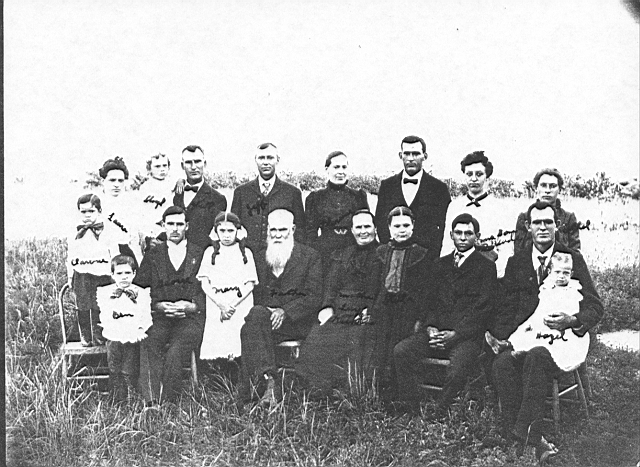
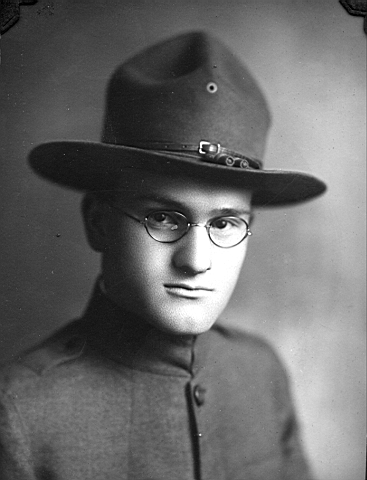
His father's people were of German descent--hard-working, thrifty and determined people are these. Oerke is a very common name in Germany and Lloyd's great-grandfather was a member of the Prussian Guard. I always thought of this when I looked at Lloyd's Army picture. To get away from military duty Grandfather Oerke and a brother came over to America while in their 'teens. The boys came over with friends who settled in Johnstown, Pennsylvania. I suppose not having a home tie, the boys became separated. At least we know nothing about one boy except that he changed the German spelling of Oerke.
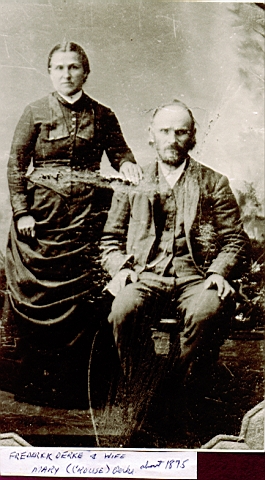
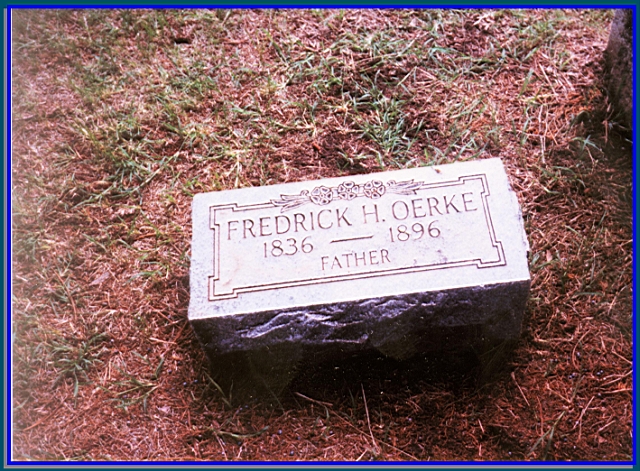
Frederick Oerke, Lloyd's grandfather, was born in 1836 in Germany and died in 1896 at Caldwell, Kansas. He had a very eventful sixty years of life as did his grandson who lived an equal number of years. I never saw Lloyd's grandfather, but I knew Grandmother Oerke.
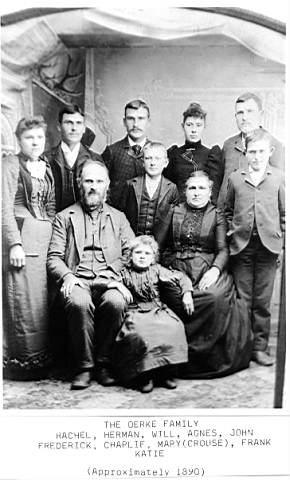
Frederick married Mary Crouse in Pennsylvania and the couple came west in a covered wagon and staked a claim near New Cambria, Kansas. They lost that claim and settled near Caldwell, Kansas, when their oldest boy John was four years old. This farm was on the Chisholm Trail; in fact, the Trail went through it. Landmarks can be seen today nearly a century later. On this farm they built an L-shaped two-story house which in time was filled with ten active children. Happiness and tragedy were found often in this home. Service in the Civil War shortened the father's life.
On one of Grandmother Oerke's visits to our home Lloyd suggested I write down some of her stories and information. I wish I had. She had retold the stories so often that I'm sure they must have been spiced with some exaggeration to hold her many listeners. She was an artist in story-telling and had a storehouse of material to draw upon. She never seemed to "run down" but one never had the feeling that she was boring or tiresome. She knew all the herb remedies, weather signs, and children's pranks. She knew the activities and the inward emotions of family and friends. Her hands were never idle and she left fancy work and quilts to prove her skill. Although she was tiny when born and would like to tell about her first cradle--a cigar box--she was tough and tireless when her family needed her most. To help with the finance she used to walk seven miles into Caldwell, do washings for others and walk back. Imagine us doing that today. She lived to be 84 years old, her husband and five children preceding her.
I never considered the family as a very closely knit one. As most families do, they separated as the children grew up. Most all of them at one time or another lived in Wichita, Kansas, except John Oerke. It was more than distance that separated them, however, for although they got together once in a while and helped each other when necessary, it was more with the idea of duty. This deep family love, that surpasses duty, was absent also in Lloyd's attitude in family affairs. Who was to blame? No one could possibly say. These are some of the threads woven into the carpet of life, we call personality.
The Long family also
came from the east. Their home was in Kentucky, and Grandfather Long, Samuel
Long, was a Colonel and a gentleman of distinction. The family owned slaves
but they were good to them, and the slaves were devoted to the Longs. Samuel
and his wife Katherine, a daughter of a shoe merchant in Louisville, decided
to go west. Two brothers, Ged Long and Geo. Maize, boarded the boat with
them, but the slaves were left behind. Or so they thought. When the boat
was several miles down the river, two slaves that the Longs had raised
from babies, were seen laboriously making their way along the bank. Again
the slaves were told that it was impossible to take them along, as much
as the Longs would have liked to do that. Such devotion was touching.
At Kansas City, then a little river town, the men bought some mules for the journey overland. Before the Longs left Kansas City, an offer was made to trade the mules for a piece of land. If the Longs had traded, they would have been the owners of the ground which is now the heart of Kansas City. Like many then, the trip west seemed more important than a piece of land on the river.
When they got to Chautauqua County in Kansas, they stopped for a while, and the men freighted from Kansas to El Reno, Oklahoma. This left Grandmother Long alone for long periods of time. A baby was born in this place and it became sick while the men were gone. A doctor must be reached. In the night with the wolves howling and the tree branches slapping her face, the young mother went for help. Snakes were everywhere among the rocks and the night sounds were terrifying. The doctor came but the baby could not be saved. For a casket, the oak boards of the floor were pulled up. When the Longs moved to Caldwell, the casket was dug up and brought there. Later two other babies were laid to rest beside this one, but other children lived to gladden the home--four boys and three girls.
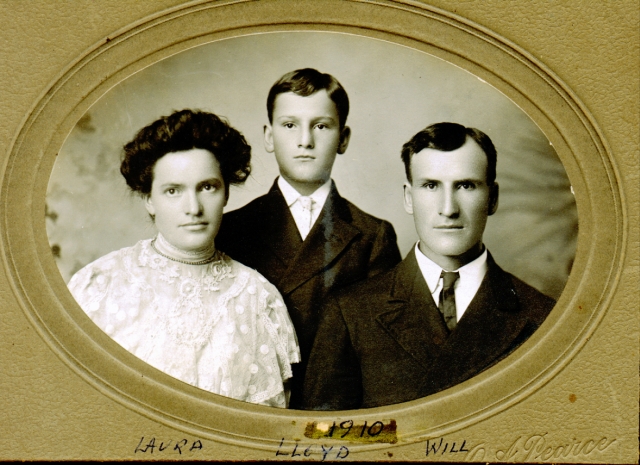
Here the Oerke and the Long families met and so started the romance of William Oerke and Laura Long.
Samuel Long was still not through pioneering. He took a claim near Kingfisher, Oklahoma, and a dugout was made and the family moved down. It was in this dugout that Lloyd's father and mother were married. The story of this is told in a later chapter. The Longs lost their claim to a Dr. Thralkill of Caldwell and they moved on, to what we know as the Shanes place, west of Kingfisher.
A word here about these ancestors--Samuel and Katherine Long.
As in the case of Grandfather Oerke, I never met Grandfather Long either. There are a lot of stories about him. He seemed to think he was too good for heavy work. He would get up at 4 in the morning to get an early start at reading. There was an old clock that stood in the parlor that he would wind every Sunday morning, company or no company, at about his rising time. As company usually had to sleep in the living-room or parlor in those days, they were awakened with his heavy walking through the room, the winding of the clock and the clearing of his throat. He was up so everyone else should be up, too.
He had skin cancer and spent lots of his time in hospitals. The family would work and save, and grandmother would have a nest-egg laid away, when he would come home Grandmother always called him "Mr. Long." He would demand all the money and when it was spent, he was off again. He really had cancer and finally had an eye removed. He had served in the Army so part of the time he spent in Army hospitals. He died at Ft. Dodge.
I remember Grandmother Long. She was a very lovely, warm person to know. Everyone else thought so, too. She was everybody's friend and that inscription is written on her tombstone.
Although the Longs had a lot of trouble and problems as most families do, they stuck together remarkably well. Perhaps all the family who have passed on are buried right there at Kingfisher. They are interested in every member of the family, even to third cousins. They have left a trail of pleasant memories along the way.
Lloyd inherited his ability and love for music from the Longs. Several in the family held prominent music positions in church choirs and schools in Oklahoma City, Ponca City and Kingfisher.
Both the Long and the Oerke families gave to Lloyd a love for farm land and farming, as a way of life. Love for animals and growing plants was a part of Lloyd's nature. The freedom and call of the wide open spaces filled his mind and heart. When the song "Don't Fence Me In" became popular, it seemed to fit his spirit.
Give me land, lots of land, under starry skies of blue,
Don't fence me in.
Let me be by myself in the evening breeze
Listen to the murmur of the cottonwood trees,
Send me off to heaven, but I ask you please
Don't fence me in.
In the first letter that I have, Laura and her family had moved from Caldwell to stake a claim near Kingfisher, Oklahoma. This separated the Oerke and Long families and so visits and letters were many and frequent.
Jan. the 14, 92
Friend Laura, I will try to write to you to let you know that I am well and have not forgot you nor the picture that I promised you which I will send I do not like it but it is as good as could be expected Rachel is agoing to have a birthday party tonight and I wish you was here We had a good time at the cotton wedding We have not had such good meetings as we had last winter I would like to see your cotton field but I would think that you have enough of it. I would like to ask you for your coraspondance and would like to hear from you soon. I believe that is all for this time
Excuse my mistakes
Ever your affection friend
Caldwell Kan
- - - - - - - - - -
Kingfisher Ok
Jan 19-1892
Mr. W. Oerke
Friend Willie I received yours of the 14th, was glad to hear from you and glad that you was well.
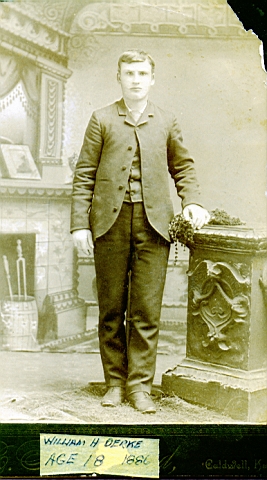
I have waited quite impatiently for your photo; you say it is not a good picture of yourself, but it will please me all the same if it is your picture.
I am sure you had a splendid time at the Cotton Wedding and at Rachel's party also. How old was she the fourteenth of January
We had meeting at our sod-school house last Saturaday night, Sunday morning and Sunday night; we have had very bad weather the past week.
Yes! I wish you could see our cotton field! the cotton is nearly all picked out now, we have picked 3150 pounds and a fraction over. I am tired of picking cotton for one year.
I am attending school; we have a literary entertainment every Thursday night and sometimes have a very nice time.
Mr. C. Ballard Dixon has been down on a week's visit and returned to Caldwell today.
I accept your proposal to correspond; shall take interest in giving all news that will interest, and shall request the same of you.
I suggest that we depart from established rule of writing on one side of the paper only, as I like to read long newsy letters.
We were all proud of your mother's visit and hope she will not make it her last one.
Father and the boys returned home Jan. 9. You may be sure we were glad to see them after so long a separation.
As I have already written a long letter I will close asking you to write as long. (Excuse my pencil as we have no ink at present and will not wait till I can go to town).
From your friend,
Laura Long.
P.S. Tell Rachel I will answer her letter presently, as I have had no time.
L.L.
- - - - - - - - - -
Jan the 28, 1892
Miss L. Long
Friend Laura, I received yours of the 19 and was glad to hear from you.
You are very good and deserve more thanks than I can give you. I was glad to know that you was pleased with the picture.
I want to tell you something about the trip that I took last Oct. to the east part of this state to attend the tenth annual state convention of the Young Men's Christian Association held at Parsons Oct. 21-25, 1891.
There was about three hundred delegates from all parts of this state and some from Oklahoma and Indian TY.
We had too misionares with us from Africa who told us how people lived there.
We had a good time and meeting every day from 6 am. till 10 p.m.
We had a misionary here from Japan who told us about the people there. he said that the girls wore red to show that they were unmarried and still in the market.
We had prayer meeting at our house last night.
The Christian church are having a good revival here now and Miss J. Smith left the M.E. church and went to them.
I suppose that you and Rachel are together now and having a good time.
I am glad that you departed from the rule of writing on the last half of the paper as I did.
Have you hard from Florence lately.
We have a good singing school here now at too of our closest school houses.
I have written all for this time, dearest Friend.
May heavens choisest blessings rest upon you.
I will bring my scribbling to a close. Excuse my mistakes.
From your Friend
William Oerke
Write soon.
Caldwell, Kan.
- - - - - - - - - -
Kingfisher, Okla.
March 29 - 92
Mr. Willie Oerke
Caldwell, Kan.
Friend Willie, I received yours of the 18--and was pleased to hear from you but sorry to hear of you being sick but hope you are better by this time.
We have had real nice weather for a day or two but last week was very bad & stormy. I was sorry of Jenny Clark's death she was such a nice little girl I thought and a good Christian too.
Lulu Mullen must come to see you pretty often or is it someone else she is coming to see? What will Lulu do when Mr. Smith's school is out?
Do you think you will get Mr. Gannawags for a preacher this year or not?
I am pleased to hear of you taking Mr Gannery's place in the Young Peoples Meeting. I know you have nice meetings at the church and how I miss them.
We have a Sabbath School organized at our sod school house now They elected Father for the Superintendent, Uncle George for the assistant, Henry for Assistant Secretary and myself for Chroster. the remainder of the officers you are not acquainted with.
I was more than pleased with your picture. It was such a good likeness of yourself. Your mustache makes you look so much better if I do say so and I guess it will not be long before I see you, at least I hope so.
I received a letter from cousin Sallie yesterday and she says they are expecting to come down this fall and buy a claim. she says Uncle Felix has not been satisfied there since Anna died. I did not once think of getting them for a neighbor again but I hope we will. All of them want to come except Sampson but he will come if he can pursuade his girl to come with him.
I will close for this time as this paper is full.
Your Friend until Death
Laura Long
- - - - - - - - - -
Kingfisher, Okla.
May 24 - 92
Mr. W. Oerke
Friend Willie, I received your letter of the 8th and was pleased to hear from you. I am enjoying the best of health at present.
We are having a real nice Sabbath school down here after all; at first we did not have very good prospects but better now I am glad to hear you have taken a class in Sabbath School.
Was sorry to hear of your preacher being gone so long but was glad to hear of the young people holding their meetings without him.
Dr. Thrailkill is building him a real nice house on his claim but we have had a sod shanty on it for nearly a month and all the folks but Johnnie and myself are living there.
I received a letter from Rachel this evening after so long a time but better late than never. I was glad to hear from her all the same if she were late in writing.
We have had bad weather this spring it has rained nearly all the time. There has been two cyclones down here lately one was three miles from us and the other one fourteen miles there was a water-spout three miles from us but didn't drowend anyone but the cyclones killed 6 people that we have heard of.
I have received the other photo you first sent, but mamma claims that she asked me to ask you if she could have it.
Katie must not forget her promise to me of one of hers and Willie W's pictures.
I will close as there is no news down here that would interest you. Write soon & often. I remain your true friend & well wisher.
Laura Long
- - - - - - - - - -
Caldwell, Kan.
Aug. the 18 - 93
Dear Friend
I received your kind and welcome letter and was pleased to hear from you as I always am.
I have attended the reunion last week and had a real nice time.
The first was old settlers day, the second and third was soldier´´s days, the fourth was Sunday School day and the fifth was preachers day so we had five days and I was there four days and had a good time.
I suppose you have had a good time at the reunion down there
I thought I would come down and see you but I was to busy cutting corn but I finished today and I am through plowing and waiting for the strip to open but I fear that it will not open for some time.
Ice-cream suppers is all the go now but the league had a water mellon supper and I wish you could have been here, we had such good mellons from Oklahoma and a good time after supper
We are having such good meetings I wish you could hear some of our preaching.
I must close for this time, from your friend,
Wm. Oerke
P.S. read carefully Acts 20:32
- - - - - - - - - -
Caldwell, Kan.
Feb. the 22 -94
Miss Laura Long
Dearest Laura I came home from the strip today and got a letter from you
I was greatly pleased as I thought you had forgotten me for neglecting you so long.
I think I have all the bad luck a going. I got on school land at the strip opening and so I stayed in the strip for a long time and did not get to write to you for so long that I was almost ashamed to write but I was very glad to hear form you and that you have not forgot me I must go to the strip agan in the morning.
I filed on a claim suposing it had been deserted but after I filed the man that staked it came back and has contested so it will be a long time until I know if I will get it but I think I will win the claim.
I have been superintendent this quarter but cannot be longer as I must stay on the claim more in the summer. I must close.
Please excuse my mistakes and neglect. it is late and my pen is bad.
Yours truly
Wm Oerke
- - - - - - - - - -
Caldwell, Kan.
May 18 - '94
Miss Laura Long
Dear Laura, I was home last Sunday and got your letter and was very glad to hear from you.
I am writing in my dugout for the first time and have just got through supper and the dishes washed, it makes me quite lat to get supper after doing a big days work.
Rachel was with me two weeks but it made to much work for mother so she went home to help at home. She said I could cook and bake better than she could.
We have had some good rains but it is getting dry now it will soon be harvest then I must go home, wheat looks good, I hope we will get a good crop for we did not rase scarcely any last year
I would like to spend the fourth with you ever so well if possible I will O yes I wish you could get your picture taken and give me one.
If I can come the fourth I will let you know
I must close it is getting and this scribbling will not interest you
Hoping to hear from you soon
Yours truly
Wm. Oerke
- - - - - - - - - -
So Will Oerke got the claim or rather half of it anyway, and we always called it the Grant Co. 80 and he gave it to Edward Oerke when he died.
Whether there were many letters written the next two years or not, I don't know. The next letter in the precious pile is dated Oct. 1 - 96 and in that two years the young people had made definite plans. Wm. Oerke fought off a call for the ministry for a while, but finally decided God really wanted him for full time service. He had little or no high school work, he was twenty-seven years old and had very little financial backing. What a decision that must have been! What a tremendous spiritual experience he must have had. He enrolled in Southwestern College at Winfield in September of 1896 and the young peoples' letters at this period were saved.
Caldwell, Kan.
Oct. 1 - 96
Mr. Oerke
Winfield, Kan.
Dear Will -- I will try to write you a letter tonight I hope you have reached your destination by this time.
Mother was in to see me today and she says Herman went with you as far as Geuda Springs I hope he will be benefited by staying there a few days. O yes those letters of Henrys I forgot them last night, you may keep them if you wish or else you may return them. How did Jessie like batching while you were away? I hope you will catch up in your studies now with out taxing your strength.
Well I am real tired tonight so much so I don't believe I will attend prayer meeting.
The second bell is just ringing and Mrs. Zimmer has gone to call on Mrs. Batten * * * *
How I wish you were here. I am so proud of my lover. And hope we will always love each other as we do now.
I love you more each time I am with you. I wish I could write such letters as yours. I enjoyed the kiss very much last night--I really enjoy being with you so much. I am looking forward with real pleasure to the time when we will always be together. I will close wishing you success in your studies. God bless and keep you.
Your little sweet heart,
Laura Long
- - - - - - - - - -
A letter written by Laura on Jan 20 - 97 has these personal remarks:
* * * * I am looking forward to the time to come for me to visit Okla. Mother says for us to come as soon as we want to. She says she will gladly give me to you and wish that Heaven's choicest blessings to rest on us. Yes you surely have a sweetheart that loves you. How proud I am of you and your love for me I am also proud of your grades but they are no better than I expected of you. * * * *
Pray for me that I may be satisfied as to my soul's salvation. I was so glad to hear of your last blessing you received & how much happier I will be when I can have you to be my earthly spiritual guide.
- - - - - - - - - -
Another letter written in Feb. of 1897 speaks of Will being sick and his mother going to Winfield to help him for a few days.
The next few letters continue to be filled with all the sweet things lovers can write one to another. Studies were proving very difficult. Batching was difficult, too, so he boarded at a club for $1.50 per week. But his heart was full and running over--
"The dear Lord was with us all day and gave me such liberty in preaching as I have never had before and I give Him the glory for it."
Also his heart was full of dreams--
"I have not been able to get a house yet. Sometimes I think I will not be able to go through school if it gets much harder. Then I do not want to buy a house I went to look at a pretty good house today with six rooms for three hundred but it will need some repairing. I do not like to go in debt."
Next letter on Oct. 31 - 1897:
"I have been getting along better this week, but I think I will drop Latin. I have bought a house and paid for it and I shall begin to fix it tomorrow. I think it will make a nice little home."
On Nov. 12 - 1897:
"I moved into my house Monday. I had one room plastered & one papered It is not as good as I would like to have but I did not want to go in debt. It has cost me now about $150. It is built in a L-shape and has a porch facing the street."
The house still stands in Winfield and I don't suppose it could be bought for $5,000 now. Of course much work has been done on it but I think he did very good indeed in finding such a house close to the college and at such a price.
On Nov. 25th, 1897, Will wrote to Laura:
"I will be down Saturaday the 18th as far as I know now. I received my suit of clothes today. They are a little to large but I will not send them back it would take too long."
On Dec. 1 - 1897:
"It is not quite two weeks until the 18th and then it will be the 22nd."
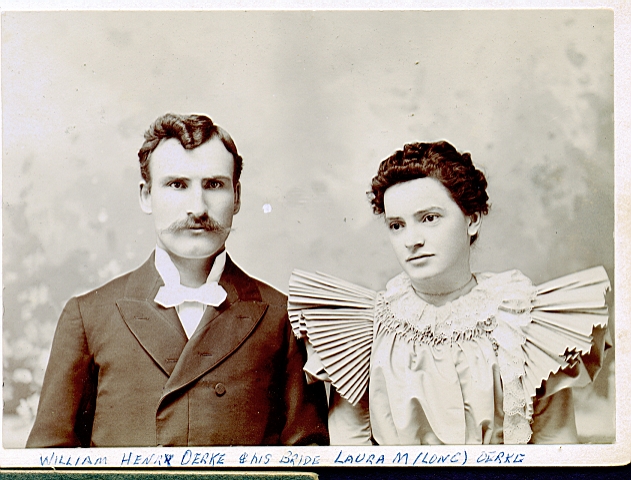
And on the 22nd of December, 18997, they were married in the little sod house northeast of Kingfisher. It makes little difference whether the place is a sod house or a palace where two lovers meet to exchange marriage vows--that place is a little bit of heaven.
The young couple returned to Winfield and Will continued his school work. He didn't drop Latin as he was tempted to do and his grades were good.
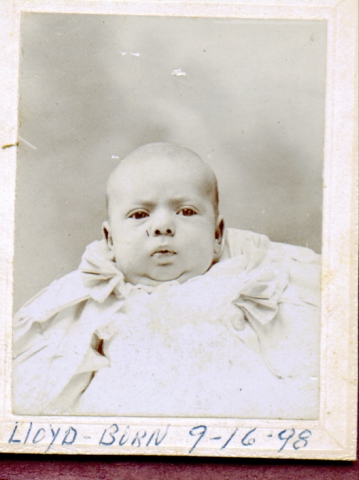
In the next school year Lloyd was born--Sept. 19, 1898--and he was their pride and joy. He was baptized on Feb. 8, 1904, by a Presiding Elder E. S. Stockwell. I presume this occurred at the first pastorate of Will. Will graduated in 1901 with the Academic Class of eleven pupils.
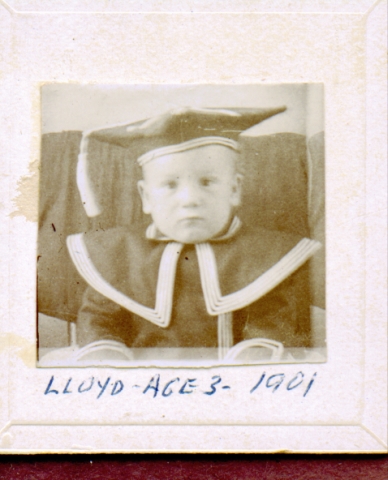
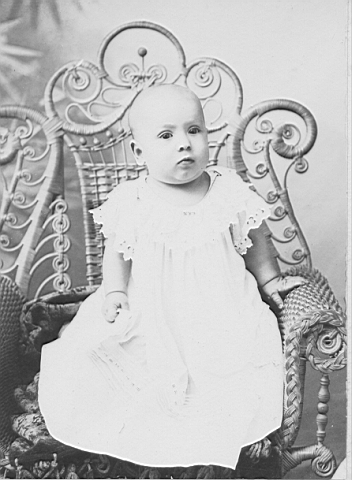
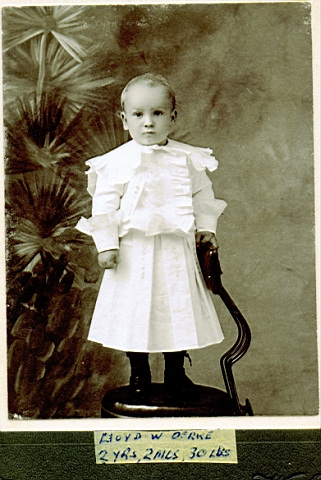
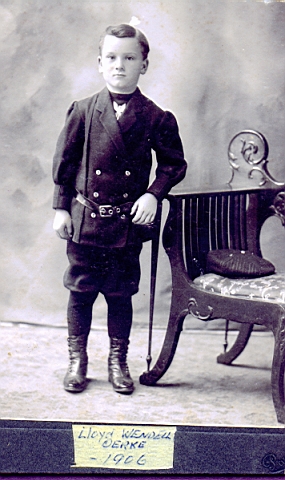
Lloyd's parents had pictures made of him often, and by the pictures I am endeavoring to trace this young minister family. I have pictures of Lloyd when he was 8 months old, 2 years old, and 3 years old, and these were all taken by a Winfield studio. So Will must have taken a year of college work after his academic work.
The first charge or circuit was Blackburn and Skeedee towns east of Pawnee, Okla. As Will could hardly carry a tune, Laura led the singing. She would stand up front with Lloyd beside her. He remembered how big he felt, but he also remembered how still he had to sit and how good he had to be
They were sent to Renfrow, and then to Skeedee and Blackburn.
From Skeedee and Blackburn circuit, they were sent to Kremlin, Okla., a town just north of Enid. Here they worked hard--built a new church building and I have been told by an acquaintance, they were the most spiritual people that ever worked there. I have three relics of those days. One a bookcase and writing desk combination that could be moved easily, and a set of Bible Commentaries in a two shelf box that could be boarded over for moving; a glass paper weight containing the picture of the pastor of Kremlin Methodist Church, Rev. Will Oerke, and the new church.
Lloyd's mother wasn't strong and the strenuous life was too much for her. That fact and either a misunderstanding or a planned injustice by a Presiding Elder, made Will decide to quit the ministry. It seemed that they found out that Will had some land, and because of that, the salary was cut or a deserved advancement was refused.
Lloyd started to grade school in Kremlin. In one grade he was the only boy and the girls were punished by having to sit with him. The punishment was his instead, and it created a desire in Lloyd to skip female companionship whenever possible. The favorite pastime was hitting a bent-up can with a stick.
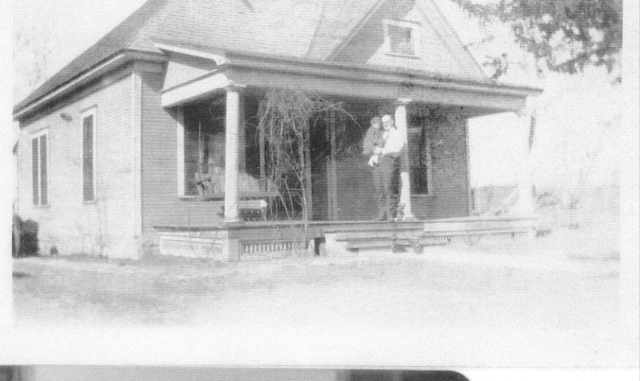
In 1909 the family moved to Caldwell. Will built a house at St. Marys Street that was a home of their dreams. Hearing his father talk so much about it, Lloyd rented the house about 20 years later, when we moved to Caldwell from Kansas City. Here Lloyd and his cousin Leo Oerke attended school together in the same grade.
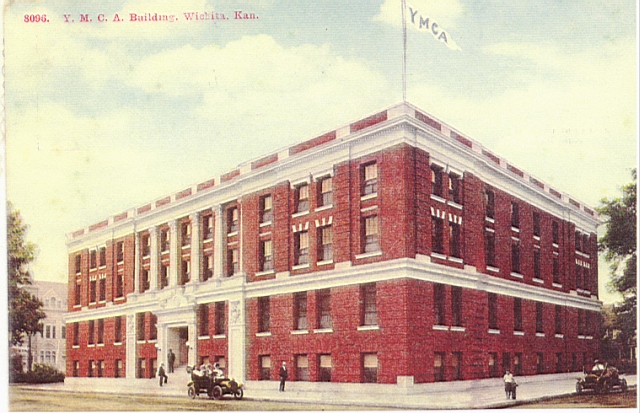
In 1910 they moved to 902 N. Waco St. at Wichita, Kans. I think they traded the house at Caldwell for a farm. In Wichita Will was night desk clerk at the Y.M.C.A. and also worked on Sundays, for the big sum of $10 a month. On this meager sum, they had to live very economically. Lloyd talked often of shopping for 5-cent soup bones, stale bread, broken crackers. Laura continued to get worse so it didn't make a very happy home life for a boy. Father was either asleep or mother must have no noise. Two rooms of their home left their impression on Lloyd.
Lloyd became a great reader of the Alger books, so popular at that time--the poor, good boy became famous. It no doubt left him with the idea that his time would surely come some day for wealth or fame.
However, it would never come by a skating rink. Under his bed was stored the roller skate equipment of an uncle Herman, and also a player piano was stuck in a corner. This Herman Oerke had lost all his money in this venture. This fact was drilled and drilled into the boy so strongly that Lloyd had a horror of skating rinks all his life.
The other room was the parlor. It was indeed a parlor for very special times only. It was closed up and unheated. In this room he had to practice his piano lessons. He didn't like his teacher either. In spite of this, he learned to play and found a great deal of satisfaction and enjoyment all his life in music. He was not expert on the piano but did quite well. The Flower Song was a specialty of his. One time at the Methodist Church at Amsterdam (when he was over 50) he motioned to the pianist to slip over at the time for the offertory and he played the Flower Song for that Everyone was dumbfounded for they didn't know he could play at all. He got a bang out of that, but never tried it again.
Another boyhood experience of lasting effect was the purchase of a bicycle. He purchased it at Sears, Roebuck & Co. One tire went bad and he returned the tire. they sent a new one without so much as a question and even paid the postage on the old one that was returned. I'm sure all the children in our family knew of his allegiance to mail order houses. This was the beginning.
Vacation time meant Kingfisher. That jolly group of uncles and aunts and cousins really put life and action into living. An uncle Jeff Mayfield had the fastest racing horses in the country and he met Lloyd and his mother at the station. Flying down the dusty road in the buggy was thrilling to a boy, but the ride most generally would put Laura in bed for a while.
When they arrived, grandmother Long would feed them well and he always spoke of her as the grandmother who made him custard pies. Everyone had a job to do and Lloyd's was bringing in corn cobs for the stove, and churning butter. That is, everyone except grandpa Long. He got everyone up at four so he could get an early start in reading.
The whole group was musical and they had some wonderful song fests. Not one had taken a lesson, but Oh, the music that came from those fiddles, and the younger children as they got older held prominent positions in music circles.
All was not roses on these vacations, for Lloyd was a city boy, a babied child, and a natural backward one. He had to wear curls until he was quite large, then he was dressed in "girlish" clothes. The cousins wore overalls and could get as dirty as they wished. His parents would wash his ears, cut up his meal at the table, and put on his hat and coat. This would embarrass Lloyd, but being the only child, he was obedient to his parents' every wish, till he married.
During the school year Lloyd's friends were Schuyler Jones and Edward Rockwell. When these two came down to Caldwell to visit us before our Edward was born, we promised that if the expected baby was a boy, we would name him after them. Schuyler Jones' folks were well off and lived in a big house close by. Edward's folks were not to wealthy, but the three boys had wonderful times together. They worked together in Scout work and each tried to do what the other could do. The mothers would sometimes exchange ideas. About that time a boy wore knickers or knee length pants till he got to a certain age. When the boys began asking their mothers for long pants, each mother would say: "All right, when the other two boys started to wear long pants." Since the mothers had agreed that each wanted to put off that change as long as she could, the boys had to really do some team work of their own.
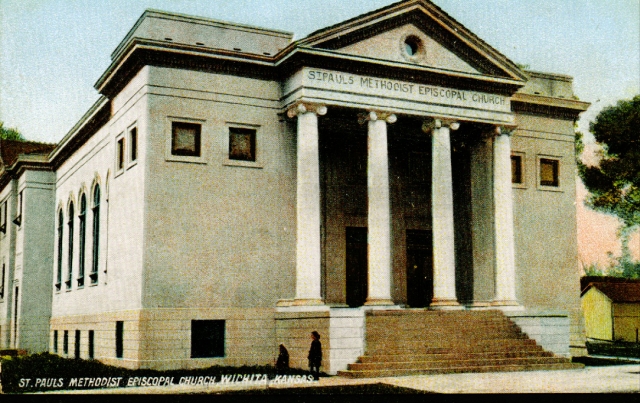
The Oerke family joined the St. Paul's Methodist Church at 13th and Broadway when they moved to Wichita. My family also attended the same church and that was how Lloyd and I finally met. The Sunday School gave pins for perfect attendance. Lloyd got a five-year pin and I a one-year, but we never met. Our grade schools were different, for he attended Park School and I Irving School, and we lived miles apart.
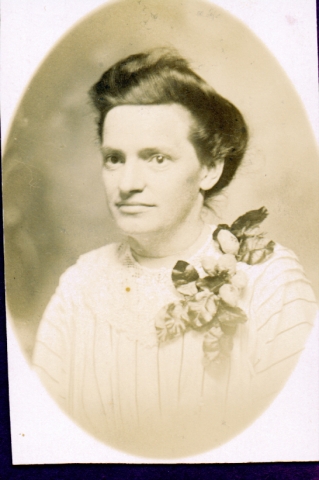
I never met his mother as she died about the time we started dating, but I felt I knew her through all the articles she left that gave me an insight into her character. She collected poems and pasted them into scrapbooks. She did beautiful wood carving and I have some pieces of her work. She was thrifty, saving so carefully ribbons, lace, dishes or anything a little special. She collected stamps and coins. She never thought much about pretty clothes. Lloyd remembers her as wearing a white blouse and black skirt, day after day. She was quite a home body and joined few organizations, perhaps partly because of her health. She was very devoted to her family. A letter written March 25, 1913, just three years before she died, shows the continued devotion of the couple.
"My Dear Darling Husband,
I am so lonely without you dear and my heart is aching for you. I feel as though I am lost without you and am almost a widow indeed. You don't really know how much I love you, darling, and hope you will soon be home again. This being away from each other, is not the desire of our hearts and life is too short to endure much of this, dear. You are my all and I know that you are not enjoying this cross any more than I am. You and I are both too much lovers of home and I know you will come back to me as soon as you have your work arranged so you can. Love and kisses for you sweetheart, and come when you can.
Your dear wife,
Lloyd's high school days were busy, but I don't know that he ever considered them to be happy ones. He had few hours of relaxation and time, to just do as he wished. Perhaps what he wished was to earn money, and if that was what he enjoyed most, maybe his school days were not so unhappy after all. His home was at 903 N. Waco, a distance of about two miles from Wichita's one and only high school in 1916 located at Third and Emporia. A bicycle was used for transportation and this was fine, only it gave Lloyd little opportunity of mixing with other young people. After the close of a school day, he would rush home on his bicycle, grab a bit to eat, and spend the evening on various jobs.
Murphy's Five-and-Ten Cent Store had delivery service for any order over two dollars and this took him over all parts of the city. Perhaps the appealing thing of this contact with Mr. Murphy was their mutual delight of treats in the warehouse. Whenever a barrel of hot salted peanuts arrived, what a thrill it was to grab a handful, or when a carton of candy was opened, to fill pockets with these goodies. This was never done on the sly for both the man and the boy were fully aware of the actions of the other. Lloyd worked after school and on Saturdays, and for this time spent, he received the sum of two dollars a week. The fact that he had the upkeep of his bicycle to pay seemed a trifle, when he could jingle money in one pocket and munch free candy and peanuts from the other. His ambition in those days was to own and operate a "5-and-10." Mr. Murphy was a Catholic by faith, and such was Lloyd's admiration of the man, that he often defended the Catholic Church and its people with ardor.
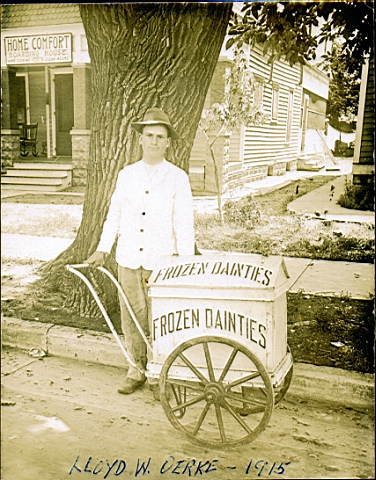
He was messenger boy for a bank and walked the streets with bags of currency and valuable papers, little thinking of danger. He set up type for a print shop and delivered these papers, besides folding and delivering papers on a regular route. During the summer he pushed a Dainty wagon up and down the streets south of Douglas Avenue. The Dainties were little cylinders about two inches long and an inch in diameter, of flavored milk ice, and each sold for a penny. Never was a sale very large, so I doubt if he made much more than enough to buy shoe leather. His father took over the route on Sunday morning while Lloyd attended Sunday School. He not only earned money, he saved it, and by the time he was ready to get married, a tidy sum was under his name at the bank.
Instead of eating and mingling with other students in the cafeteria during the noon hour, he made his way to a chili shop where a large bowl of chili was sold for ten cents and there was no limit on crackers. Nor did he ever change his menu during the four years of noonday lunches. Of course he got tired of chili and crackers, for he loved to eat as much as any other boy of that age. A dollar saved was a dollar earned, and there were so many wonderful things to be bought with dollars. He always took care of the pennies for the dollars would take care of themselves.
As far as studies were concerned, Latin was a dreadful demon and English was not much better. Both studies were required. To conjugate a verb in Latin was a difficult as to put poetry in simple words. To translate Latin was equal to translating Shakespeare. Mathematics were fine as long as they stayed on numerals instead of the elusive x's and y's. Psychology discussions were batted around by the class leaders and others sat around with blank stares, hoping the leaders would just keep on batting. The studies that filled the grade card with A's were those of a practical nature. He enjoyed the penmanship class, the print shop and especially the woodworking hours. Mission furniture was popular at this time and Lloyd created his own design of table and bench and, although it was the most difficult project of any member of the class, it was finished with honor. So sturdy was it built, that it survived all the moves it was due to take, and will no doubt be a well-preserved antique hundreds of years hence. Perhaps if Lloyd had had more time and more favorable surroundings, his attitude might have been different toward scholastic goals. Studying was done late at night after finishing his after-school work, or early in the morning. It was all work and no play. He graduated in 1916.
Although we attended the same high school and were just half a year apart in class standing, Lloyd and I didn't know each other then. We didn't meet at extra-curricular activities either, as Lloyd was busy with his work and I was taking care of my invalid mother.
Chapter 6 .- The Decisive
Years
Much has been said about, and to, the young people graduating from high school. Just where in this wide, wide world are they going to find their own little world? How are they going to react, adjust and conquer? They must make their own decisions, solve their own problems, learn to take both life's joys and life's sorrows. It is a necessary part of growing up.
Lloyd's first head-on bout with life was caused by the death of his mother. As is most generally the case, the home was broken up. Not only that, but it seemed that his father could not reconcile himself to the loss. Lloyd's mother had been ill for many years but one is never willing to give up hope. This is as it should be, but perhaps when one fights off death for a loved one, and then death finally comes, he is drained of courage, hope and perspective. Lloyd's mother was only forty years old when she died and the Oerke stone in the Kingfisher Cemetery is carved to signify a life unfinished. Lloyd's father cried, moaned, and sat around with his head in his hands. Thinking a change of residence might be best, the two men, father and son, went down to Kingfisher and lived on the Makepeace Place, as it was always called. They bought a herd of mules at Dover and drove them to Kingfisher. In the sales ring a gentle mule was used to show the others, and not until they were miles away did they know how very, very important that one mule was to the group. In fact it was the only mule that was not an outlaw, and the only way to handle any situation was to use old Maud as a lead.
Hardship after hardship was met. The men lived on pancakes and eggs. Buttermilk was plentiful and cakes were cheap and satisfying. Evenings were spent in grieving. There was only a coal-oil lamp to brighten the bare rooms and this was no incentive for reading. Finally Lloyd persuaded his father to sell the mules and all the items Lloyd's mother had bought at sales and saved. There were dozens of cooking utensils, brand new, that were the main attraction of the sale. It was a relief when the last of those pesky mules was gone.
Back in Wichita, Lloyd's father returned to his work at the Y.M.C.A. and it also became their home. Lloyd took a course in automobile mechanics but he wasn't too happy with that work. Neither was his father, for he wanted the best for Lloyd as any father does for his son.
A banker was a regular visitor at the Y.M.C.A. and the two men made arrangements for Lloyd to start to work at the bank.
I wish I could say just when I first became aware of the young man who was to be my husband, but I must have been his girl for a long time. He helped with a Sunday afternoon church group which I was trying to supervise, for the sole idea of being near me. If I had known this, perhaps I would have had my mind more on him than on my work. He pointed me out to his visiting uncle Lee Shaner one Sunday morning, and the only comment that was relayed to me later was: "Lloyd, those big brown eyes could really snap if she got mad at you." I admit they did, too, whenever we didn't see eye-to-eye on a subject. Maybe I wouldn't say anything, but my eyes would tell plenty. He also made a statement, much to the amazement of his friends who always considered him shy, that he was going to break up that group of girls who always sat together. I was very popular at that time and was a leader in all the church activities, but I had not always been so vivacious. In fact, I had been so shy myself, that mother had forced me to mingle with groups. They told me later that many a time they were tempted to throw a pillow at me, to see if I would move or talk This backwardness held true throughout both of our lives in certain places and under certain situations. What might bother me might not affect Lloyd at all, and vice versa, but it gave us a mutual understanding of the other's problem.
I went off to college, the Kansas Wesleyan at Salina, to finish the last half of my senior year with some first year college courses. Returning home in the spring of 1918 I immediately had a suitor. Our courtship was not without problems on both sides. My mind was filled with college ideas, college personalities, and college-sized ambitions. It had been one of the most wonderful years of my life. The only heartache had been an unrequited love for a young man who was to be an outstanding preacher in California. Not that he offered anything but friendship, for it was well known that he had a sweetheart in his home town, and certain plans. Nevertheless this clouded my thinking and, combined with the firm determination I had to be a missionary, Lloyd's attention was taken lightly. I didn't care for picture shows, dances or sports. The young people's group provided recreation in the form of wienie roasts, swims, picnics, parties and get-togethers.
To offer me something different and to be able to get me alone, Lloyd bought a canoe, a lovely dark red with a white band around the top. Here he could focus all my attention on his art of paddling and I could only sit and try to look beautiful and entertain only him. Quite a clever move on his part, wouldn't you say? Well, if a campaign proves its worth by its success, this strategy worked. None of the other couples had canoes and it was a new experience for me. We were going steady. "Going steady" in those days didn't mean the same as it does today. Much more serious intentions were involved and the next step was thought to be an engagement. We did not "play the field," as they say today.
To offset my college crush, Lloyd went with one other girl and that was all of our looking around. It didn't worry me for I thought I should not get too serious anyway and I was beginning to think about going back to college the next year. I decided that when he called for a date, I would tell him that I was through with him and he'd better find someone else. He knocked at the door and I opened it. He stepped in with one of his big smiles and full of confidence, handed me a box of chocolate-covered cherries and his photograph. I just couldn't let him down. He and a fortune teller had decided I was the one. I don't know how he came to have his fortune told. It seems some of his relatives were going into the tent and he did also. Anyway, the fortune teller told him about the two women in his life, described us both and advised him that the dark-haired girl, which was I, would make him the best wife. Also, she said that he would have either two or six children, she couldn't tell which. Later when we were expecting our third, we thought of her comment. It would be useless to defy nature and the fortune teller, so we settled down to the indisputable fact that we would have six.
Going back to the canoe and its power, we progressed rather rapidly in our understanding of each other's character and personality. This was replaced with affection and love. Lloyd could paddle a while, then find a quiet spot to part near the bank and slip down beside me. Who could resist the soft moonlight of a summer night, the musical swish of the branches overhead, the lapping water on the sides of the canoe, the nearness of a lover speaking those things which only a lover can speak?
What fools we mortals can be!! Why do we set the stage and then seem to be surprised at the result? I knew what was coming and yet deprived Lloyd of the biggest thrill of a lifetime. Instead of returning his proposal with all the warmth and surrender which a man so rightly looks for and deserves, I had to think it over. It was not just a matter of being coy. When the crucial moment came, I just couldn't without a struggle, give up my desire for full-time Christian service. All through our married life it has been an invisible barrier. We both tried to break it down; he, by cooperating in all kinds of church activities with me or urginig me to go and take part, and I, by giving my last ounce of love and strength into the maintaining of a happy and successful marriage. It was not a perfect marriage, but I believe we made it far above the average. It takes a heap of living to make a house a home.
How did we spend our engagement time? Loving, hoping, planning as most lovers do. However, the world was in turmoil at the time and war was raging overseas. We were knitting khaki sweaters, buying Liberty Bonds, singing "Over There," and living as simply as we could. I guess it was the spirit of the time, for I don't remember receiving any flowers, any outstanding presents or such from my sweetheart. He had a closed watch that had a perfect place inside for someone's picture to be pasted. I remember taking the watch home, tenderly putting in my picture and keeping it under my pillow at night--a little bit of my lover with me till I saw him again. I tried to get him to stay for meals and be one of the family, but he always refused. He said as a boy his parents forbid him to eat at other's homes, and he never did. But there was more to it than that. As a very little boy he resented deeply having to be entertained as one of the preacher's family. He considered it a "had-to" invitation for the poor preacher and it crushed his self-respect. Also since his mother was ill and couldn't return any of the kindnesses of neighbors and relatives, it was a one-sided deal. He had lived off of others too often.
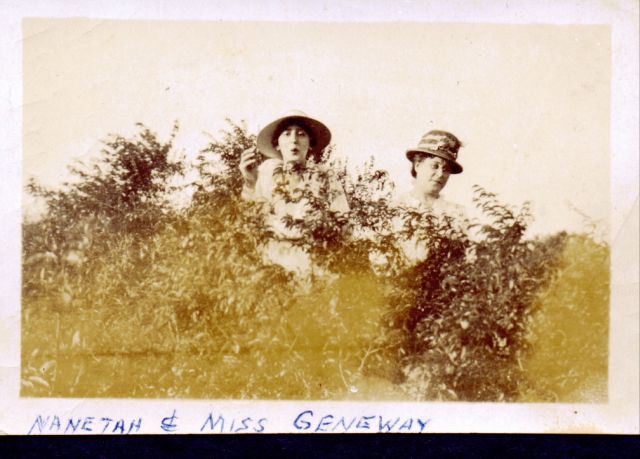
We spent some time with the piano and playing Polyanna, but mostly we rode, and I learned that the chief amusement of the Oerkes was driving and talking farms. Lloyd's father had begun going with a very lovely lady whose name was Miss. Geneways. She and I enjoyed each other's company, so we double dated quite a lot. Those rides I will always remember. I was raised in the city and knew nothing about farm land and farm interests, and cared less. This talk was Will Oerke's hobby and he was at his best when discussing land. Each farm we passed was analyzed and appraised, was legally described and the history given. No doubt this made an impression on his lady friend, as she was interested in farms also, but to me it was boring, to say the least.
Once in a while I would come alive and exclaim with zest on some wild flowers or a shaded creek, only to be told what a pest those beautiful flowers were and how the creek spoiled the cultivated acres of land. Much information, however, was absorbed as school work is absorbed by many a resisting boy and girl. I loved going places and we made trips all around Wichita for fifty miles. One trip I always enjoyed was the long ride to Caldwell to visit the John Oerke family.
We were especially fond of the whole family. There were two girls and two boys, and we decided that number would be ideal for our family. Bess and Marie were both artists. On the walls of their home hung beautiful paintings that the girls had made. I had never known anyone who could paint and this put them in a class all their own. Besides pictures, they painted china. Bess started a set for us when we were married. I have added to it and it will pass on to our children. Leo and Lloyd were practically the same age. These four--Bess, Marie, Leo and Lloyd--once took a trip in the old Model T Ford to Oklahoma. This doesn't sound very exciting now, but they had to ford streams, climb hills, eat dust, and experience all those things which are fun when they can be told in later years.
Oh, the meals that were served in the John Oerke home! My first introduction to Baked Alaska was in their home. Even today this dessert is rare. Bess Oerke's talents and interests led her into the Home Economics field as teacher, writer, and an authority on food and clothes.
They had a big house and used all of it. They each had a car and that was something in those days; but it wasn't the house or cars or food that made the visit so pleasant. We felt so comfortable with them, almost as if we were part of the immediate family. They were always kind to Lloyd's family, and we were with them more than any other Oerke family.
Then the drive home was long but never long enough. It was so nice to be alone--just us two. There were so many things to talk about, but lovers don't need to speak words to communicate. When Lloyd finally delivered me safely at my home, it was the end of a perfect day.
- - - - - - - - - -
In 1918 the First World War began to take all eligible young men into service and Lloyd's turn was due. After exploring all fields open, it was decided that the Reserve Officers' Training Corps at Fairmount College--now Wichita University--was offering the most and Lloyd would be close. This was the beginning of military training in colleges. I also decided to attend Fairmount that year and the reason is not hard to surmise.
It was the history-making year of the flu. Hundreds died of the disease, and it hit our soldier boys especially hard. When Lloyd took it, he was sent along with the others to an old building near the stock yards that was converted into an emergency hospital. His father acted as a male nurse so he could be near Lloyd; but help was very scarce--one to every forty or fifty cases--and it was impossible to do what needed to be done. Lloyd's fever raged high for many days, and his nose was plugged up to keep him from bleeding to death. He was given up and put with the worst cases, many already dead, but it would take hours to get them moved out.
When I finally was allowed to visit Lloyd, I didn't know him. He walked down some steps toward me, a pale, thin, unshaven man, and only when he stopped in front of me and smiled, did I know it was my Lloyd. From that sickness he never fully recovered, for he had scalp trouble all his life and the high fever of many days killed the roots of the hair. Many accused me of pulling it out, but honestly, I didn't.
Just as soon as the boys could walk, they were sent back to the barracks. I don't know why, but Lloyd told of that first day back and how they had to march double time and, weak as they were, they were sent a long distance to carry back straw for their own beds. It all sounds more like the concentration camps of today, but war was anew to us then and the country wasn't geared to meet the demands. It surely would soon be over--and it was on Nov. 11, 1918, when the Armistice was signed. Lloyd was discharged after only 48 days of service. He went back to his bank, and I quit to prepare for our wedding.
Most girls in my day had a hope chest into which went precious handwork. Every piece must be embroidered, edged with lace and tied with ribbons. A girl started her hope chest as soon as she could sew, and by the time she was ready to get married many, many hours of labor had been given. My hope chest was not as large as some, but it was very nice and, one by one, I added my wedding outfit to this treasure. Lloyd got me a position as telephone operator in the same bank at which he was working, so I could get all I wanted. The date was set, but we were to have more trouble before we used this hope chest, for to use it we never did. My folks decided to move over to Sallyards, Kansas, and join my uncle in an oil well project and we hurdled that interference by having the wedding invitations made for Sallyards.
Our furniture was loaded into a commercial transit moving van and we waved it on its way. Near El Dorado, Kansas, it took fire and burned, and nothing was salvaged. My mother cried over her furniture, her pictures and her clothes. My little sister cried because she had lost her pretty new doll. I cried because I had lost my hope chest.
In all the confusion that followed the loss of our personal possessions, even a small home wedding was impossible. It was suggested that we postpone the wedding, but I wouldn't go along with that. A hope chest was nice but not necessary, and the girls had given me a shower to help replace a few things.
Lloyd also went ahead with plans which were very elaborate for the year they were made. A request was made to the local car dealer to arrange delivery of a new car at the factory in Detroit. The dealer said it just wasn't done, but since this was final wish of a young man about to be led into the bonds of matrimony, he would do his best. On the night of the shower, Lloyd was all smiles and very excited as he called to take me to my room in a friend's home. In his hand he had a letter granting his request and the necessary papers for the car. You can imagine the excitement that prevailed among the girls as I spread the news. Such a trip was unheard of in those days of open cars, dirt roads and unmarked highways.
Somebody said it couldn't be done
But he, with a chuckle, replied
Maybe it couldn't, but he wouldn't be one
To give up until he tried.
So he buckled right in with a bit of a grin
And put his whole soul and body in it,
And tackled the job that couldn't be done
And low and behold! he did it.
The above poem is so typical of Lloyd's endeavors. He was not out of line in his thinking, but ahead of his time. That's why I call him a non-conformist. When most people were planting shrubs, he started a ten-row wide shelter belt, and many said he was silly. When most houses were bungalows or full two stories, he was enthused about split-level houses which were an oddity when he was a boy. He had the only little car in his town many years before the popular demand for foreign cars. He thought used brick were mellow and beautiful, when they were considered discards; and now they bring a premium price on the market. He did his own thinking.
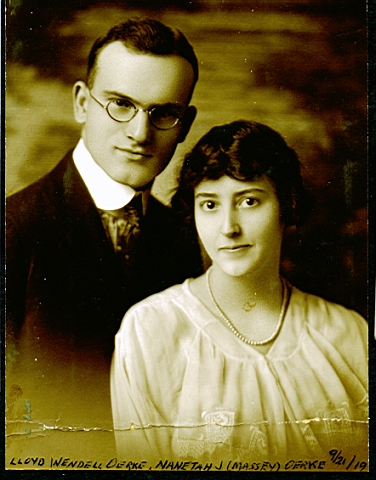
Our wedding was very, very simple, more from necessity than planning. We were attending the St. Paul's Methodist Church at the corner of 13th and Broadway (Lawrence in those days) in Wichita. The pastor was Rev. Jesse Roland Caffyn and the parsonage was at 13___ North Topeka Sunday morning at eight o'clock on September 21, 1919, the marriage vows were exchanged, and the "I do's" spoken in the parsonage living room. Only the immediate families and Miss Geneways were present. There were no flowers, not even a corsage, and no music to add beauty to the service. I wore a navy blue suit trimmed with black braid, and I don't remember what I had on my head. Lloyd also had on a blue serge suit and as we stood before the minister there was no evidence of the wedding traditions except that I had "something old and something new, something borrowed and something blue." My wedding ring was a cluster solitaire of seven small diamonds instead of the traditional band; but my two diamond rings meant conquest and possession, love and companionship, the rainbow and the pot of gold. The mountings have been changed several times, small diamonds have been added to each side of the engagement diamond, and the cluster has been broken up and put around a band, but the stones are there as a permanent reminder of Lloyd and his love for me.
After a wedding breakfast in the Fred Harvey Dining-room of the Union Station, we boarded the train, trying to look as nonchalant as though nothing special had happened. The stars in our eyes and the caresses of our hands made many look twice at us. It was ill-mannered to show affection in public and too precious, private and sacred to cheapen by display. There is a section of our lives which is ours and ours alone, and neither spoken word nor printed page will be able to penetrate into this realm.
We changed trains at Kansas City and walked over the bridge that spans the tracks while waiting for departure time. Little did we know of our future and the many days Lloyd would spend as mail clerk in this locality. We changed trains again at Chicago and made use of the stopover by riding the elevated and so now we can say, I remember when---
The upper berth which we had to Detroit was a little uncomfortable and crowded, but who were we to complain?
Arriving at last at the factory of the Oakland cars, we had a little trouble getting our business transacted, as it was an unusual arrangement. You can imagine the joy in our hearts as we piled our luggage in our own shiny new car and headed home. The car had to be driven slowly the first five hundred miles and, as a car radio was unheard of in those days, we sang and talked and planned as we rode along. On a post card which we sent home are these words:
It was a lovely honeymoon; not perfect as they are pictured to be, but very nice. I realized for the first time Lloyd's unswerving adherence to certain principles. I felt on a honeymoon we might splurge a little, but even our first breakfast on the way home was a cause of mental disturbance. We had a room in a rather semi-private home and were asked if we would like breakfast. Lloyd said we would, and the next morning we sat down to a table loaded with all kinds of fresh fruit, breakfast goodies, and gleaming silver on snow white linen. The motherly service we were given warmed our hearts and everything was rosy till we paid the bill. It was the enormous sum of seventy-five cents each which was about three times the amount of the usual breakfast in those days. Lloyd fussed and fumed for hours and I sort of froze inside. I suppose I should have gone along with his attitude, but to me it seemed such a little thing to mar our happiness and fun.
We stopped at Trenton, Mo., to visit a cousin of mine, and at Kansas City to visit an aunt and uncle. Here again a basic principle was involved. With Lloyd's people an open-arm welcome was always there, no matter the time of day or night a relative arrived, and no matter what business was on schedule. However, my family was more formal and one didn't just drop in, bag and baggage. This Lloyd insisted on doing, and I didn't want to discredit my family by not going along with his idea of what a family should be. Of course, they were gracious enough to see that we were entertained, but I was conscious of a breach of etiquette several times. This is hard on a bride who wants her new husband to be the essence of perfection in the eyes of everyone.
When we got to our home at 21st and Cleveland, we were ready to take up the daily routine of living. Had Lloyd endeavored to carry me across the threshold, which he didn't, he would have dropped me in the shock that we both experienced. We had left our home in perfect order with the idea that we would step into our love nest on our return and rest a day before Lloyd started back to work. But what we saw when we opened the door made us dismiss nay thought of relaxation. The dining table had been turned over and nailed to the floor, the piano was over on its back, and everything was in utter confusion. We never quite got the straight story on this as our friends at the church admitted they had been out and mussed things up a bit, but no one would admit to the terrible destructive acts. They were of the opinion that some neighborhood boys had turned over the piano and nailed down the table. Even to this day this fracas is talked about with shaking heads and unbelief among the group. Never has there been a closer knit group of young people, especially when one considers the fact that the parents were strangers to one another. There was nothing to bind and hold the group together except the interest in St. Paul's Church and the love they had for each other. In spite of marriages, moving, and business obligations, the group, or at least part of the group, got together every few years to exchange experiences.
A few weeks after we were home from our trip, this group surprised us with a party, gifts and congratulations. Neither punishment nor praise would alter our friendship.
Lloyd was a very affectionate husband, never tiring of love-making. I felt all the loneliness and frustrations of his youth were now finding expression in his new-found companionship. At last he had someone to share his joys and his sorrows.
Chapter 8.- Early Years
of Marriage
The first year of marriage is often a time of extreme joy and bewilderment. The romantic love of courtship is sprinkled generously with the arduous task of actual living. Adjustment must be made to each other's peculiarities which are not noticed, or at least minimized, before.
I had my meals carefully planned to live within the monthly salary of one hundred dollars, when one day here comes in my handsome husband and provider, with a 100 lb. sack of pinto beans, 25 cans of roast beef, and other edibles. These were bargains from the Army Surplus, but now what could two people do with a hundred pounds of dried beans!! He admitted he didn't know they expanded in cooking, but he thought they would keep well. Beans had never been a favorite food of mine, but I learned then, as I had to do all my life, to adjust my cooking to his purchases. These buying sprees never failed to amaze and perplex me. He was a good provider; the "good" should be in large capital letters.
Lloyd's father was set on Lloyd being a banker and it seemed a good idea to me. I thought of a banker as a man who worked short hours, wore clean clothes, held the respect of the community, and lived in one of the best homes in that community. Lloyd seemed to be excellent in figures, quick and smart in handling deals, and he just looked like a banker to me. Lloyd's father and I decided Lloyd was to work in a bank and Lloyd just went along with the suggestions. That was the trouble; we, not he, made the decision.
There was opportunity for advancement and when Lloyd was offered the job as Assistant Cashier of a small bank in the new oil town of Elbing, Kansas, we were all delighted. The fact that we could find nothing but a two-room shack to live in made no difference. Lloyd was on his way to the top. We purchased bank books and spent the evenings studying. Yes, that's right--we studied. At first I let him do it alone until I found out he was asleep back of his books. Maybe he needed a boost, so I read aloud to him and tried to understand what I was reading. He went to sleep on this. I began to talk about the lessons and how interesting they were, but he called them the driest writing published. My dreams of a big banker vanished. Oh, well, he didn't have to be a big one, just a small one. We made numerous trips to Caldwell, Wichita and Sallyards. No car could pass us on the road and I felt like a queen with my car and my husband and the world was our kingdom. We moved into a larger house, three rooms. The banker often invited us into his home. I had begun making baby clothes and dreaming about how I would fix up the baby's room--when fate stepped in.
The first blow stunned me, the second laid me flat, mentally speaking. Lloyd was rather late coming home from his work one evening and I was watching for him, when a dilapidated old Ford drove up to the house. In a moment Lloyd climbed out of it and happily made his way to the house. I couldn't have been an accident, for he was too cheerful. His joy came from the fact that in his pocket he had more money than he had paid for our car, and he still had a means of transportation. How could he? That car was almost as dear to me as my wedding ring. It had given us luxurious, happy and romantic months of service. It was a sort of symbol of all the good years we expected ahead of us. Sentiment would never enter into a good trade, and he often said he would sell anything he owned but his wife. A car was just a car and he would trade this old Ford in on another, which he did; but we never owned a car that meant as much to me as our first Oakland.
Shortly after this came the collapse of my remaining bit of pride. My dream of Lloyd being a big banker had been replaced with the satisfaction that he would be a small banker anyway. Now he had decided he wouldn't even make a good banker of any size, and of all the positions he might have chosen, he wanted to farm. His father and I used all the arguments and persuasion that we could muster, but to no avail. Lloyd had never lived on a farm, but he had heard both his mother's and his father's relatives talk about their farm life and his father had made money owning land. This would be an ideal life, being one's own boss, working in the big outdoors with plenty of fresh air, and being able to wear overalls. This was the life.
All of my false pride was gone, and a very meek, submissive and dutiful wife helped pack up the few belongings and rearranged them in the three-room farm house at Kingfisher. It was a miserably hot, dusty trip in July, and I was pregnant so didn't feel my best. Lloyd tried to cheer me up by selecting a coal cooking range with white porcelain doors and a water storage box in one end, so I could always have warm water. It still had to be filled and ashes cleaned out, but it was a beautiful kitchen range for that time. Once a week we would go to town for groceries and ice, but that ice didn't last a week. I shouldn't worry about not having ice for there was a walled well about a quarter of a mile down the lane where I could lower a box. This box would hold the butter and milk and perishables and keep them so nice. Oh, yes? The first thing a farmer must get is a cow and enjoy country living, but I didn't find the cow very cooperative. When Lloyd was busy I tried to milk, and I don't know which was the more confused, the cow or I.
Lloyd was also having his trials and tribulations. He wanted to be settled in time for early plowing in preparation for the fall wheat crop. Wheat then was put into bundles, stacked in shocks around the field, and when the threshing crew and machine arrived, teams and bundle wagons were used to haul the bundles to the threshing machine. Lloyd decided to drive a team and pitch bundles to hurry the clearing of his land, to earn some money, and to condition himself for work. This was really breaking in a soft-handed bank clerk in a rough way. He would have to get up early enough in the morning to drive several miles, hunt up the horses, feed and harness them, and be ready by sunup for a cook-shack breakfast, then work. The days were long, the nights short; blisters appeared at various places over his body; muscles grew sore and tired and tense. All this was forgotten when he climbed up on his new Ford tractor and started plowing the good earth. He plowed day and night; plowed his own place and neighbors' farms. He planted his wheat, and then he was finished. I couldn't interest him in putting up shelves, fixing fence, painting, or in doing the hundred and one things that make a farm home attractive.
I had been trying to do my best but as a bride I was having difficulties, not only in getting accustomed to my own home duties, but in fitting into his large and friendly family. I tried to return their kindnesses and invitations to dinner, and perhaps tried too hard. I was sick, miserable and tired and the winter ahead looked far from rosy.
About this time a letter came from my folks who still lived on an oil lease near Sallyards. There was an opening in a garage that was paying good money, and would Lloyd like it during the winter months? Lloyd thought it might help to get ahead financially and I could have my mother to counsel with about my health problems.
This decision to go to Sallyards for the winter was probably a mistake; at least it completely changed the course of our lives, for we never returned to live on the farm.
Lloyd had a much worse time with my folks than I had had with his. The house was small for two families and there was little chance for privacy. Water had to be hauled for miles and groceries many more miles. All this we had expected and thought it would not be so bad for only a few months. Personalities clashed, tempers were stirred and tension was always felt. Besides this, the garage job didn't work out either. The automobile mechanic's training that Lloyd had taken earlier didn't make a mechanic out of him. I can well understand his difficulty in the garage for he never could trouble shoot on a car. When anything went wrong he became nervous, guessed at this or that and then, cornered, he would admit that he was supposed to know everything about a car, but he didn't. It usually made him mad for that was hard on his ego.
Lloyd's father had bought a big two-story house in Wichita at the corner of First and Poplar, with the hope of sharing it with Miss Geneways. But the proposed marriage ran into more pitfalls than pleasures, and he was living alone in that big house. We gladly consented to move in with him and, besides giving us a nice place to live, he also bought part interest in a Cafeteria with the provision that Lloyd was to be cashier.
Moving from a three-room house into an eight-room one was indeed quite a change. We didn't buy any furniture I know, so we must have used discards from both our families. I remember our first piece of furniture bought without asking anyone and with our own money. That came later. The house must not have looked too bare for I invited my girl friends in for an afternoon. I had switched from filling a hope chest to filling a baby layette and I wanted to show the pretty things. They asked which was more exciting--getting married or having the first baby. They might as well have asked which was better, chicken or ice cream. It's an unfair comparison for both are equally wonderful, but in such a different way.
During the Christmas rush at the Post Office, Lloyd applied for work to help boost our bank account for the new arrival. The work was hard but he liked physical work, and the cashier job at the cafeteria was stuffy, confining and tiresome, like the bank job had been. He got a big thrill in hearing the names of towns called out for distribution, for he really knew Geography.
He studied, took the examination
On April 25, 1921, he was appointed Substitute Mail Clerk.
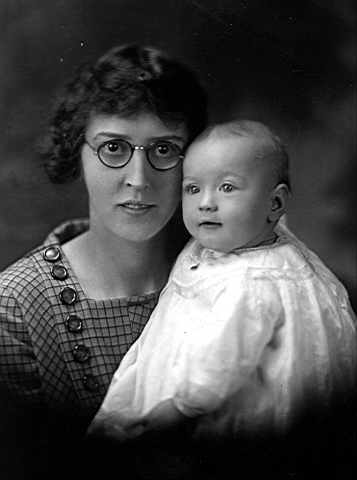
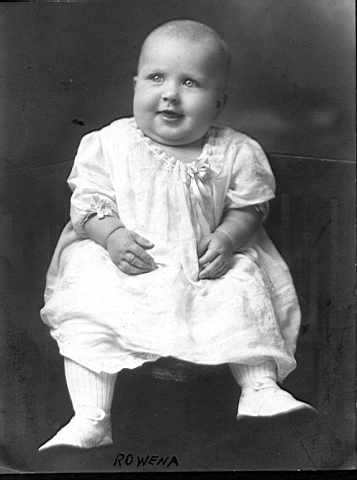
On the 15th of March, 1921, we became parents of a little baby girl and we called her Gladys because of my girlhood friendship with Gladys Meeker. The first baby picture was secretly snatched in the Wichita Hospital before we left, so anxious were we to include the little one into our family. With this event Lloyd's father became Grandpa Oerke and a good grandpa he was, too. How he loved to rock and sing "Bye Oh Baby, Byo little baby girl" over and over till sleep came, sometimes to both. He didn't think Gladys should ever be allowed to cry and I was reading in the baby care book that a baby should not be spoiled. Just a bite or two of a nice Hershey bar was often slipped into that little mouth by the doting grandpa, but on the whole everything went well between us.
Lloyd's grandmother, Mary Oerke, was still living at this time, as were the other three grandmothers of our two families. How often we wished that we could have taken Gladys' picture with her four great-grandmothers! Grandma Massey was in bed with a broken hip in West Plains, Mo.; Grandma Hopper was in Clarence, Mo., but seldom traveled any; Grandma Long was in Kingfisher, Okla., and neither did she travel. Grandma Oerke was the only one on the go. We did, however, at different times visit with all four great-grandmothers and all saw both Gladys and later our first boy, George.
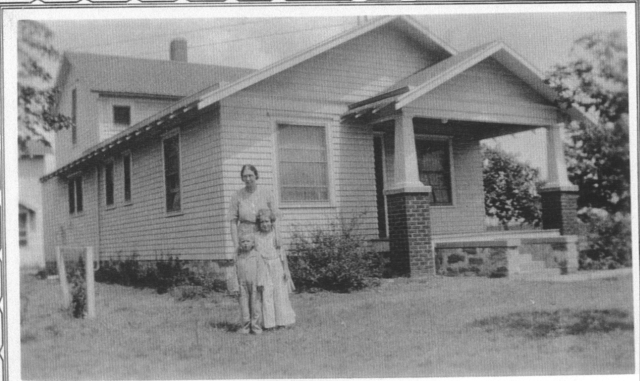
Grandma Oerke had a little house on North Hillside in the ninth block. It is torn down now. When the Poplar Street house had to be sold, we moved into the Hillside house and at last we were along again. Lloyd was making more money and we began buying new furniture. Our first splurge was the chest we still have, with the doors covering the drawers. How handsome we thought it was! Then the three-piece living-room suite was next and part of that set is in the trailer house.
An insight into Lloyd's character can be found in the purchase. The suite came with a davenport, a straight chair and a rocker. Lloyd demanded and got two rockers with the davenport, so we could both rock at the same time. The salesman said they had never had a request like that which again shows Lloyd's originality.
George was born while we lived in this little home. Between these two, we had lost a baby in the second month of pregnancy. This scare and the conviction of Lloyd that we would have only girls because of my family, made the event of the baby boy a very satisfying and happy experience. Lloyd tried to get the same room I had had in the Wichita Hospital when Gladys was born, but couldn't; so we took a room in the Wesley Hospital as it was closer. I was in no hurry this time to take pictures. George was not a pretty baby as Gladys had been. He was red, pimply and ugly The first few months we walked the floor, interviewed doctors and tried every suggestion. Finally when we and George got together on the right food, he made a good subject for anyone's kodak. He carries the names of his two grandfathers--George Massey and William Oerke.
Mail in those days was worked in one of two places--a distribution room in a Railroad Station called a terminal, or on the train while in transit. Terminal clerks had regular hours and steady work, but substitute train clerks were told to be available and ready at all times. Because of illness of regular clerks, a substitute would often be called at the last minute, hardly having time to get to the train before it pulled out, and a train doesn't wait.
Lloyd would come in from one run so tired. The telephone would ring and he would be asked if he could go out again. He never refused. He was on every run out of Wichita and once he had a run out of Oklahoma City for two weeks. He took his family along. It was exciting and always different.
But a man doesn't want to say he is a substitute forever, and to get a permanent job he had to take terminal work in Kansas City. So we got ready for our ninth move in five years.
To make it easier for me, Lloyd went on ahead to Kansas City to find a house. It had to have a Kansas address and be close to the Union Station. Anyone familiar with Kansas City knows that to find a nice clean house for rent in this location is a hard thing to do, or it was in 1924. He was delighted at finding a brick one with a fenced-in yard on a street without much traffic. I soon knew the reason for this. Coming up from Southwest Boulevard it was necessary to climb a hill so steep one couldn't see the road ahead of the car, only the crest of the hill, and it was two blocks from the bottom to the top. We wore out the low and second gear on the car in a year. The other approach was through two parks, side streets and around many sharp corners. The house was nice.
It was a new life. With no seniority Lloyd got the poorest shift, the graveyard, which was from eleven at night to seven in the morning. The terminal was then under the Union Station, no outside air, light or sun. The dust from the sacks filled the air and there was no relief. There was no place to buy any food, so this meant me staying up late and giving Lloyd a hot meal, packing a lunch at night, and getting up early to have a warm breakfast the next morning. I wasn't happy about having all the night responsibilities by myself any more than Lloyd was to have his working hours reversed. The only advantage we had--if you can call it an advantage--was that we had all day to drive around Kansas City providing Lloyd didn't sleep. And he slept very little. The children made noise, the light disturbed him, the heat woke him up. Some may learn to turn their night and day around but Lloyd never did. How could he relax when there was so much of the city to see!
We entered George into a baby contest. Although he was by now a very attractive baby, I had little hopes of meeting the competition of the big city, but Lloyd insisted. Imagine my surprise when our baby was selected from the first elimination. There were six from which to choose the winners. George got fourth and we felt very proud.
Gladys caused us to take another trip. I always watched her very closely when I was using the meat grinder, but her "Let me" attitude won out. I just turned my head for a second and she got her chance to put in a piece of meat, also her finger. The crying woke Lloyd. He dressed and we raced up and down icy hills trying to find a doctor. The end of the finger was hanging by just a piece of flesh. The doctor stitched it on but gave us little hope of saving it, but it healed nicely.
We made regular trips to Montgomery Ward, to the exclusive residential sections and the new developments. There were few streets that we didn't explore. When Lloyd had finally worn himself completely out, we would go home so he could sleep a few hours before going to work again.
I must mention here Lloyd's job when he got home in the morning. It was very, very embarrassing to me and only I know about it. Had I followed Lloyd around it would have been more than I could have taken. The same feeling would be present when we would drive through cities in a truck, eat in cafes with Lloyd in overalls, or carry unsightly packages into exclusive places. Call it false pride or silliness or plain snobbishness, but I couldn't help it. These things would not register with Lloyd at all. He would take them as calmly and as nonchalantly as if he were perfectly in accord with his surroundings. So it was with this job as garbage collector of the neighborhood. He would go around to each back door and dump all available garbage into a pail. This he fed to a bunch of hens we had in the back yard. His theory was that the chickens needed food, this was good food for them, so what.
We did have some back yard but the houses were so close together that it was impossible to have a driveway in between. In fact by reaching out of a window, I could touch the house next door. When the windows were opposite each other, as they were in one place, it is small wonder that we could see right into our neighbor's house. At this particular window, there was a big comfy chair and beside the chair a table. I couldn't make out what it was on the table until the man of the house told Lloyd it was a crystal set. What was a crystal set? This was a new invention just out to pick up radio signals. We had barely heard of radio. In fact, the whole idea was so new to most people, that many lost their minds trying to figure out how that sound could fly through the air. This old couple would sit for hours with earphones on, listening. We looked around for one that was cheap, and a place had a home-made affair hooked up to an old phonograph horn. It was three years before we invested in one.
The owner of our brick house returned and wanted to move back into it, so we moved across the ravine to another hill. While we were living in this house, Sara spent some time with us, as also did Grandpa Oerke.
In spite of the fact that Lloyd was continually applying for train runs anywhere in Kansas and had no intention of remaining in the Terminal, we added to our furniture. He couldn't resist a dining-room suite that was on sale. As was always his method, he would see articles and buy them without even consulting me about the make or style. This was a beautiful set of furniture and well built, serving us a lifetime.
We missed a piano. Lloyd was reading the advertisements as he always did to get an idea of values, whether he was in the market for the items or not. Montgomery Ward advertised baby grand pianos for $385. This he must look into. When he went to ask about them, they told him they couldn't produce the pianos as a local company was prohibiting the sale. It seemed it was a brand name piano but Montgomery Ward had put on their own brand and was selling them too cheap. There was only a demonstrator on the floor and, by some maneuvering by the manager, Lloyd got that piano.
We felt we were getting up in the world with our new furniture, our two nice children and another on the way.
There is a saying that "you can take a boy off the farm but you can't take the farm out of the boy." By some method Lloyd was going to get back on that farm. An opening occurred at Caldwell for a rural carrier. Even in those days these jobs were hard to get; but it would work out perfectly for us. We owned a farm at Caldwell and Lloyd thought he could run that and also carry the route. This was what he was looking for. He wrote to influential men in Caldwell, wrote to Congressmen, made a trip to Caldwell to interview, and finally the Post Office Department sanctioned the transfer.
We began to pack. I don't think there were many cross-country moving vans in those days, and if there were, we wouldn't have used one. We always moved the hard way. Moving was never easy for me and this one was especially hard, for we shipped the things by train and everything had to be boxed or heavily wrapped and tied with strong string. Especially our new furniture must not have a scratch. The dishes were packed in wooden barrels and the furniture crated--and still the final papers had not come through. Oh, well, in thirty days, that was the length of time the freight could be held at the freight depot, papers were sure to be there.
I was to go on to Wichita and visit my folks who had a home there by this time. The oil field project had flopped. The best laid plans sometimes go astray, and no one hurries the Government. Thirty days passed. If it had not been for a mail clerk friend who felt sorry for Lloyd and took him into his home, Lloyd would have had a nervous breakdown. On the twenty-ninth day of storage, he located a house and had the furniture moved. In another week the papers came through and we celebrated Thanksgiving together in our home at Caldwell.
We lived in Caldwell longer than in all the other places put together, before or after. Lloyd had put down roots. We lived in Caldwell from the fall of 1925 till the spring of 1945. The Oerke name was well-established there for many years and it was like going home. In fact, Lloyd rented the house his father and mother had built as their dream home in 19___. It is located at _______________ North St. Marys Street. The John Oerke family were prominent in business and social circles and very dear to us.
Coming out of an inside job and having to face all kinds of weather in the winter months that were just ahead, Lloyd felt he needed very warm clothing. Those long-handled fleece-lined underwear saw little use. Lloyd had enough natural heat stored in him even for this test. There were seven rural carriers then for the roads were so terrible it was impossible to serve many miles, but there was no night work Sundays were ours to attend church and do with as we pleased.
Rowena was born January 26, 1926, a couple of months after our arrival, and a sweeter, better baby couldn't be found. Grandpa Oerke chose her name from a character in "Ivanhoe." For the first time since our marriage we felt we were in a position for happiness, contentment and success.
As you look at the farm today it is hard to picture it as it was when we moved to Caldwell. It portrays the work of the most productive time of a man's life. To change the wheat field into the well-improved area it is today; to raise six wonderful children to be capable, fine, Christian adults--took a lot of planning, laughing, crying and work. To go into detail for this period of our lives would alone fill a book. I can only mention many phases of our lives there and I'm sure that at least the four older children can elaborate in their minds.
The first move was to tear down the fence and put in a culvert to get to the staked out improvement site. An old house between the grade school and high school was bought and moved out as a nucleus for our building. The old barn with this house was also moved, so Lloyd could have that necessary animal--a cow. Rooms were added to the front of the house, a basement was dug, water system built, fruit trees planted, also a grape vineyard; shade trees and flowers were started; chickens were added to the animal world. All this Lloyd did besides carrying mail.
The activity inside the house was just as active. Edward arrived on the scene August 3, 1928, and named after Lloyd's boyhood friends, Edward Rockwell and Schuyler Jones. Kenneth arrived September 15, 1935. School days began for the older children, and we entertained school teachers and had parties for the children's friends. Our house seemed a meeting place for relatives Sara finished her senior year of high school with us.
I was active in all avenues of church work even with the many demands of our family. Lloyd sang in the choir, sang for funerals, sang in the Lion's Club quartet for community affairs, sang solos at church and at clubs; carried the flag in the Memorial Day parade, was secretary of the Lion's Club, active in Boy Scouts, song leader at Church School, and treasurer of the Methodist Church.
I remember one time telling my mother that I'd rather lose the children than part with Lloyd. I could have more children but there would never be a second Lloyd. That was an exaggerated statement to make, but I was so proud of him and loved him so much.
The heartbreak of this period was the children's illnesses. I had always thought that it wasn't necessary for children to have all the so-called children's diseases. Our children looked the picture of health and they would stay well with all the fresh air, milk and garden vegetables they enjoyed. They had nearly everything that most children have and more.
Whooping cough and mumps came at the same time. With jaws so swollen, it was agony to whoop. Small pox, chicken pox or tonsillitis would surely affect at least one, whenever we planned a trip. Pink eye made the rounds, and colds. We had the tonsils of three of the children taken out the same morning. But the worst was measles.
George was the first one to take the measles and he had a bad time. In fact, our doctor asked permission to call another for counsel. This we did. He was barely over the crisis when Rowena took sick and her complication was not pneumonia, as George had, but Black Measles, seldom heard about. For her we called in a special nurse who kept hot packs continually all over the body, so the blood wouldn't congeal and cause a fatal blood clot. This crisis over, Gladys and Edward started their own special show. This time the complication was abscessed ears and when the doctor advised hospitalization for Gladys and mastoid operation, two frustrated parents didn't know anything else to do but go along with the idea. The operation seemed successful and we thought we were over this crisis also, when infection set in on the hip joint. Such suffering the little girl went through. Today's modern medicine probably would have saved Gladys this long and painful and permanent ordeal. We had her in two hospitals, and doctored her at home when the doctors could do no more. When the infection was finally gone, another operation was necessary and then months in a cast. We kept the road hot between Caldwell and Wichita where Gladys was. All this took most of our time for 18 weary months. Lloyd was always very thoughtful and had help for me until I could make my work alone.
We always had a new car in those days, even if the car was covered with route mud most of the time. The dealers were anxious to get their particular car before the public and they made Lloyd good trades. Lloyd was game to try them all. I'm sure I cannot remember the names of all of the makes and few are being sold today. There were the Harroons, Stars, Austins, Stearns Knight, Oakland, LaFayette, . . . and the more familiar Chevrolet and Dodge. The Dodge was bought the same year Marvin was born, and was driven until we got our Lincoln. You see, I didn't even count the old Ford that replaced my beloved Oakland for a few months.
We felt crowded in our home as the children were growing up and, as most families do, we began to plan for one bigger and better. We liked our location from town and decided to build just east of the present home. A basement was dug and walled and covered. It contained a recreation room, a small bedroom, a storm cellar, a laundry room, furnace room, and large two-car garage. We waited several months for this to settle before adding the house and in those months we lived with house plans. Several could fit on the foundation. I wonder how many couples almost have a divorce before the home which was meant to be their pride and joy is finished? I wanted small pane windows, Lloyd wanted large panes; I wanted painted woodwork, Lloyd wanted varnished. I wanted a door one place, Lloyd thought it would be better in another. The door should swing this way, the cabinet should be larger, the plumbing, the furnace, should it be this way or that way? When all of that is settled and the finishing and decorating are still ahead, every color must harmonize and draperies be so-so. It doesn't always work out, for money becomes more of a problem as the house nears completion. We compromised on many issues and the kitchen was left for me to plan. The depression which hurt so many people helped us. Lloyd's salary, though small most years, seemed large in comparison. We had no trouble getting excellent help for forty and sixty cents an hour, and the boss carpenter got one dollar, and they were all delighted to get the work.
We did have a lovely home. Lloyd had sung the song "The Little Grey Home in the West" to me before we were married. This wasn't little. It had five bedrooms and all the extras, but we did paint it grey and trimmed the gables with a little orange. So much of Lloyd went into this home that it made him blue to go back and see it, after we had left. It was his masterpiece. To frame it, he designed driveways, rock walls, landscaping, rock garden and pool. He went through untold hardship to bring the hundreds of "wholg rock" from east of Arkansas City to add the final touch of beauty.
Just as outstanding in its way was the barn. He would take off, as soon as his mail route was completed, for ___________, Oklahoma, and come crawling back about two in the morning with a trailer load of oil field timbers. Often George went along and the high spot of the trip was an ice cream treat at Blackwell--in Oerke language the "yum-yum" town. The barn was well planned and extremely well built.
Another accomplishment was the shelter belt. Because of severe opposition and criticism, Lloyd was determined to make a success of it and he certainly did. He joked that he was planting it so the passer-by couldn't see him at work behind it. The plantings were so small at first that they could only be seen by close scrutiny. After every rain Lloyd worked the ground deep and kept it better than a garden. The result was shelter belt that was the talk of the country and the pride of the government men. In the spring, the front row of Red Bud trees with the evergreen behind is a sight worth driving miles to see.
With a family of children, Christmas is always a much looked-forward-to event. The first year that the house was built, Lloyd had lights strung all around the roof lines and over the rock garden. The lighting won a prize. Perhaps this was the happiest Christmas Lloyd ever had, for usually he dreaded this time of year. There were two reasons. He didn't like all the extra activities connected with the event, the social as well as the pile of extra mail. The other reason was the gifts themselves. They were not purchased at a time best for the financial economy of a good buy, and they were also often the wrong size or color or some article not needed or used. However, I was always firm about the observance of Christmas Day and the erecting and decorating of a tree. We even had one our last Christmas together. Though presents varied from year to year in quantity and quality, we always managed to make Christmas morning as pleasant as possible. Christmas morning didn't always come on Christmas Day which worried the children. Sometimes Lloyd's Christmas mail rush interfered or a trip was planned for the school vacation.
We took many trips in those days for so large a family, and I marvelled that a man would endeavor such a job and do it with so much joy. Motels were not nice like they are today; we even took bedding along piled under the kids in the back seat. There were boxes and suitcases for Lloyd to load and unload while I was taking care of the children. It was hard to find a restaurant, not too dirty, not too expensive Once on the inside it was difficult to seat our group and we always were needing a high chair. We usually didn't ask the children what they wanted for that took too much time. Each child had to finish his plate regardless, as was the strict rule even at home. The rest room demands at the most inopportune time were Lloyd's biggest grief. We learned to carry drinks and games, damp wash cloths, and first aid.
We drove the Star to the lower Rio Grande, leaving Caldwell in the snow and eating ice cream in bare feet at San Antonio--a never forgotten fact. We drove several times to Colorado and never missed a mountain pass or a canyon road. We made frequent trips to Kansas City or Oklahoma City and Kingfisher. We nearly always attended Rural Letter Carrier Conventions, both State and National. One of these National trips took us to California and Oregon. Every February 22 the District held a meeting in Wichita, and the George Massey family had dinner together--Dad, mother, Sara and I. We tried to make it an annual affair while Lloyd attended the Letter Carrier meeting but I couldn't always make it.
Then there was the trip that George and Edward and I took to Kentucky to visit the Kintners. For our hard work during harvest, he repaid us by buying a new car and turning us loose to have all the fun we could.
He was always doing such wonderful things for the family. He bought the children each a thousand dollar insurance policy when they were born, and a five thousand one when they reached the age of ten. It was quite a burden to meet the premiums. He bought all kinds of musical instruments--violin, viola, trumpet and oboe--and insisted that the children had lessons and even had me taking piano lessons with the children. He hoped for a family orchestra. If the children asked for a 5-cent bar of candy, he would come home with a big box full. He would give us a catalogue to order anything we wanted and when our order was finished, he would add to it. He would get up early, do the milking, start fires, and call us in just enough time for the children to get off to school--and we could go on and on.
With all this he was not an understanding and chummy father on the children's level of thinking. They were supposed to act like grown-ups, work like grown-ups, and talk like grown-ups. He had no patience with careless or thoughtless work. He couldn't stand crying, either the children's or mine. He never played games and so didn't mingle in our fun, and at times felt sorry for himself for being left out. We all had to be careful what we said or he might get mad. Many a time he left the table in the middle of a meal in that mood, and would go to bed and pout for a day or two. When Dad's face lighted up again, we would draw a big sigh of relief and really live again. He was like the little girl with a curl in the middle of her forehead--when he was good, he was very good indeed (which was most of the time) but when he was bad, he was horrid. These perhaps were traits of a very artistic, very sensitive and very forceful man.
A paragraph must be inserted here concerning his father. Grandpa Oerke had moved to Caldwell when we made our change to be near us and help Lloyd. Part of the time he lived with us. Up to the time of our marriage, Lloyd had done just what his father wished in every little thing. Even when we were first married Lloyd tried to learn banking to please his father. Lloyd felt that when a man starts his own household, he should be free to run it as he thought best. So it should be, but Grandpa Oerke didn't like the way Lloyd was doing things and told him so. Nothing that Lloyd did seemed to please him. This brought about hard feelings between the two which continued to his father's death. Grandpa Oerke was very devoted to me and to all the children, and to us he left most of his property. So many arguments took place that when he died, we closed the book and nothing was said about him. In recent years though, Lloyd referred often to things his father stood for and believed in, and these were mentioned in the spirit of admiration and agreement.
In 1940 Marvin was born. We hoped he would be the first baby born in the New Year. He was the first boy, but a girl was born January 2d to a couple quite a distance from Caldwell but in the trade area. However, we got a few gifts.
This was the peak of our family unity. This was the turning point. From this time on our family began to slip away and Lloyd did what he could to help them with their plans.
Gladys was sent to the best college he could find for Home Economics. He would drive back and forth to Manhattan at her every wish or need. She married an Army man in California and so was gone from us.
George entered the college at Stillwater and volunteered for the Air Corps. When he brought his application home for us to sign, Lloyd was very disappointed, but he signed--and we lost our oldest son
When Rowena graduated she wanted some type of telegraph work, and her Dad inquired around. The next morning after her graduation, he put Rowena and Oma Reeder, her friend, into the car and took them to Springfield to start Western Union training. She was always grateful for his help, but our other girl was lost to us.
Edward suddenly became ill with epilepsy, a disease we had only known existed, and the doctor thought a change of environment might snap him out of it. Lloyd knew a man whose son was in the Hays Military Academy and we made every effort we could to get Edward in and settled happily. Another son was gone.
Grandpa Oerke had a stroke one Sunday after eating a big dinner with us. We nursed him and took care of him. Finally we took him to the St. Mary's Hospital in Enid. He wanted to be in Oklahoma when he died, and he was.
It was then that we realized how very fortunate we were in having the two younger boys who would be with us a while and make our life richer and fuller.
This change in the family threw more work on Lloyd. He tried to keep things going alone, but it was too much. He developed rectal trouble because of the long hours in the tractor and mail route riding. Edward didn't like Hays and we felt he should not stay at Caldwell. A change was due.
We began looking around for a rural route some place else but it was no easy matter to find a good route and a man who could take over our interests. The Lowe family were prominent in Caldwell and Lloyd had carried mail to them. As a boy, Howard had quizzed Lloyd as to how he could get one of those mail carrying jobs and Lloyd had helped him all he could. As a stepping stone, Howard had accepted the Wauneta mail route but was looking for something better. When the grape vine got hold of the possibility of Lloyd wanting to trade away from Caldwell, Howard began to visit us regularly and talk trade. It was a perfect set-up for him and we knew it. Also, we knew that Howard would stand back of any agreement.
We traded, subject to the Postmaster's approval. I can't see why anyone would refuse Lloyd. He was a man six feet tall and well built and carried his weight with a light, springy step. His face like his body was well built, broad forehead and nose and square chin. Deep-set twinkling eyes softened his rather stern features, and a warming smile and cheery laugh put everyone at ease. His skin was smooth, radiant with health and so warm to touch. Perhaps his teeth were too small and far apart, but when he spoke the only thing one remembered was his musical speaking voice. He was extremely polite in actions and conversation.
He got the job and we moved what things would go into a five-room house at Cedar Vale. The rest we sold to Howard or a furniture dealer. This was quite a change for us in several ways. The house we rented for ten dollars a month, which shows it was in bad repair and we wouldn't fix up a rented house. The house was an extreme opposite to the one at Caldwell. The Wauneta post office we called a cracker-box because of its shape and size. The mail route was shorter and much less mail. We had practically no work to do and we spoke so often of living on "easy street" that the boys thought that was really the name of our street. Lloyd didn't quite give up all his farm interests. He brought over two calves and some chickens.
We had some money to re-invest and we threw our energy into studying Chautauqua County. Lloyd soon knew every farm that was for sale, its legal description and history. We bought the Fred Archer place. The papers required some legal work, so Lloyd decided to farm it until that was cleared up and a good renter could be found. It wasn't a very satisfactory undertaking, being so far away from his home and with only one-half day to work. By the time the light weight tractor threw him a couple of times, we were looking for a renter. Roy Hull asked for the place and got it. Lloyd liked him immediately and helped him get started.
We soon got into church work again. Lloyd sang his way into everyone's heart. In the morning there was the choir at Cedar Vale, in the afternoon he led the singing at Wauneta, and then again at Cedar Vale at night. When they found out he sang solos, he was a busy as he had been at Caldwell.
Among the favorite sacred songs were "The Ninety and Nine"; Malotte's "Lord's Prayer"; "When Jesus Came"; "Hold Thou My Hand"; "The Stranger of Galilee"; "Face to Face"; "Jerusalem"; and the one he sang most elegantly, "The Holy City."
In a lighter vein, he liked the songs that went low like "Old Man River," "When the Bell in the Light House Tolls" and "Asleep in the Deep."
Vagabond songs were fascinating also. He even dressed up like a tramp while singing "The Wanderer" or "The Ragged Vagabond." The swing of minstrel songs would send his feet to tapping and he would relive his minstrel show experience of Caldwell.
How beautifully he sang "Because," "I Love You Truly," "O Promise Me," and the love songs of our youth, "The Little Grey Home in the West," "There's a Long, Long Trail," "Some Sunday Morning," and "Till We Meet Again." My favorite was "As High as the Stars and as Deep as the Sea, Is My Love for You and Your Love for Me."
These are only a few for he had a cabinet full of sheet music. Music was to him life and breath, meat and drink. He would be so filled with his solo and on returning home, he would have to sit down and play and sing it, till he could quiet down. The words of "Without a Song" expressed so well his feeling.
"Without a Song"
Without a song -- the day would never end,
Without a song -- the road would never bend;
When things go wrong --a man ain't got a friend,
Without a song --
That field of corn -- would never see a plow;
That field of corn -- would be deserted now;
A darky's born -- but he's no good no-how,
Without a song.
I got my trouble and woe,
But sure as I know the Jordan will roll --
I'll get along as long as a song is strong in my soul
I'll never know -- what makes the rain to fall;
I'll never know -- what makes the grass so tall
I only know -- there ain't no love at all --
Without a song.
He used Meloids to clear his throat and he always carried a box of them in his pocket. If any one cleared his throat in the choir, the box was handed to him. If one had a cold, he was given Meloids. But if Meloids made his singing easier, no wonder he used them a lot for he did a lot of singing.
Rowena came to visit us one time while she was working for the Western Union at Hutchinson, and asked her Dad to find a farm where she could invest her savings. He bought the Pore Place. That request put her in so solid with him that he was ready to trust her judgment on other things, for instance, Wilford. We heard plenty about him, but never met him until he came for the wedding which would make him one of the family.
It was Lloyd's idea to have the wedding at the close of the church service as he wanted a crowd and Rowena wasn't known here. Lloyd and I had lots of friends among the church people because of our activity. I was working in every organization in both churches and everyone wanted to come, but still we didn't want personal invitations. The Wichita folks came and helped; Ann lighted the candles, Sara poured punch at the reception. George went AWOL to get there, and he and Joe and Wilford brought over the cake and flowers from Arkansas City. George also was best man. Lloyd never forgot how proud he was, marching up the aisle with his beautiful daughter; then walking up to the piano he sang for her the beautiful song of devotion, "Because." He was called upon to repeat this song for others of his family later.
About a year after we moved to Cedar Vale we bought the house we were renting, and Lloyd remodeled it. He dug a basement under the porch which he enclosed. He terraced the yard and ran sidewalks. He built an extra wide culvert and filled up the drainway, which was a water run, with solid stones to make it the finest driveway possible. When this was done, he started the rock house which he always called his widow's home, and it is. Material was very hard to get because of war priorities so he used what was available. There is no house like it in the country, I'm sure, but I love it. It's quite attractive, and Lloyd through and through.
Edward graduated from high school and tried to attend college with George at Stillwater, but his health wouldn't let him continue. Lloyd felt there would be more opportunity in the city.
The pay was low at Wauneta, only $2649.97 a year. The most he ever got was $4584.62 and it took a mighty good manager to raise a family of six on that and give them all the advantages he gave ours. Retirement pay was based on the last five years of service. Railway mail paid the best, if he could pass the physical. He reported to the designated physician, took the tests and passed with flying colors. I've never seen him happier, not because he was going back into railway mail but because of the fact that he could, after all these years, do the work of a younger man. In his spirits, he was twenty again.
He was careful to get a good man for Wauneta and Roy Prather of Kansas City seemed the one. He wanted to move to a small place and out of railway mail. Another young man Lloyd helped, and he got a satisfaction in helping deserving young men get a start.
Three years in Cedar Vale--the mayor commented once on the unbelievable fact that a stranger had come in and bought the two best farms in the country before anyone else knew they were for sale. Lloyd got a chuckle out of that.
Chapter 12 .- Kansas City Again
What a thrill we had thinking of the big city, things we would see again, places we would go and things we would do. Another complete change of living.
We certainly started in a big way on our first day in Kansas City. We drove up to find a place to live. Roy Prather had located a house close to his property and we had put a down-payment on it sight unseen. We were going up to see the house and close the deal.
The whole sky seemed to be celebrating our jubilance that early morning as we left Cedar Vale. The Northern Lights, so seldom seen in this part of the country, were never prettier.
Arriving at Kansas City, we went to look over the house. It wasn't bad, good income property if that was what one wanted, but it didn't look like a home to us. The houses were very close together, and I could just imagine Lloyd wiping his brow continually and spending sleepless nights on a wet pillow.
We drove around some, looking at other houses. Just for fun we rode through a few streets of an exclusive district that was only a five-minute drive to the Union Station, and Lloyd saw it--just our house. Our hearts stood still with unbelief. Could we possibly make a deal? I didn't even get out of the car for I considered it a hopeless dream. We were already under contract to buy another house. I watched Lloyd look around and copy down an address and 'phone number. As was his custom, he offered the real estate agent a smaller price than they were asking and they could take it or leave it. By this time my dream home was coming close to realization and to act nonchalant was beyond me. Lloyd said it was written all over my face. The real estate agent said he couldn't do any better on the price and Lloyd turned around to leave; me, he almost had to drag. I guess the real estate agent saw how badly I wanted this house and he said he would call the owner and submit the bid, but he thought it was useless. The owner accepted. We signed on the dotted line. This made us the owners of two houses in the matter of a few hours. No one but Lloyd would probably have done such a thing. He managed to make an arrangement on the first house, so he didn't lose his down payment, and we drove home that same day, tired both mentally and physically, but happy.
The refinishing of the house wasn't so easy or quick. An old couple had lived there for years. The wife died and the old man just refused to be moved. He sat and rocked in front of a window through which all the fairyland lights of the city could be seen. He rocked a hole in the hardwood floor. A son came in to fire the furnace, but he let the furnace smoke and smoke till everything was covered with a black layer of soot. The wallpaper was peeling off in strips, the kitchen was filthy. However, the prospects were promising.
From the front door you entered a large hall, to the left was the living-room with a fireplace between two sets of French doors. A bay window in front and a large window in the back gave light by day. An imported crystal chandelier with drops lighted it by night. To the right of the hall was the dining-room with a bay window also and windows over the spot where the buffet was to set. A door led into a butler's pantry and on to the kitchen and the back porch. The breakfast room was at the end of the hall and boasted a half-bath. This was Lloyd's delight, for he insisted the children wash before and after meals, and he practiced what he preached. Off the hall a stairway led upstairs to four bedrooms and a bath, and from the large hall on the second floor a stairway led up to a third floor which consisted of a large bedroom and storage closets. Besides the three floors, there was a full basement for the furnace, washing and hobbies. From the basement a flight of stairs led outdoors to a spacious yard outlined with a variety of iris, spirea and lilies of the valley, and backed by a rock garden.
After we had decorated the place from top to bottom, we of course, had to entertain to show it off. The choir of the Grand Avenue Methodist Church was invited out, the ladies' groups and the Oerke family was asked to gather for a reunion.
Besides all this, we tried to go to every show possible. We saw the stage shows of "The Student Prince," "Carousel" and "Oklahoma." We bought one season ticket to an outstanding musical concert series, saw an Ice-capade, shopped in all the stores of the down town district, ate dinners at the Forum Cafeteria, and attended events in the Municipal Auditorium. We drove all over the city, and usually we made a point of dropping into the Montgomery Bargain Room. We would have nothing special in mind, but came out with electric blankets, clothes, silver, dishes, furniture or knickknacks, whatever struck our fancy.
Kenneth was busy with Boy Scouts and won a trophy as the best all-around Scout of the year.
Edward sang in the choir and was especially active in the Young Adults' group of the Grand Ave. Church. He also had a drafting job in the City Hall on the 19th floor and was doing fine.
I was doing a lot of church work, even to big church-wise program managing. How did I ever do it?
While we were stepping out, Lloyd was riding the rails. The trips were long and hard, and meals and sleep inadequate, but working on the crack trains, "The Spirit of St. Louis" and the "Portland Rose" and coming in and out of the beautiful Union Station had its glamour. His work might have been easier by taking a letter assignment. Four things kept him from this--standing in one place bothered his legs, sorting the thin letters bothered his fingers, working at high speed bothered his nerves, and the lack of distribution know-how bothered his mind. So he handled the heavy bags of parcels, Denver mint coins, military camp payrolls, and papers and magazines, besides taking care of local and catch pouches. It was a tough job. He had four days on and four days off. The off days were not exactly "off" either, for there was book work to do and studying for the next examination. Lloyd took quite a pride in making top grades on these and it didn't come easily. He would fret and stew, fret and stew, but he came through with flying colors. These examinations were also accompanied by an inspection of all equipment, books, schedules, guides and gun.
One time returning home after one of these ordeals, he laid all of his equipment on a desk in the hall and we went for a visit to a friend of his. We got home late and went right upstairs. We had just turned in when I heard a noise in the hall downstairs. I went to the stairway and called: "Who's down there?" A policeman showed himself. He said a neighbor had 'phoned and said there were prowlers in the house and that we were not a home. I said I didn't know anything about it. He picked up Lloyd's gun and asked if we had a permit. I explained that his work in the Mail Service required him to carry one. He took our name and address, and left.
The younger boys who slept on the third floor came down to see what was going on and they confessed that they were using a flash light in a sort of game they had made up. That accounted for the prowler angle. But neighbors in Kansas City report everything to the police and we got plenty tired of it. The next morning when Lloyd was putting his equipment into his suitcase to go to work, the gun was missing. We tried to trace it but it was no use. The Post Office Department heard Lloyd's story with a grin. We never quite knew whether that grin was because of the impossibility of the story, or the impossibility of such acts by the police.
Nothing is more pleasant for a pastime than looking at land. We had the boys' money from Grandpa Oerke's estate and the crop returns each year, to invest for them. We looked at everything that was advertised for sale in the paper. Our first view of the Ranch was from the Foster Road entrance. That expanse of level farm land was immediately a challenge to us. Lloyd made a complete investigation of records, interviewed authorities of the proposed dam Association, studied the land itself, and asked questions of anyone who might have an answer. The two obstacles were the proposed dam at Oceola which might inundate the place, and the enormous amount of land and money the deal involved. True, the land was only $25 an acre, but 1275 acres amount to $31,870 which was too much money to gamble.
We were sitting in the breakfast room listening to the six o'clock news when all at once Lloyd looked at me and I looked at him with startled expressions. The story broke that instead of the big dam, smaller dams and conservation practices were planned to make this part of Missouri a show place of farming. We hurriedly turned off the radio, councilled for a few minutes, and called the agent saying we would take the place. We were afraid someone else would take the place, or the price would go up, or the owner would decide not to sell. Lloyd was leaving for a run that night, so it was up to Edward and me to go to the Top Hat Bowling Office, contact the agent and sign on the dotted line. That little signature got us not only the ranch but a sentence for years of hard labor and worry.
Our money and that of the three boys, Edward, Kenneth and Marvin, was pooled, a partnership formed, and we were in business. Every opportunity we would drive down, take care of business, bounce all over the ranch on roads and through brush and drive back to Kansas City in the same day. Then we bought Army cots, portable icebox, camp stove and groceries and stayed overnight in the improvements on the west corner. It was a run-down, termite-ridden house, but a shelter.
A family by the name of Molos lived in the east side improvements, and another set of deserted improvements was located near the ford. There had been a time when this place was really farmed, drainage ditches made, wells drilled, and cattle pastured. We were told that at no time had anyone been able to properly take care of all the acres. Breaks in the levee had been expensive to repair and the owner, Mr. Skaggs of the Safeway Stores, had lost interest after his move to California, and everything was run down. Brush and small trees grew up rapidly on the unworked land, fences were destroyed, wells ruined by high waters and debris. The place was almost public land when we took over in the fall of 1947.
All these trips to the ranch, bouncing over fields at random, worry over the business end, added to my already full schedule, put me in bed The breakfast room became a bedroom and the family lived as a family does when mother is sick. Sickness always worried Lloyd and made him feel so helpless. It wasn't new to him because of his mother's life, but it was nonetheless unpleasant. After a few months of rest and treatment, I was better but rather low in spirits.
One of his lovable traits showed up. He loved to play Santa Claus and, without saying a word to us, he took me to a doctor's office and when he came back to pick me up, he was driving a new car. He said he thought it would help make me well. It was the finest, nicest car we had ever owned--a new '49 model Lincoln Cosmopolitan sedan in steel grey. I was insulted when the neighbor said they considered the Cadillac a better car! It must have made be better, for in 1950 we took off for Pennsylvania to be with Gladys when Sylvia was born.
As we left Kansas City to see new places and new things in a car Lloyd always dreamed of having, and that car filled with his happy family, Lloyd was in his glory. As he sat behind the wheel, skillfully guiding us over highways and through cities, he was like a king on a throne. He never wasted a minute of time. While I was with Gladys, he and the boys went to Philadelphia to the Car Show, to Delaware and Rhode Island.
I must tell you about the New York trip for it was typical of Lloyd and his resourcefulness. He had his idea of how he wanted to enter the city, and that was over some bridge instead of the Lincoln Tunnel. He had all of us looking at signs, but in the maze and newness of it all, we landed in the tunnel after all. As he feared, he became a little confused on emerging and that instant of hesitation caused us trouble. A uniformed man motioned us to one side and questioned us at to our destination. Learning we were new to the city and sightseers, he tried to dictate how we should do. We were to go three blocks to the right, park our car, get a hotel room and let a sightseeing bus take us around. Lloyd tried to be polite, but the man was so insistent that we could never get around by ourselves in the big city of New York, that Lloyd got rough. He said no one was going to take his car away from his, and if this man would just show him which road went into the city and get out of his way, he would make it all right. He did, too, in spite of the fact that he was directed on a truck route.
We went up one street and down another, as was his method of seeing a city. We went to the top of the Rockefeller Center Building, to Coney Island, to Wall Street and to the Statue of Liberty. We crossed bridges and saw the lights of Times Square at night by riding the subway. We walked around in the famous Grand Central Station and ate at an Automat on Broadway. I am amazed at the scope of information we picked up in that one day and night in New York.
The next day we took in Washington, D.C., just as thoroughly. Lloyd climbed to the top of the National Capitol with the boys, we visited Lincoln Monument and Jefferson Memorial. Having a Missouri license, Lloyd drove up to the gate of the White House and asked if neighbors of Harry Truman could look around. The guard said that all friends of Harry should go back to Missouri where they belonged and take Harry with them.
We drove past the Pentagon on leaving Washington, traveled the famous Blue Ridge Highway of Virginia.
He not only enjoyed trips he planned for pleasure; he thought transportation by car was the most convenient, cheapest and satisfying of all. When any of the children had transportation problems, he thought it was his fatherly duty and pleasure to offer himself and his car. Many of the trips were spotted with discouragement and trying hours of confusion and hardship. We will have to give him an "A" for effort.
The levee work at the ranch went smoothly, if expensively. It seemed Henry Lukin, the contractor, was always due four or five hundred dollars, and we liquidated one asset after another.
The old Dodge car became a truck for transportation of building materials when the house was started. Everything that it was possible to haul, Lloyd hauled in that car--heavy stones, big doors, cement, lumber and plumbing. Most of the purchases he made in Kansas City, and all he made with extreme care. He bargained and bargained until I would feel sorry for the seller, but when the deal was over, they were both laughing and friendly. I have tried to use his tactics at times but when I do, I feel that they would be glad to kick me right out the door. Lloyd never made them mad and there was always a cheery welcome and friendly smile when he returned and a "Well, Mr. Oerke, what can I do for you today?"
His affiliation with the builders and workmen at the ranch was not as pleasant. Perhaps we were not accepted as one of them because of being city people or because of jealousy or just because they thought our sights were too high. Maybe it was just us, but we had very little cooperation and lots of sabotage. George Decker finally started to work and was on our side. Cecil Goode, Lloyd's substitute carrier at Cedar Vale, was moved into the house. Lloyd had a deep admiration for Cecil and he would go to great lengths to help someone he liked. With these two friends on the job we were able to relax a little and leave the details to them.
In 1950 Gladys and her family decided to move from Pennsylvania to Kansas City. The furniture was brought through in a truck bought for that purpose. They stayed with us until a house could be bought. Lloyd helped them all he could.
In 1950 also George was married. There were thrills and excitement among the members of the bridal party, to be sure, but we had our share. The wedding was to be at Evanston near Chicago, and we were all going. Rowena had left Wilford with the children and had come up to Kansas City, to go with us. Gladys was leaving her children at home also, so Lloyd was to have all of his family with him again except George and we were to see him soon. We didn't even have the feeling that we were going to meet a new family or new daughter-in-law as the Kintners were old and very dear acquaintances. George and Dorothy's first date was one of family obligation as both their mothers were good friends. The whole affair had a romantic twist. The wedding was to be a semi-formal affair in the college chapel for weddings. We all wanted to look our best and clothes were carefully selected. We were to get to Evanston in time to dress for a wedding dinner at the hotel the night previous to the wedding.
In preparation for this trip, Lloyd had taken the car down town for repairs and check-up before he left for his mail run. The plan was for him to get a little nap after he got back about eleven at night, and we were to leave about two a.m. We got the car and packed in the suitcases. The train was late getting in, so he decided it wasn't worth while to try to sleep and a very tired mail clerk and a very jubilant group of passengers climbed into the car at midnight and headed north. We had barely left the city limits when the car stopped, and we could find nothing wrong. Lloyd started walking. He walked a couple of miles to an all-night filling station and got a man to come back with him. The trouble was so unusual that it is hard to believe. In repairing the car, the garage had put the gas gauge indicator to "full" instead of "empty," as was the tank at the time and were simply without gas when the car said full. Since several people had a part in getting the car ready to go, everyone thought that another had put in the gas.
This delay cost us a couple of hours of carefully planned time, but we had left a little early.
After a few hours of driving Lloyd became very tired; he was to the exhaustion point and when he was tired like that he drove slowly. He felt the wheel was the only place for him, so we didn't insist on relieving him until we woke up to the fact that Chicago time was not only one hour earlier but that they also had daylight saving time. We just couldn't make the wedding dinner. I have been teased many times about my fast driving to that dinner. We just had to make it and we did. We wedding party stood around and waited for us; the hotel management said in a half hour they would serve, no more time. We didn't have time to change our clothes, as we had intended to do. We washed our hands, ran a comb through our hair, Lloyd shaved, and we were walking in with the wedding party. "We made it, we made it, we made it," ran through our minds all during the meal.
The wedding was beautiful in every respect. I was given my first and only orchid corsage which I pressed and kept. The reception was nice also and the pictures taken are priceless. Ever mindful of some little thing he could do to please the children, Lloyd slipped some money into George's pocket as the couple left for their honeymoon.
The ride home was short as we had so much to talk over. Lloyd hated to see it end for his passengers would be solely his no more. He climaxed the trip by taking the group to the Forum Cafeteria in Kansas City before we went our separate ways. It was a trip not soon forgotten.
On July 13, 1951, we left Kansas City for the ranch. We were going down to take care of a lot of business and our minds were on this rather than the local news. A person doesn't live unto himself, for what affects the world, affects him. We were caught up in such a tide and were powerless to do anything about it.
The rain had been falling in torrents for many days. The streams were all swollen and bank-full, and still it rained We were worried about the levees at the ranch and our hearts were in our mouths, as we rode over the last ridge from which point the ranch could be plainly seen. The place was green, the crops looked promising and all was well.
While visiting with the Goode family, we learned that the Kaw River was out of its banks at Kansas City, the streets were covered with many feet of water in the lower districts, and the water was causing the chemical plants to be plagued with explosions and fires. We had seen a column of smoke as we left the city. Flood warnings were filling the air waves and television channels. We decided to hurry back to our home. As we neared the Karnes Boulevard district, the streets were closed and no one was permitted to go in. We explained we were not curious sightseers but our home was in there. It made no difference, we couldn't go in. The chemical explosions in the bottoms might rock the hill and be a danger to anyone in the vicinity. Lloyd argued, and finally we were allowed to go to our home with an escort. I had always wondered what I would try to rescue in case of fire. I went from room to room touching this and that. I realized I couldn't carry much, and the more I looked the more confused I became. I came out with the silliest things--nothing of much value; and the children didn't do much better. They couldn't have done worse for I brought out winter coats on this 13th day of July. Lloyd got some tires and we drove to Gladys'. We watched TV for a while and the pictures of the water and fires. There were five of us and too many for beds and meals. From the TV it didn't look as if we would get back into our house very soon, so we piled ourselves into the car again and headed for the ranch. We had our apartment upstairs.
It was midnight when we got there, but we didn't have to see to know all was not well. We sat up on the sleeping porch and listened to the roar of the water as it poured through breaks in the levees or over the top, we couldn't tell which.
The next morning the 1273 acres was a deep lake of water. It came almost up to the house but never got any closer. Black Friday the 13th. $10,000 in levees gone, no crops, no pasture and, what was worse, no prospects for other years. We drove back to Kansas City and the area was declared safe, and we were allowed to drive in. At least we had a home.
The last few months had been very discouraging and heartbreaking for Edward. One of our hopes in moving to Kansas City was to find treatment or help for him. Every angle we heard about was tried. He was doing quite well when a spell occurred in the daytime while he was at work, and he lost his job. Another job was not to be found because of the City Hall reference. We had to do something.
The younger boys had already fallen in love with the ranch and spent all the time they could down there. Cecil Goode decided he could not make a go of it and moved back to Cedar Vale. No one wanted to move on it as it was then. So with these things in mind, we knew the only thing was for us to move down.
Lloyd got permission from the Post Office to commute because of the emergency, otherwise it would not have been allowed. If he failed to make his train at any time, we would have to move back. This knowledge made Lloyd extremely nervous as he drove up through snow and rain, in the wee hours of the morning. A flat tire, or the one-hundred-and-one parts of a car might fail him, and the whole family and future plans would suffer. When he completed his run, he either had to drive home at midnight and fight sleep all the way, or stay over and do a lot of shopping to bring back to the family. He anxiously looked over that ridge, as we did when the flood was close, to see if everything looked o.k when he had completed his four days and came home for his days off.
His days off were days of work. The doctor told him if he didn't want to be helpless because of arthritis, he should get a shovel and dig. If the doctor had told him to diet, he would have said he couldn't. Shoveling he could do. I never saw anyone who seemed to enjoy handling dirt as he did. Every shovel-full was carefully looked over for foreign matter, placed deliberately in a new location and stomped down. It seemed to quiet his nerves and mind. It was a job no one else would do. He could work alone and he was accomplishing something.
The repair of the levee after the flood was not a shovel job. He contacted engineers and government people in several towns and succeeded in getting the government to replace the levees free of charge, with the understanding that any other flood damage in future years would be likewise repaired.
While we are speaking of digging, the swimming pool idea was born as he moved shovel by shovel of dirt to fill up the driveway. Probably it was an impractical project, but again he was ahead of his time. Today there are swimming pools by the thousands in town and country. Even the irregular shape which was original with him is good planning and seen in the swankiest pools.
We needed a tractor. He went down to buy one and came home with an order for two tractors, two combines and a loader. He did big things in a big way. He would lie awake nights dreaming up projects, and I was often a wet blanket to his schemes. Sometimes, however, he called me his balance wheel.
I think everyone has an urge to accomplish something worthwhile and a desire for the acclaim of his family and friends. To Lloyd it was life itself. Understanding and praise would make him as easy to live with as a kitten. Criticism and contradiction would make him a tiger. He had the temperament of an artist, changing quickly from one extreme to another. This caused a fear and a lack of security and confidence in his children toward him, and to many people who knew his moods. He was really not as rough as he sounded at times, but when his pride was hurt, he would strike back.
The Ranch contacts proved very difficult and, partly to get away from questions and explanations and partly because we just felt so warm and satisfied on our first visit to the Amsterdam Church, we joined the church there. The men's Bible Class was friendly and well attended, and stimulated discussion. This Lloyd liked. There was an open field for music which he had missed in Kansas City. He gave freely of his talents and time. The habit of faithful attendance was continued from the first Sunday, when we as a family walked in and took the only seat available, up front, to the time we left the community. Although it was a twenty-five mile trip, the Oerkes were always there. Many a time we would have stayed at home but Lloyd insisted we go, and we thought if he could do it, we could also. My activities proved quite a chore to the family but they cooperated when I asked them.
Lloyd would sing, help decorate, play Wise Man, and even was Santa Claus one year. He never failed to tell about my work and to brag about how much church work I did. I think he was really proud; but I think in the back of his mind, he realized he hadn't held me down in my original desire for Christian Service, and he was glad.
In 1953 Kenneth graduated from high school and went to Missouri University in the fall. How we hated to have him leave! We took him over to the college and before we left, Dad had put a little extra money in his son's pocket.
The trips seemed to get harder and harder for Lloyd. The Kansas City house wasn't sold yet for we thought something might happen that we would have to move back. We had to change renters and re-decorate some. In the deal Lloyd's gun was stolen and although it was recovered, Lloyd was given twenty-five demerits. It was no fault of his. I doubt if any mail clerk took demerits as hard as he did. This broke his attachment for the mail service. He was having a lot of trouble with arthritis and a skin allergy from handling the sacks. He was going to use his sick leave and retire. This he told me on January 2, 1954. He also announced that he was going out to try Spears Chiropractic Hospital at Denver. I had never heard of the place. The next morning he was off, and this trip started our allegiance to the Denver Hospital. Lloyd was pleased with it from the first. No place else was at all interesting to him and he said he was going to spend his last days there, and he did.
With one less in the family, we decided to put the built-ins in the kitchen We covered the furniture and moved upstairs so George Decker could have the whole main floor for inside work.
Lloyd kept writing wonderful reports of the hospital and he wanted Ed and me to come out and try it for a while, and then he would come home with us. About the middle of April we drove out, leaving Marvin with the Deckers. They were very fond of Marvin and we knew they would take good care of him.
Lloyd had so much to show us, so many people for us to meet. He knew the whole routine. It was almost like showing visitors a new home. I must meet all the good guys in Room 177. I already felt I knew them from his letters. One was a bargain hunter, one was a Catholic, one was a clown, etc., etc. There were fourteen.
I must meet Dr. McKever, a lady who adjusted, but had wonderful devotional services early in the morning. Then there was Dr. _____________ who had an evening service. Dr. Burton in Hydro; Dr. Jones in traction; Doctor, Doctor, Doctor--there seemed to be no end. Would I ever get straightened out?
In the meantime Lloyd had some new faces to learn also. Ed's roommates were a different group. We had so much fun with Mrs. Stopilla and her son; Dick Wright and his father; and wonderful Mr. William Miles.
Patients were not supposed to leave the grounds, but Lloyd and Ed and I took off every hour we could and traveled the mountain canyons and shelf roads. We always, and I mean always, got back in time to eat.
Pages marked nos. 105 and 106, on letterhead of the Spears Chiropractic Sanitarium and Hospital, are attached. They are evidently to be inserted here, and are not copied in this typed rough draft.
The hospital gave him a loose schedule for that was the reason he was having so much fun. He would take every treatment offered whether it was on his list or not. He went on a juice diet but insisted on eating a big Sunday meal. He insisted and got heavy massages. The Doctors all loved him; everybody was his friend; he was feeling better, and he was willing to stay a lifetime. Spears try to cooperate with every personality and they were certainly successful in helping him.
Dr. Leo Spears was the controlling authority at that time. You can see how Lloyd and he got along from the letter Leo wrote to Lloyd on my second trip to Denver. Most everyone was afraid of Dr. Leo, but he really got things done. I think both men respected the vitality of the other. Since Dr. Leo's death, Dr. Dan and Howard Spears and their staff are carrying on with the same firm determination of restoring health and happiness to all that come to them.
After the spring and summer work, Lloyd began pushing his retirement harder. He took his last examination in September of 1954. Government red tape surrounds a retirement and especially a disability one, as well as an appointment. Lloyd finally had to send his X-rays to Washington over the heads of some, to get his release. His release was effective Feb. 28, 1955. He had served the Post Office Department well.
In the fall of 1955 Lloyd bought an air-conditioned Mercury, and Ed bought a 1955 Station Wagon. Both cars were in for a life of romance.
Ed started dating and won a wife. During the fall of 1955 the apartment upstairs was decorated and in April, 1956, Ed and Vina Hughes were married. Lloyd sang for their wedding also as he had done at Rowena's. The Hughes family had a big wedding dinner and we saw the couple on their way to an Ozark honeymoon.
Spring again and the busy summer season. In August we took a ten-day vacation trip to Florida. We had to try the air-conditioner in the hard top. Kenneth had been away to school for a while; Ed had his new interests, so we decided to take Marvin with us. To make a happy foursome, Lloyd suggested taking Donna Leister, a girl friend of Marvin's.
We got the idea on a Sunday morning, so after church Lloyd and I drove to Leister's home to ask what they would think about it. It was breath-taking--not only such a trip to glamorous Florida, but we were leaving on Tuesday morning. Consent was given and on the appointed time we started.
There is nothing that keeps a person young as being with young people. Lloyd was at the height of his glory playing Santa Claus to these two. He did everything that he thought would delight them. We got a beach cabin, rode in a glass-bottom boat, and rode in an airplane. We drove all the Florida Keys and back along the west coast to Tampa and St. Petersburg. As in the New York trip, more things were seen and more places visited in the ten days than most people could crowd into three weeks. When Lloyd proudly returned Donna to her parents, well and safe and full of life-time experiences plus a box of souvenirs, he was indeed a happy man.
Life is so full of ups and downs. They say that's Life. Well, Lloyd and I have really lived. Sometimes I wonder whether we were more up than down, or more down than up. No one can say our life was dull. The next event was very unpleasant, but to leave it out of Lloyd's life would not make it complete. It was a great heartache and burden during the remaining years of his life, and I'm very sure the worry shortened his life.
Water had always been a problem at the ranch and with two families now using it, it was more of a problem than ever. Something had to be done. Lloyd started to dig a storage well. He dug down as deep as he could by throwing the dirt out by shovel-fulls. When that wouldn't work, George erected a tripod over the hole and fashioned a pail. The boys, Ken and Ed,d would start the tractor and pull out the loads. Lloyd always tried to do the digging part of any job and no one objected. He also stayed down in the well hole because that was the dangerous part of the job. When he struck rock, he had to stop. George then started to wall up the hole and he walled up about five feet, when Edward walked by and accidentally hit a board which fell on George's leg. Lloyd was cleaning brick close by and he helped George out. Then he had Ed bring the car around to take George to a doctor. George refused; said it would be all right after he put on some medicine. We tried to see and doctor the spot but his underwear was so thick and tight, we couldn't get to it. We offered to take him home, but he said he could drive his car all right. Lloyd didn't know what else to do but to let him go.
The next morning Lloyd tried to find the stick that fell on George's leg but couldn't. Ken drove over to see how he was the next day, but they were gone. Days went by and we didn't get any word. Lloyd knew that George's daughter lived in Kansas City and a friend of George's gave Lloyd the address. He couldn't find the name on the entrance hall directory. He tried another address, but no luck. The Butler doctor said he had treated George and the leg didn't look very bad. We let the matter drop, but kept worrying about it.
Chapter 14 .- Trailer House
Living
To get away form work and care for a while, and to let the young people try their hand at managing the ranch, Lloyd and I started off for Texas the 17th of January, 1957, with a house trailer. It was a thirty-foot model and seemed quite large for our hardtop Mercury. I'll never forget that exalted feeling of freedom the first day of our trip. After raising our family, we were again out on our own. It was not the same feeling as is felt on a honeymoon. We had lived through joy and sorrow together. We had worked and planned together. We knew each other's likes and dislikes. No need for conversation. There was a oneness of feeling, of understanding, and our love had been tried and proven. It was more in the spirit of the "September Song" which I had made mine--
It's a long, long time from May to September,
And the days grow short when you reach September.
The autumn time turns the leaves to gold.
One hasn't got time for the waiting game
For the days dwindle down to a precious few
September, November,
And these few precious days, I'll spend with you,
These precious days, I'll spend with you.
Time was no concern of ours. If a needed repair took a day or a week, it didn't matter a great deal. We took the speed of about forty to fifty miles an hour, stopping over-night at filling station, camp, or at the side of the road. We pulled into the Joe Jones block at Garland and stayed all night, and such a wonderful visit we had! They looked over the trailer and thought it was wonderful, and wished us a happy trip.
Leaving Dallas and heading south, we made our first sight-seeing detour at San Marcos. We watched some underwater acts from a lowered tank and thought the stunts were remarkably good--so good, in fact, that we didn't mind carrying around the display that was pasted on our car bumper.
By a trailer book, we selected Gulley's Camp at Corpus Christi. Later on viewing other trailer parks, we thought we had made a wise selection. It was a little too far from Gladys and Rowena, but they gave us a royal welcome by driving out the first evening we were there. Lloyd had a couple of cases of pop to treat the guests. It was an ideal way to visit, for we had our own home and yet would drop into the girls' homes for dinners and fellowship.
We often went to Aransas Pass and watched the shrimp boats come in or go out to sea, one following the other parade fashion for miles. No more beautiful or picturesque sight--a shrimp boat with all of its nets and rigging. To be sure not to miss any local color, we bought fresh shrimp at the wharf. It took me a while to learn how to clean and prepare them, but our meals of that pink delicacy were worth the effort.
Tropical Isles was just being opened in the Flour Bluff District. This was a real estate development that featured canals between rows of homes and each canal opened into the Gulf. The men behind this were some of the big developers of Corpus Christi. Lloyd spent many hours with them and he almost considered them personal friends. The urge to buy a lot was very strong as this modern Venice fascinated Lloyd. He just didn't quite close a deal. The same thing was true with boats. He studied them and three times failed to really make the purchase. To show his daring, he thought of buying one and sailing it up the Mississippi to Kansas City, and he had never had boat experience except the canoe. A house on the water's edge and a boat he must have. When he lived in Wichita, his home was close to the Arkansas River. As a boy he would walk over and watch the activities along Riverside Drive. There the wealthy had magnificent homes and their own private boat houses, and no doubt he thought that was the ideal setup.
Tropical Isles was replaced by the Whitely project which was in an earlier stage of development. It was interesting to him to return later and see the change for he could "remember when. . . ." He loved to plan, to visualize, to improve. He would look at a house or motel or farm and his mind would race as he saw how it could be improved. After a sleepless night he would have every detail worked out.
Although he liked building, once in a while, a completed project would take his fancy. A certain home in the Parade of Homes in the ______________ District was one of these. It was ultra-modern, with wall-to-wall carpets, patio, palm trees, everything--a show place. All the children and grandchildren were taken to see it and we even offered a certain amount, but were turned down.
He was full of ideas. If one didn't work out, he would pitch head-on into another. The family never knew what was coming next and wasn't surprised at anything. We explored, investigated, and bid on a house and lot on the _______________ Channel. Of course, if he had really closed a deal, the fun would have been over. He offered a fair price always but a bargain price, and if they had accepted, he would have been happy with the deal.
When he knew all the building projects and real estate offerings around any town he visited, the thrill of exploration was over, and we would move on. We pulled the house trailer to the lower Rio Grande and camped at Harlingen. Here not only the cities but the rich citrus groves and vegetable farms were looked over. We covered every road on the map and some roads that were not. We drove north to Falcon Dam and south to Brownsville and across the border into Mexico. Here he met his Waterloo. He was no foreign traveler. He toyed with the idea, even interviewing the Mexican Consulate, getting prices on airplane excursions and having the necessary papers filled out. We studied Mexican road maps, Mexican expressions, Mexican money, but never went any further than the border towns. He did almost inherit a Mexican family. A citrus grove in a Resaca was for sale and the family went along with it. He almost touched Mexico again when we drove down to historic Boca Chica and he tried to reach the mouth of the Rio Grande. We gave up any Mexican tour and turned his thoughts north.
We saw the famous Charro Day's parade at Brownsville, a magnificent spectacle of floats. Everyone in the community wore Mexican costumes. There were street dances and we mingled with the crowd and listened to Mexican conversation. The next stop was Port Isabel and Isle Blanca, then north to Port Mansfield.
A not-so-joyous letter came from Kenneth one day. The chicken house at the ranch had burned, as also had a lot of chickens and forty little pigs. We knew Kenneth had worked day and night with the pigs, and Lloyd would shake his head and say: "Poor Ken."
The chicken house had been Lloyd's pride and joy. It was a well-built building, was attractive and designed especially for the place it was in. He had built a large one for we thought chicken raising might be Edward's main endeavor. Since only a few chickens were raised, Ken had turned the building into a farrowing house for his pigs. An explosion occurred and the fire had spread so fast that nothing was saved. Lloyd would moan over the loss of the chicken house, then over Ken's disappointment. I could have cried for him if it would have done any good. We stayed a little longer but this had dampened our spirits, so we headed north.
Close to Kingsville, there is an ice cream factory that specialized on attractive Sundaes. Rowena and Wilford had told us about it and had taken us in once. The menu included a Suicide Sundae If a person was able to finish one, he would get another free. Lloyd had said he would like to try it for he could not imagine not being able to eat any allotment of ice cream that they would give. We had plenty of time and were causing no hardship on anyone else. I could see when they brought in the Sundae why it was named as it was. With a smile the attendant sat down a water pitcher which was lined with slices of banana and filled with several kinds of ice cream and toppings. I didn't order anything for if Lloyd did finish it, there would be another for me, or if he didn't, I could finish his. I sat and watched. The first half went easy. He began to go slower and slower. A glass partition separated the factory from the service counter. All the help in the factory kept glancing sideways at us, wondering. Only two or three people had ever been successful and the feat was newsworthy. The chocolate ice cream just about proved too much, but he made it.
They put the second Suicide into a carton, invited us to come again next year, and wished us good luck. Lloyd needed it for he was a very miserable but happy man. He had me rub his stomach, and I did and gave him some Tums. His breath came in short pants, and he stopped the car once and got out to stretch. I was worried for a while, but I was busy with my own problem. I ate on the ice cream all the way to Corpus Christi. When we got to Gladys' home, we had enough left to make big dishes for four people. Lloyd walked over to the Jones and back to help work off the tight feeling. He got such a lot of enjoyment and kick out of telling about it, that he felt it was worth the price.
The climax of our trip to Corpus happened the next few days.
Lloyd took me down town to get my hair set and while he was waiting, he strolled to the T-Head to look over the boats. A large sight-seeing boat called the Gulf Clipper was tied up at dock and he made friends with the men working on it. In the course of conversation Lloyd learned that the boat was being overhauled for a chartered trip at Houston. A group of eastern bankers were making a survey of Texas industrial opportunities with the idea of investing some money. Texas was doing its best to impress them. Houston business men had chartered this big boat at Corpus Christi to take the men through the Houston Ship Channel, which really is an impressive sight, commercially. The owner was going to take two members of his family along for the ride to Houston and back, but a death in the family prevented. I wasn't there but I can just see how Lloyd might have looked just then. His eyes probably began to snap with interest, his hands went into his pants pockets to study them, his feet began to shift around, and with a big smile from ear to ear, he inquired: "Would you consider taking an old land-lubber and his wife who had some time to kill, with you if we paid our way?" They would. We were to leave early the next morning.
We were as excited as two kids going to a big picnic. The girls hurried up hats and suitable clothes. The Jones loaned us their movie camera; we purchased sea-sick pills, just in case, and got a check cashed. We were ready.
Early the next morning the boat pulled out with horn blowing, lights ablaze, and with two passengers who felt as strange to the boat and its ways as a fish would on land. I'm afraid the crew really thought us "squares" before we were to see Corpus again. The crew consisted of Capt. Roberts, who had run these waters since he was a boy, and Hemphill, a sports announcer on radio. They did their best to give us the local history of islands, towns, animals that they could see but we couldn't, passing boats and water lore items. No one except those with no concern for time or without a monetary purpose, would have enjoyed the slow 4-mile per hour gait, except true seamen. We were privileged to spend a few days with the best. The Intercoastal Waterway goes through miles of unpopulated country then suddenly, a bay has to be crossed, a bridge has to be lifted, or a series of locks has to be run. The Intercoastal does lots of shipping and we learned about different cargoes. We were an oddity, for this pleasure boat never made such a trip.
The lower galley provided us sleeping quarters and delicious meals. Hemphill did the cooking, but I tried to help. We had unusual meats of the wild game variety. We stretched out on the sunny decks and enjoyed the quiet and peace. We rode with the Captain in the ___________.
We watched the big porpoises as they leaped and played. The sea gulls were continually with us and, although sometimes we couldn't see one anywhere, the boat would hit a shrimp bed and immediately the air was full of them. We took pictures of interesting spots and ocean-going cargo ships.
The understanding was that when we reached Houston, we would be on our own for two days and nights. They docked, and Lloyd and I picked up our suitcase and started walking. We found a street car line and rode to the center of the city. It isn't easy to get around and find what you want in a strange place. We walked the streets, resting from time to time at a sidewalk care, a barber shop, or Lloyd would sit on the suitcase as he did in the mail service. Finally we found just what we wanted for a room. We were close enough to enjoy walking to the stores, the shows, and the cafeteria. We seldom went to shows so this was a change. We saw the "Iron Petticoat" with Audrey Hepburn and Bob Hope, and "The Ten Commandments." Eating was always fun whether in the swank cafeteria, at a drug store fountain, or in our room. While I rested Lloyd would shop around and bring back barbecued chicken to be eaten with fingers, ice cream, cookies or fruit. We rode nearly every street car line in Houston. Transportation was more tiring than car sightseeing, but it was fun, it was different, and that Houston stay was very sweet and precious to me.
We boarded the boat again at San Jacinto Park after climbing all over the Texas battleship while we were waiting. The trip back seemed shorter. We pulled into Corpus Christi Bay fully realizing that we had just taken a never-to-be-forgotten trip and one few people have the opportunity of enjoying.
Back in our car with the trailer hitched behind we headed north to San Antonio. We stayed there long enough to see--believe it or not--all the new real estate investment projects. We bid on one house that was on a hill and all the majestic lighting of the city could be enjoyed from its terrace. We also bid on another house, very nice and complete with swimming pool. Always some little hitch prevented the closing of the deals.
We went to the Alamo and the San Jose Mission. The Art Gallery has national reputation and we talked with two artists in their studios. Many social events are held within its walls.
The most romantic and picturesque place to me was the river side cafe. The Alamo River runs under the street surface through most of the city, but in the center it is exposed and lovely park effects created. One walks down a flight of steps and follows a sidewalk along the river's edge. At one place a cafe is built with large outdoor patio with tables. This patio is lighted by torches that reflect their light in the water. Waitresses are dressed in Spanish costumes and singing Troubadour serenades to couples as they eat. The one who sang for us was extremely handsome and dashing, and when he smiled--oh, oh! He had a wonderful voice. His guitar work was the best. Lloyd said he couldn't touch me with a ten-foot pole for days.
From San Antonio we pulled to Dallas where we were destined to stay for a while. Here Lloyd got into a deal that he couldn't back out.
I really don't know why, but he had been looking at new cars. We were having no trouble, but he had always wanted a station wagon and it would be heavier and better for pulling the trailer. He really wanted a truck to pull it but I didn't want to drive around in that when the trailer was off. We stepped into a Mercury Agency and I thought we would never get away. I would go out and sit in our car for a while, then getting bored would go back into the office. They bargained and bargained. Lloyd had found his equal. I think he was pushed too hard, for the salesman and he had a falling out after the car was purchased. This was very unusual for Lloyd had the knack of hard dealing but always holding that friendship. This station wagon was a bad luck piece for us.
We had been in Dallas through the tornado and, although we went into a cemetery to avoid falling wires, it didn't hit our trailer. Something, however, hit us almost as hard.
We left Dallas one morning, Lloyd pulling the trailer with the old car and I following with the new one. It seemed too much of a job to change the electric brakes and the hitch to the station wagon. We would have the boys do that. On the outer belt road we were going east. A car going west suddenly stopped with car trouble. It was an old junk of a car that was being taken to a garage for repair. A car close behind hit that car to one side and careened across the highway and hit me head on. It climbed up on the driver's side, ignited the wires so that a fire blazed higher than the windshield and pinned me in with broken wrist, dislocated knee, numerous cuts and bruises, and broken glasses. A cruising police car close behind came to the rescue. They pulled the car off of mine and dragged me to the side of the road after they had radioed for ambulance, fire truck and wrecker.
I informed the police of my husband's route and he brought Lloyd back in time to direct the wrecker where to take the car. In the meantime I was taken to Parkland Hospital for treatment. This is not the story of my life only as it touches my husband's. How helpless, how flustered and unhappy he always was when I was ill. It really was the end of the world for him. The Joe Jones family of Garland gave him sympathy, understanding and friendship. Another lift to his morale was singing in the choir at the Dallas Methodist Church, a big choir and a friendly one. Three of its members even came to the hospital to visit me.
While I was in the hospital, the rains came and stayed. The Trinity River flooded and so did a lot of Dallas. We were there then in a tornado and a flood. The three boys from Amoret came down for my birthday, thanks to some good friends. They took one car home as I wouldn't be able to drive. Their dad showed them around a little and fed them at his cafe. They said to me later: "Leave it to Dad to find the best place in town to eat."
We were in Dallas three months. Dr. Halley dismissed me with a partial cast still on. He had done his work well. I am no worse because of the accident.
We pulled our trailer up to Amoret from Dallas and began to resume our farm work. However, it didn't go well, and when the Cedar Vale house became vacant and badly needed repair, we decided to move down. Marvin was to be married and needed our part of the house, so we moved, taking our trailer house with us.
Chapter 15 .- Cedar Vale
Again
Because of my accident, I could not resume any activities in church or club. I continued to give Lloyd my whole attention. It was making him so happy. He begged and begged me to take up either church or Welfare Club work at Cedar Vale, but I had a strong conviction that my place was right by his side at all times. We never were apart. I tried to do anything that I felt he liked to do. He loved to wear overalls and felt sensitive if I dressed up. He just wilted if he put on a coat or wore a tie, so we didn't dress and go to church. We did watch it on television. He didn't want me to work when he was sitting around, so I sat around with him.
All our married life, my first attention was to the children for I thought they needed it, or to the church for I felt that was so important. Lloyd got what time and effort I had left, which at times was very little for him. Now he was my one and only. He thrived on this affection. We spent a very quiet and enjoyable winter together.
I haven't mentioned my Ceramic activity which I started in Kansas City, and no one had more encouragement than I. Lloyd showed what I made to everyone who came to our house. Not only did he brag about my work, he made every effort to see that I had lessons that I wanted, material to work with and a place to work. On our southern trip we visited every ceramic shop listed in the telephone directory. We had over four hundred dollars worth of ceramic supplies in the station wagon when the car was wrecked. He wanted me to set up a studio, for he thought I would like it and I had expressed a desire. He was responsible for getting the set of dish molds at San Antonio. It was his idea that decorates the dishes that Marvin and Shirley finally got. I should have made more success with the work for there was never a word of criticism no matter how messy things got around the house, how long meals were delayed or how much money I spent. In fact, he seemed to enjoy it so much that I thought it might be one project that we could work at together. He would pour and dump the slip in and out of the molds. He helped clean green ware and even paint.
One time when my mother was visiting she was impressed with the ardor in which Lloyd and I worked together. She called us a couple of kids and she was always telling her friends about our work.
Lloyd painted a pink mantel horse that was really beautiful. However, his hands were clumsy and he made many mistakes. This discouraged him, so we stopped working for a while. The trailer shed was built with a carport so I could use the regular garage for ceramics. After the wreck I wasn't able to use my hand much so ceramics became only a second interest.
It seemed Kenneth was always having difficult letters to write to us. This time it was another fire. George Decker lived in the improvements on the east side of the ranch. Kenneth hoped some day to make his home over there and when Decker couldn't work at the main improvements, he worked on this east house. The house had just had a lot of recent improvements when Kenneth wrote that they found it burned to the ground. No actual cause was ever established. It was quite a blow for Lloyd.
In the spring Marvin and Shirley were married. Lloyd was so pleased when they requested that he sing for the wedding. He realized his singing days were about over for he would get so nervous that I was afraid he might suffer a heart attack. George Oerke was asked to officiate.
Lloyd had been interested in the Lake Hattie project in Wyoming and wanted to investigate further. We wanted a new trailer hitch which was made at Salt Lake City. I suppose we also wanted a trip. We drove to Greeley, Colorado, where George lived and took him with us to Cheyenne to sign up for the drawing. Snow prevented us from going to Laramie. That left us a little extra time and we took off for Salt Lake City to get a hitch. I hoped the factory would install it for us. There was no one to do this and they made Lloyd a better deal by taking three. Yes, you guessed it--Lloyd bought three. To do him justice, he did have a friend in mind who wanted one, and he thought he would have little trouble in reselling one.
The only high points of the trip were the chicken dinner we had at Salt Lake City and the scenery. The wide open spaces of Utah and Wyoming were covered with sheep. The sheep-herder's outfit was most interesting.
Perhaps the trouble was with me. The boys and I had agreed that we wouldn't tell Lloyd about a certain matter until after the wedding. We knew that George Decker was filed a damage suit immediately. This knowledge would undoubtedly hinder the solo work for it would throw him into a mental and emotional state of mind that would completely ruin his enjoyment of one of the biggest events of his life. It was so hard not to tell him. I would find myself on the verge of saying something and would bite my lips. Once or twice he asked why I was so quiet.
We picked up George at Greeley; Grandmother Massey at Topeka, and stayed overnight at Pleasanton in a cabin camp. It was the wise thing to do, for the first floor was being redecorated and we knew everything would be in a hustle and bustle at the ranch. Confusion was something Lloyd definitely did not need. The wedding was in the Mulberry Church. The bride was beautiful. George handled the service very, very well. Lloyd sang "Because" and Malotte's "Lord's Prayer" just as nice as he always had done. Kenneth was an indispensable manager for everyone. It was quite a family affair. The pictures taken then are so valuable and precious, as several have been taken away from us since that time.
Lloyd always got a thrill out of doing something extra special. I didn't know whether this would work out or not. When we picked up Grandmother Massey at Topeka Lloyd was impressed with the Jayhawk Motel and thought it would be a nice place for Marvin and Shirley to spend their first night. He reserved a room for them and paid for it. When he slipped the receipt into Marvin's pocket before the wedding, Marvin didn't know just how to handle this development. Finally he confided to his dad that he and Shirley had driven to Topeka the Sunday before and had decided on that very Motel. He requested that no one should be told. Another idea of Lloyd's that seemed impractical worked out just right.
Things did not always work out as Lloyd wished them to. After the joy of the wedding came the sorrow of the lawsuit. It was not for a small amount but a fortune. Lloyd was deeply hurt for he had been so friendly with George. George had been with us nine years and in that time we had tried to help him in every time of need and he had done the same for us. We had helped with his family problems and his financial problems. Perhaps there is where part of the trouble started, the other part was the building project and the accident was the proverbial straw that broke the camel's back.
It was like two brothers that fight each other. If a third party comes in and fights one brother, the two brothers help each other. George told Lloyd so much bad about his family. Lloyd even tried several times to help George save his home. Then Lloyd took a dislike for George's family and maybe expressed himself too freely. George was on the defensive.
On the other hand, George was not in sympathy with the building project, and in fact none of the family were. George became more quiet and uncommunicative and disgusted. He had always told Lloyd that after all, he was building it, paying for it, and who was he to say how it could be done. In fact, Lloyd did create jobs to give George work. This job was getting more complex and difficult every day, and it burned him up to work on it.
Another angle was money. George had borrowed so often. We had gone on his notes at the bank. We had got him out of first one scrape, then another, till Lloyd put his foot down and said no more.
Maybe those things are not the whole story. There are always many sides to a question, but Lloyd was perfectly honest in his mind that he had been deceived, abused, persecuted without a cause. It was unjust, unfair and vicious.
We all have a fight with our own personalities. There are certain areas of life which we by nature cannot bring ourselves to participate in or enjoy. With some it is social, some sports, some people just have to talk, some are quiet. I believe Lloyd tried as hard as anyone ever did to fit into human relationships. He was no hypocrite in any sense of the word. He wanted to get along with everyone, but his unswerving adherence to his principles sometimes hindered. He had his own idea of honesty, thrift, work and play, praise and blame. He didn't like to be cornered or made to do something. No one but I will ever know the nights and days he went over everything that happened between George Decker and him. He was puzzled, perplexed and provoked. I wish he could know how it will end.
With all this on his mind, he was not in a position to enjoy his son George when the family moved from Greeley back to Ohio. He had made quite an effort to help them move from Ohio to Greeley, and he couldn't understand the desire of George Oerke to get into the ministry in the first place. His attitude was, of course, molded by his father's experience. Lloyd stood up for what he believed, no matter how unpleasant it was.
Action is what a person needs in trying times, so he looked around for something. The rock work on the side of the house had to be done, but that did not suit his mood. He looked over the two pieces of property in Chautauqua County and his creative mind was challenged. He drew plans and outlines equal to a big corporation project. Again I was a wet blanket, for it seemed so fantastic with the money we had and the questionable returns.
In early years I thought I was the visionary one and he the practical, but it turned out to be the other way around. He compromised by having a pond built on the land, near to the city of Chautauqua. He would leave home in the morning with an axe, a saw and a lunch. He would trim trees, plan houses, a park and place to pull the trailer for living quarters while he was doing these things. The pond was finished and had to be fenced. He and I crawled, climbed and walked, setting posts and stringing wire. Carrying rocks for the dam was a hot job for July. We were still on this job when July 11 came.
July 11th is my mother's birthday and she was at Wichita with Sara. I wanted to go. Mother was 86 and I felt these get-togethers would not last long. We drove up and Lloyd, after visiting a few minutes, went to town to get some tire work done. Here again was tragedy for the station wagon.
Lloyd had his first wreck. All those miles as a rural carrier, all those trips north, south, east and west, had been without even a scratch. It occurred at a street intersection on the amber light. Although no one was injured both cars were damaged and Lloyd was reported as the guilty party. If he could have cleared himself as I had been able to do in my accident, he would have felt better in telling the family. He did conduct himself very admirably and I was proud of him. It took several weeks to get the car repaired, and we used a loaned car to complete our pond project.
Since it was too hot to work long outside, Lloyd would go into the back yard and dig dirt, dig and carry by shovel-fulls. He fingered through each bit for Johnson grass and foreign matter with slowness and deliberation. I couldn't stand to watch him, but it seemed to quiet his nerves. When I spoke of that he would often say that I would be surprised at all the terrible thoughts he was thinking
And so that was August of 1958--just twelve months left for planning, thinking and working. Would he have lived it any differently if he had known? I think not.
In the fall of 1958 we made frequent trips to nearby cities--Coffeyville, Arkansas City or Winfield--to shop for groceries mostly. I can see him yet, coming to the car with that mischievous grin of a little boy, carrying some choice morsel for us to eat.
Sometimes it was larger purchases such as the Color TV. On one of these trips we went into a Jewelry store to a sale. He urged me to buy something, and all I could think of was a watch band. That didn't seem enough to him, so I suggested a piece of sterling for Rowena's dinner service. He looked over what they had of that particular pattern and, to my surprise, instead of selecting two or three, he asked for a price on the whole group. There were about fifteen pieces. Although some Rowena could not use, she was allowed to trade them in on others she wanted with her home jeweler. He had made a very wise purchase, and both he and Rowena were pleased.
In November he became so restless that we took off for Wyoming to look over our lucky number drawing at Lake Hattie. We took a cabin in Laramie, and the owners still treat him as a friend. He took time to visit with them and we know all about their lives and they knew about ours. We drove out to Lake and staked out our lot with the help of neighbors. We hauled rock from the side of the highway to line the boundary. Lloyd would pick up rocks with the shovel. I would sit on the tail gate and pick them up and toss them into the wagon. This caused a little concern among some of the neighbors. No one had ever picked up rocks as we were doing, and they wondered. One neighbor came over with his pistol, and when he found out we owned the lot, that made a difference, but he declared we had the wrong boundary line. He invited us over to his house to straighten us out; but Lloyd was right. It is an odd shaped one and larger than most.
A snow storm hit Laramie one night, and for two days we were snow and ice bound. To pass the time Lloyd walked to the library and brought back books on early Wyoming history for us to read and study. If we were to live in Wyoming we ought to be familiar with the country.
It was a mystery to everyone there how we, living in southern Kansas, could have possibly found out about that Wyoming drawing for Lake Hattie. They didn't know Lloyd Oerke. They should have seen the diagrams he had at home. By correspondence he had found out the whole lists of small land tracts that the Government still owned, not only in Wyoming but in Colorado, Kansas, and Oklahoma, and he had written to Texas. We had looked up tracts in Kansas and Colorado. Two in Colorado were especially interesting--the Dillon project and one in Shadow Mountain District near Granby Lake and cold, cold Fraser, Colorado. Both projects would be fine settings for cabins but they were without roads, electricity and water. We didn't have time to wait for this development. It was later than we thought.
We had been home only a day or two when a letter came from Rowena saying she was in the hospital. It didn't take Lloyd long to make up his mind that I could help her a great deal when she returned home from the hospital. Without writing we packed our clothes again, picked up the package of sterling and took off for Corpus Christi. The Saturday Evening Post artist should have been there to picture the scene. Rowena had been home just an hour or so and was sitting in a padded chair with her foot up on a pillow. Wilford had just been to the grocery and the table was loaded with sacks and cans to put away. Mike was endeavoring to make a white sauce with his mother's help. We stepped into the room, radiant and beaming with our surprise visit. It was perfectly timed, and we were lovingly accepted and entertained. We stayed a couple of weeks until Rowena could do her own work.
As an act of appreciation the Joneses paid our way to see SOUTH PACIFIC. We took Gladys and her children, and it was an evening never to be forgotten by any of us. Lloyd was in seventh heaven. The music and scenery just lifted him out of this world. I never saw anyone more uplifted in spirit
We tip-toed out early one morning and headed home. We stayed over night at Turner Falls, Oklahoma, where the Longs had spent so many vacation times together. Arriving home we made preparations for Christmas, and the season was made joyous by the children's visit from Amoret. Lloyd enjoyed and took great pride in the big fire in the fireplace for us to sit around and talk.
The next event was to add a lot of richness and pleasure to our lives. It was the arrival of Terry's pups. We enjoyed Terry--a little dog we had brought down from the Ranch as a solace for Lloyd. He loved animals on which he could lavish his love and attention, and the love was always returned. It is true a dog in a city creates lots of problems, and complications began to happen. We felt we must part with Terry, but we wanted one of her pups. On a cold night Lloyd brought Terry into the house and on that night the pups were born in front of the fireplace. We made plans for all except Chief. Lloyd wanted to name him Arrowhead because of the marking on his neck. That seemed too long but sounded Indian, so we settled on Chief Arrowhead and called him Chief. He became a part of our family and went with us everywhere we went. A bed was fixed in the back of the station wagon, and he lived in luxury and returned our love ten-fold.
In January of 1959 Kenneth drove down to Cedar Vale and we tried to help him decide what to do about his military stretch which was imminent. He expressed a desire to investigate colleges and the National Guard program at Oklahoma City. His dad immediately said: "Let's go." That happened to be the same day that Rowena and Wilford moved up to Norman. We wanted to see them but felt it might add a burden, so we let Ken look up their home and we came back to Cedar Vale. Kenneth arrived at Rowena's house just as the moving van was pulling up. "These Oerkes and their unexpected appearances"--was perhaps Rowena's reaction.
Kenneth signed up for the Maintenance Corps of the National Guard, and in a month he had to report for duty. That month we made plans to pull the house trailer to Oklahoma City and be with Ken during his processing. Kenneth at this time was our only unmarried child and it wasn't that he had to be mothered and looked after, but it was the idea of making it more pleasant for him. Often Lloyd's ideas were what he as a father thought would be happiness for the children. He was so anxious to do things for them that he often forgot to get their reactions to his suggestions
I think Ken did enjoy being with us, but perhaps we enjoyed more having him with us. We camped in Bethany, Oklahoma, and this camp was between Ken's interests and Kingfisher. Ken found a job at Montgomery Ward Garden Shop, and Lloyd spent every day with the well driller on the farm at Kingfisher
Water is a problem there as it is in many places. Every device or idea is used to locate the underground streams. Lloyd found an Old-Timer who was a well witcher and they located three possible spots for water. Then a well driller was called in and instructed to drill on these spots. Nothing was said about the witching as Lloyd knew the driller didn't believe in the signs. After the wells were completed the driller told Lloyd that he could drill another well on his own selection and get water. If it was a good well, we would pay double; if not, we pay nothing Lloyd had no trace of gambling blood in him. He told the driller to go ahead on the same basis as the other wells. Water was found, and now he had four wells at the edge of a nice shelter belt and he hoped to divide it into a subdivision. These wells were capped, and whether his dreams of a subdivision materialize remains to be seen.
The old, old house, badly dilapidated, was still standing. We remembered our first few months together on this farm. We would spend our last few years together here also. As anxious as Lloyd was to wreck this building for forms and lumber, he didn't seem to have the urge to start. I think he doubted his physical ability to climb and hold himself on the shaky timbers.
We took a trip to Florida, partly on business and partly for relaxation. He got the idea that he could do most of his own work in construction if he used the aluminum Panel Fab prefab units. We had been studying about it for our Wyoming project. It was light-weight material, and Lloyd thought he might as well pull some of it back as we had the car equipped for pulling. He stopped part-way down at a boat trailer factory and bought one. This would do double duty--bring back some aluminum and haul around that dreamed-about boat of ours.
To find a cabin near the Panel Fab factory that would allow a trailer and a dog, took some doing. We spent a little time revisiting remembered places of our other Florida trip. This trip had an altogether different atmosphere. Most of the sparkle was gone. He spoke often of being old and decrepit. It got to mean to me nothing more than the passing of the time of day. He seemed so big, so strong, so vital. He carried himself well and was light on his feet for so large a man. He had a most cheery laugh and heart-warming smile, and even the last month before his death I told him how my heart jumped with pride when I saw him in a crowd. He never smoked or drank. This was the way he looked and appeared. Inside he felt crushed and defeated.
Nor did a letter from Gladys help any. We knew she was having marital trouble, but the news of the contemplated divorce was breath-taking. Instead of getting mad, he began to make plans. He felt it was our duty to help Gladys, and all the different suggestions he thought of, we put down on paper. This we mailed before thinking of eating. The suggestions were many and varied, and none were the solution; but it showed to what length he would go to help one of his children.
The loading of the aluminum was a feat never before undertaken by the company. They boxed, tied, wrapped and loaded with shaking heads, but still Lloyd put on more. It really wasn't heavy but so large and cumbersome that all the way home people would stop and stare at us. Nobody but Lloyd would have attempted that trip. We went through the middle of Mobile, New Orleans, Baton Rouge and Lake Charles. Lloyd was so proud of his load and his ability to manage it, that he begged to go by way of Norman and show the Jones. I prevailed on him to take the shorter route, but I wished I hadn't for it would have meant much to him
We pulled into the Kingfisher farm through mud and on to Marvin Shaner's through mud. They offered us the old Shaner house west of our farm and we pulled through the mud to this place. By hard and fast work on the part of both of us, we managed to store the material and trailer, clean up the scraps and get to the pavement just before a storm broke loose. The rain came in torrents. We couldn't see the pavement ahead. Our mission, however, had come to a satisfactory finish and snow, rain or sleet couldn't have dampened our spirits.
Kenneth still had some time before leaving for Lackland Field in Texas, so it seemed the practical thing to do to wreck the old house. Kenneth gave Lloyd the boost he needed. He went with us one day and helped remove the shingles and start the wrecking. I pulled nails to clean up the lumber and helped stack it. Before we finished the wrecking, Kenneth left to close up his affairs at the ranch before he was to report in at San Antonio. We pulled the trailer to Kingfisher and parked it at the side of a vacant gasoline station. Marvin Shaners helped us in every way they could and we enjoyed visiting with them. No one will ever know how completely exhausted Lloyd and I were when we had piled that last board. We sat in the car that last evening and watched the trash burn, little realizing that our plans to turn in the fall were not to be carried out.
We took our time on the trip to Wyoming for Lloyd knew he had one weak tire. As soon as we got located the wheels were to be removed. It didn't make it, but a Sunflower Van driver helped us change. One time the actual wheel broke and we had to get that welded. The worst was the transmission going out just as we entered Wyoming. We were relieved to be in Wyoming at last and were singing: "Hello, Wyoming, here we are." We didn't make a very glamorous entrance in Laramie. Pat Rinker pulled us in with his wrecker. He proved to be a real friend and helped us in many little ways. The mechanic was also tops in Lloyd's book. A friend in need is a friend indeed.
Our trailer was parked close to the tracks and we got a big bang watching the long, beautiful Union Pacific trains go by. We were comfortable and warm, but not to our destination as yet. It was the middle of May and snowing up in this man's northern country. At last we pulled to Lake Hattie to start our new home and new way of life.
Lloyd immediately began again to collect rocks, but this time he piled them around the trailer to keep the winds from rocking it. Kansas winds were nothing compared to Lake Hattie winds. He did such a neat job that I know we still hate to dismember it, and with every rock we will think of Lloyd.
On our second trip to Laramie we got a telegram from Gladys asking if we could come down and help her finish up her divorce. It was such a big favor to ask, especially since we had offered to go by that way on our trip to Florida. How very, very glad I am that we did make that next trip. It was the last time the children saw their dad, and so many wonderful things happened. It was the most memorable trip of our lives and the most precious in view of what was ahead for us all.
We left Lake Hattie about two o'clock in the morning and encountered early morning fogs all through the mountains. We followed Hiway 287 to Amarillo, Texas. It was Memorial Day. My family had lived in Canyon, Texas, a town about six miles south of Amarillo, and while there a sister had died. It seemed so opportune on this day to visit her little grave and I knew Mother would be pleased also.
Lloyd and I had been there many, many years ago. I had forgotten where the grave was located, but he had a general idea and soon found it. I took a rose from the grave next to my sister's and placed it on hers. The family couldn't object to that, I was sure. Lloyd made a drawing of the stone and a diagram of the cemetery so someone else could find it later. It was a wonderful coincidence, being at this place on this particular day. I thanked God.
The night was spent at Happy, Texas, and by hard driving we got to San Antonio about five o'clock. It was a hot and tiresome drive, the worst part of the trip. Lloyd was glad we were to be in cool Wyoming for the summer. The heat sapped his vitality, and he would get out and lay down for a few minutes at the side of the road.
Kenneth was at Lackland Air Force Base and, as is most often the case, we had difficulty locating him, since he wasn't expecting us. Boot training is so difficult and Ken was having his share of hard knocks. We hadn't heard from him much since he had left. They just didn't give him time to read his mail, much less for him to write. He was blue and we felt our visit helped him over the hump.
Our next stop was Corpus Christi. After some very trying and heart-breaking experiences, we finally made satisfactory arrangements and headed north. We made quite a picture. In the station wagon were three adults in the front seat; the rear seat was jammed with boxes, two children and a dog; the bed was piled from floor to ceiling with boxes of every kind and shape, and spilling out on the tail gate were two trunks. We were almost dragging the ground. Driving was very difficult, for if Lloyd would relax a minute, the car would sway. Not once, however, did he complain. He joked with the children and saw to it that we were all fed. It was interesting traveling through the country when he was along, for he knew so much to explain. He felt relaxed and important at the wheel of a car and was equal to any emergency load.
Unloading at Norman, we went directly to the hospital to see Rowena and the baby. Wilford had not told us the baby's name, but left it up to Rowena to tell her dad that the baby would carry his name. Tears came to his eyes at this thoughtful recognition. In the light of future events, Rowena has asked me if I would like the name changed to the first instead of middle. I wanted it to stay in the middle. There can only be one Lloyd to me. Rowena asked us to stay till she came home so we could hold the baby. Lloyd got to hold his namesake and we got a picture to treasure.
Leaving Norman with Bob and Mike, we drove to Kingfisher to pick up the boat trailer. Lloyd took the boys to the cemetery and showed them the Oerke lot, and where he and I would be buried. He told them about the different relatives and how he was related to them. The boys remembered this talk especially after his death.
It was harvest time at Kingfisher and Marvin Shaner was busy on the combine. We just waved to him and went on to Cedar Vale. I don't think Lloyd stopped talking all the way. There was so much he thought the boys would be interested in knowing.
The stay at Cedar Vale was a terrible hardship for the boys. The utilities were not connected so we had very little water to drink and even to wash. It wouldn't have been so bad if they hadn't got so tired and thirsty pulling weeds. They looked at the back yard and said it couldn't be done. They wanted to get someone with machinery to do it. Finally they said: "Why don't you sell it?"
This was the third time that Lloyd and I had driven to Cedar Vale to pull weeds and each time we left it looking neat. We knew it could be done with the price of sore muscles. Needless to say he fed the boys well, but he felt so sorry for them that on the way to the Ranch, he promised them a swim. He knew this delay would make us drive after dark and the trailer had no lights. The boys' happiness came first.
The Ranch stay was a very happy one. The fields were in better condition than we had ever seen them. He was worried about leaving everything to Ed and Marvin to do and felt so guilty at not helping. We drove away with the feeling that the boys had indeed become men, and we could now really take hands off and they could stand on both feet.
We were again home in our trailer and plans started in earnest. There was hardly a day without a new idea. The wind blew so fiercely that Lloyd said he was going to go underground. The idea took form when he started to dig a hole for the old furnace we had bought from the ranch. As was typical, the plans grew and grew. As long as he was digging he was happy. When he thought of actual construction, he would back away. For protection from the mosquitoes he wore an Arab type hat. The buzzing and biting are terrible in June because of the hordes hatches during the irrigation season. I stayed in most of the time. He would come in to rest, and then go out and dig and haul dirt and gaze at the beloved Snowy Range Mountains.
Lloyd requested I come out one morning and see the Snowy Range. It was especially beautiful and as we gazed, we pictured in our minds where all the lakes and snow lodges were located. We had been over the range the day before, filled our water containers, gathered rocks and enjoyed the grandeur. Wouldn't it be sad if he had never taken the day off to actually explore the Snowy Range that he talked so much about? As we stood there he said: "Write to the family and tell them how the snow is still clinging to the tops of the mountains here in August. Tell them of the lake that nestles at the foot of the highest peak. Tell them of the campers and the camp grounds and how we got our water 'way up there beyond the gates that hold out winter travel. Tell them of the beautiful colors in the rocks. Tell them how we can stand by our trailer and see this range." I tried to include these things in the last round robin letter written before his death. I must complete in some manner his unfinished work.
How sad, too, if he had never had the privilege of sitting in a boat on Lake Hattie and making a try at fishing. He was always going to learn to fish. He was always going to have a boat. He had a drawer full of boat pamphlets. Thanks to a kind neighbor, he spent one morning with a pole in his hand, on the lake of his choice.
But with all his dreams which he tried to keep alive, he was failing; something seemed to have snapped on the inside. He pushed himself to work. There was nothing else to do. The time on the lot was slipping away. It tired him to drive and the car wasn't acting as it should. We had no television to brighten up our lives. We kept worrying about the children and Decker. I read about four library books a week.
We were not deeply needed any more. Pleasure is empty if it is not shared and given. We had been so busy serving others all our life, we had been so busy doing things, that our life was empty. We neither one felt equal to the demands of heavy work, but a man has more adjustment to make on retiring than a woman. In the Mail Service it was a noticeable fact that a clerk seldom lived to enjoy his retirement benefits for many years.
On the fatal morning, Lloyd was out digging. He had been in for a drink. He said he was so tired but would go out for an hour and I was to call him for the Radio Church Service.
I thought I heard him call--"Netah, Netah"--very weakly. I looked around and couldn't see anything amiss and thought perhaps I had heard some neighbors talking. I tried to locate him out the window but couldn't. I listened again and I heard the faint "Netah, Netah." I ran out and he was lying face down on the bottom of the basement with his head in a twist against the opposite wall. He was fully conscious and told me to be careful and not fall, for one of us hurt was enough. I climbed down, pulled him away from the wall and turned him over. He smiled at me. He said to rub his hands, he felt like he had hold of the wheelbarrow handle. He said he had started to wheel that last load and he had lost his balance and fell. Now someone was going to have to handle that dirt all over again. He had tried to get Chief to bark, but he was tied up and only wagged his tail.
Lloyd was completely paralyzed from his neck down. He had a terrible indenture on his head about like a tablespoon but deeper. I crawled out of the basement, got towels, water, ice and aspirins. He wasn't in any pain, but the sun was boiling down and something had to be done. I crawled out again and got chairs and a sheet to cover the chairs as a shade. Lloyd had decided that he wanted to go to Spears. We had often talked about the time one of us might need help and we had both decided that we wanted to try Spears first.
My problem then was how to get him there. Lloyd insisted that I could drive the car, although I hadn't since my accident two years before. The neighbors helped lift him to the back of the station wagon on a cot. Then someone said: "How about the dog?" We tied Chief beside me in the front seat. To make matters worse, when I tried to start the car, it wouldn't start. That didn't restore my confidence any. The men shorted the wires and away we went. I was so tense that I forgot about being scared. The driving seemed strange, but I had no trouble. I stopped occasionally and gave Lloyd drinks. He complained of his headache, that's all. We passed Three Forks, an eating place we always patronized for a family-style meal. Lloyd asked if we had better stop and I, in an equally light mood, said we would wait until we returned from Denver.
After what seemed ages, we pulled into Spears Ambulance Drive. This was my first time to attend to business and wait on Lloyd. It seemed unreal. Dr. Dan was most cooperative. A specialist from the city was called twice, but he said Spears were doing all that could be done. The nurses and doctors that we knew from former visits did what they could. Lloyd knew them all and talked and laughed. The fever continued to be high.
Those were hectic hours for me. Lloyd had insisted that I take treatments, too I thought I was surely going to need some help. Chief was tied out by the car, and as the weather was extremely hot, he had to have food, water and a while in the cooling shade. Lloyd liked to have me near him. Each one of the family had to have long letters of explanation. I did what I could.
Dr. Dan wanted further tests and sent Lloyd to Lamb Memorial Hospital. Before he left, however, I got to stay with him a whole night and help wait on him. I fed him his breakfast and he ate every bite and said how good it tasted. The only warning I had of his slipping away, except Dr. Dan's comments, was pus coming over one eye. We never talked of anything except the difficulty of handling him. I said we would work it out somehow. It was hard to find a place to kiss him. His face was bruised and medicated, his hands were lifeless; but I gave him a kiss on the forehead and he said I was so good to him. The moment I had with him at Lamb's, I told him that while they were making the tests, I'd run up to Laramie to check up things. His last words to me were: "Be careful. Don't have an accident."
When I got back to Spears I was so exhausted that I lay down and cried and then slept. The nurse aroused me about midnight and said my husband was very low. I didn't know what to do. I didn't want to drive in the night, and then, bless her heart, one of the girls in the room asked: "Wouldn't you like for me to call a cab?" That was it--just what I wanted, but I didn't know it. While I dressed the cab was called, and I arrived at the bedside as Lloyd was breathing his last breath.
Looking back I have few regrets. I did everything I could. He went with little suffering and it was better than living a life of an invalid. There was a doubt if his mind would remain clear.
I 'phoned Marvin and Shirley and they took the first plane they could get and flew to Denver. I don't know what I would have done without them. They helped me with all the necessary business arrangements, but their help was much more than that. It was something to lean, to share, to satisfy the need for understanding, that only close family ties can provide. They drove the car with a load of things that couldn't be left behind--one of those things was Chief I felt he was so much a part of Lloyd's and my life that I couldn't leave him.
After they left, I took a cab to the station, and to my surprise, there was Harold Shaner. He was so sweet and sympathetic.
I boarded the Union Pacific in Denver with two tickets in my hand; one was mine, the other for my husband's remains in the baggage car. I was accompanying the body to Kingfisher, Oklahoma, for burial.
Everything that was happening to me seemed too unbelievable to be true. I hadn't driven a car for two years because of an injury and fright caused by an accident, yet when my husband fell and had to be taken to a hospital, I had driven our car from Laramie, Wyoming, to Denver, Colorado, a distance of 143 miles of difficult driving. It's surprising what a person can do if he thinks he must.
We never talked of the possibility of death, but laughed and joked, till suddenly he was gone. Could this be happening to me in a strange place, among strange people? I was to find out that one need never to feel strange or alone, and that even in this experience, life can be wonderful.
At such a time of crisis everyone is helpful, even the sales people. Friends and relatives do what they can. Then suddenly you are alone. I wanted to make this train trip, but dreaded it. I had no way of knowing the surprises there were in store for me.
It certainly wasn't planning on my part. The first surprise was the unusual situation of taking my husband for his last ride in the same train on which he had worked mail for years. The run from Kansas City, where we lived, to Denver and back was extremely hard. This was a trip where he had no work to do.
The train was late and I began to worry about how I might make connections at Kansas City for the Rock Island south. I not only had to get on the right train myself, but I had to see that the baggage men made the transfer also. I didn't want to arrive at Kingfisher without the body.
You may call it circumstance or just luck, but I call it God's hand, that changed the whole aspect of that trip. Because the train was late getting out of Denver, the transfer was made at Topeka, Kansas. A remarkable incident occurred there--one that perhaps never happened to another person, ever.
The train was crowded and I had a little trouble finding my seat as I got on at Denver. When calling for the reservation, the mortuary was told that the only seat available was one in a private room. I had protested as I didn't want to be closed into that small room by myself at a time such as this. A last-minute cancellation of a seat in the chair car solved that problem. I slipped down into a seat beside a young man. I was so tired and heartsick after having made all the necessary arrangements for the funeral.
"Would you mind if I slipped off my shoes?" I asked.
"Certainly not," he replied. "Look, I have mine off."
He was friendly and I told him why I was making this trip. He asked if I would like a drink. It was August and hot; also I had not eaten anything for hours.
"Oh, how I would enjoy a coke!"
"If there is any on the train, I'll get it," he said, and off he went.
He came back with a coke and gave me some of his lunch. I found out that his home was in Mississippi, and my husband and I had traveled around that state, so we had common interests. His father was a rural mail carrier as my husband had been for many years. He played the accordion and so did I. We talked of his schooling, his ambitions, his work. When it was time to sleep, he adjusted my chair, covered me with an extra wrap he had. He seemed almost like one of our sons. I was no longer a lonely sorrow-filled woman, for I had found a young, understanding friend.
The transfer at Topeka was ideal for me. I avoided the crowds and confusion that is always present in a large Union Station. What was more important, I would get to visit with my mother. I have longed to feel her arms around me and to pour out my grief in her sympathetic ear. It was early morning. I took a taxi to her home and crawled in bed with her. She wasn't able to attend the funeral, and by discussing the events of the past and the immediate plans of the days ahead, we felt she was with us in spirit anyway. I will always remember that hour and a half together.
Back in the Topeka Station Waiting-room I relaxed. I sat there thinking of all the things my mother and I had discussed. I was so wrapped up in my own little world, that I was just vaguely conscious of the people around me. Suddenly a face across the aisle gripped my attention. I looked again and again.
"It couldn't be," I said to myself. "It just couldn't be."
I got up and walked over to an elderly gentleman who was sitting with his daughter. I gazed searchingly at the face. "Could this be Dr. Caffyn?"
He stood up and looked at me a moment and called my name. "What are you doing here?" he asked. "I can ask the same of you," I replied, for I knew his home was in Wichita.
Dr. Jesse Roland Caffyn was the minister who had married my husband and me forty years ago. I had seen him but a few times since that day, and he knew nothing about our activities.
As we got on the same train for Wichita, the baggage men were loading my husband's remains.
"Dr. Caffyn, look," I said, "That's all you will see of Lloyd."
What a wonderful, comforting time we spent exchanging confidences, discussing mutual friends. It was a soothing balm to be sure. It was so very wonderful. I asked if he could conduct the funeral service, but his doctors had forbidden any extra strain. His last words to me were: "I lost my wife when I was your age. I know how you feel. A person just has to take it and do the best he can." How gloriously he had done that very thing! With God's help, I could, too. At Wichita we parted, but more experiences were yet to come.
Again I sat reviewing all that had just been said. I felt like I was in a dream world. I shook myself, twisted around in my seat, and tried to bring myself back to a physical world outside myself. I studied other people; wondered what they were thinking and planning. My eye caught the sight of another familiar face--a friend of mine who lived at Caldwell, Kansas. It had been fifteen years since we had moved from there and I had not been back. We finally recognized each other and she came over to speak to me. There were no vacant seats where we could sit and talk. I asked her to tell our friends about my husband's accident. She invited me to come and visit sometime and added:
"Come to our Sunday School Class meeting. You know, we still sing the song you made up for us.
I had no idea. That was fifteen years ago. It warmed my heart.
My next experience was quite different.
At one stop a woman about my age got on the train. She could hardly make it along the aisle for she was badly crippled and carried a cane. It had been cleaned up from a branch of a tree and was over three feet in length and crooked. A younger person carried her belongings which were tied up in a carton. After helping her into the seat beside me, he left. She kept looking around the car and out of the car window. I realized she was nervous and disturbed, and I started to make conversation. She had been visiting a son and was going home. This trip she had made before but never on a train. She hoped she would get off at the right town and that her husband would be there to meet her. Every station we stopped, she would ask if it was her town. I felt so sorry for her; she seemed like a very brave soul in many ways. We talked of her home, her garden, her quilts She had a soft, sweet voice, and she talked about her health and poverty; she kept a smile on her face.
When we finally pulled up to her town, I had a difficult time trying to get her to wait until the train came to a complete stop before she tried to get up. Twice I had to pat her hand with a pressure of restraint, but I wasn't able to hold her in the seat as long as she should have stayed. Her husband was no where to be seen. She had so hoped he would be right there. When she finally got off, I saw her look this way and that, and finally back up to the station to wait. The train switched for about twenty minutes at least, and she was still standing there, looking expectantly around, when we pulled out. My heart went out to her.
I continued my journey with mixed emotions. What if my folks were not there to meet me? My journey was over. We pulled into Kingfisher, and I stepped off the train. Three carloads of relatives were there, thank God. I cried in gratitude that I didn't have to stand all alone.
"What long, terrible journey it was for you," my family said.
"I know you are tired. We will get something to eat and you can rest."
Tired? I didn't even think about being tired. Hungry? I had had food to eat they didn't even think about.
"I've had a most wonderful trip," I informed them. "I can hardly wait to tell you all about it."
We circled around a table in the friendly kitchen of an aunt and cousin and talked and talked.
"And we were feeling so sorry for you. You have brought us a new feeling of triumph over our sorrow. God was certainly with you."
Yes, He was. There are a few things sad as death--loneliness, disappointment, ingratitude, suffering, but also there are wonderful experiences and wonderful people. There are always the living to make life worth while.
Aunt Dell opened her home so freely and took care of our every need. All the children and grandchildren were there except George and Dorothy's little ones. Bess and Leo Oerke drove down, and also Howard Lowe. The family and friends around Kingfisher were wonderful
The funeral service was conducted by Rev. Arthur Olsen who had been our pastor at Amsterdam, Missouri. I think Lloyd would have liked that. The music was his best-loved song, Malotte's "Lord's Prayer," and "Beautiful Isle of Somewhere," which was sung at his mother's funeral. The flowers were beautiful, and the family flower offering was just what I think Lloyd would have chosen. The pallbearers would have been his choice, I know.
So we end this history with the thought that ended his obituary:
How sadly we will miss your guiding hand,
Your interest in each and every plan;
Although your voice will never more be heard
Your influence will be more lasting than your words.
"Lives of great men all remind us
That we should make our lives sublime,
And departing leave behind us
Footprints on the sands of time."
He certainly left footprints--big, strong, firm ones. He also left a
family who thinks as he did, that it is so much fun to do things, so satisfying
to see dreams fulfilled. There is definitely a place for people like this
in our ever-changing, ever-advancing world.
- The End -